Essayer OR - Gratuit
REINVENTING THE WHEEL
Octane
|January 2025
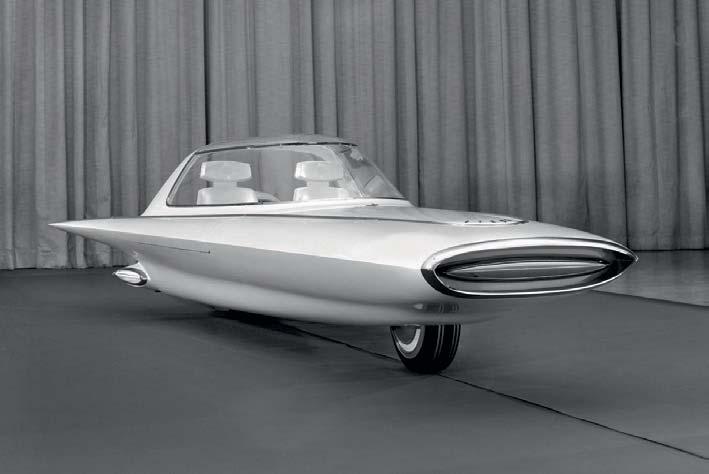
The gyroscopically stabilised Gyro-X blurred the line between reality and science fiction. Sam Glover takes the prototype for a spin

The Gyro-X should never have existed. A two-wheeled gyroscopically stabilised car, like contemporary flying, magnetically levitating and nuclear-powered cars of the 1950s and 1960s, would not normally have made it beyond the pages of Mechanix Illustrated magazine. Its improbable leap from fantasy to reality was thanks to two uniquely talented individuals: a designer with a penchant for heroic failures, and a scientist with world-leading knowledge in gyroscopes. They met in 1960s California, as NASA launched the first Americans into space and Sharp landed the first microwave ovens on the shelves of Sears department stores. If ever there was a time and place that anything seemed possible, it was then and there.
Tom Summers had a flair for logic, physics, mathematics and mechanics. A textbook genius. He also had an aviation fetish, attaining a pilot's licence before he graduated from high school. In early adulthood, he invented a gyroscopic air speed indicator that became the basis of the US Navy's Norden Bombsight in World War Two. He continued in the same field post-war and established the Summers Gyroscope Company in 1946. When he stepped down 15 years later at the age of 51, the company had over 1500 employees and he had more than 30 patents to his name. In 1961, he formed the Summers Gyrocar Company in Northridge, California, to scratch his itch to develop gyroscopically stabilised vehicles. 'Four wheels are ridiculous, three wheels are foolish, but two wheels are proper,' he explained in 1975.

Cette histoire est tirée de l'édition January 2025 de Octane.
Abonnez-vous à Magzter GOLD pour accéder à des milliers d'histoires premium sélectionnées et à plus de 9 000 magazines et journaux.
Déjà abonné ? Se connecter
PLUS D'HISTOIRES DE Octane
Octane
The Driver Robert Coucher
Why simplicity is best in the era of cars as appliances

3 mins
May 2026

Octane
The Legend Derek Bell
One of the great joys of my life in motorsport is the travelling. One of the biggest curses of my life in motorsport is the travelling. I am a farm boy from West Sussex and, growing up at least, I never thought that I would ever get to see the world.
3 mins
May 2026

Octane
The Aesthete Stephen Bayley
Nostalgia was once defined as a psychosis. So I certainly don’t want to be described as nostalgic.
7 mins
May 2026
Octane
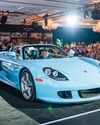
Records tumble as Amelia and Miami sales top $251.9m
Hypercars attract big numbers as 'Florida week' sales rack up biggest total yet
1 mins
May 2026

Octane
DTM legends
Bonhams, Monaco 24-25 April
1 min
May 2026

Octane
The photo booth
From a practical necessity to a cultural phenomenon
4 mins
May 2026

Octane
All aboard for Monte Carlo
1956 Daimler Conquest Century
3 mins
May 2026
Octane
Hardcore pawn
Is a race-bred track star with impeccable Italian heritage too uncompromising for the road or worth the inevitable sacrifice? Massimo Delbò is feeling brave...
6 mins
May 2026
Octane
The end is nigh
1968 Ford Mustang GT390
2 mins
May 2026
Octane
Lancia Beta Montecarlo
Styled and built by Pininfarina, this mid-engined sports car is sensibly priced exotic fun
2 mins
May 2026
Listen
Translate
Change font size