Essayer OR - Gratuit
The new bare minimum
Down To Earth
|November 16, 2021
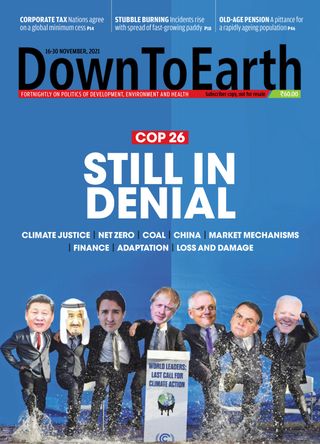
The newly agreed global minimum corporate tax to prevent ultinational firms from avoiding the legal cess regime is riddled ith clauses to ensure that profits stay with the rich nations

ON OCTOBER 31, the heads of the world’s major econo-mies—the Group of 20 (G20) nations—approved a new global minimum corporate tax. The deal, announced at the G20 summit in Rome, Italy, is “historic” since this is the first time nearly all nations have agreed to such a system. Earlier, on October 8, some 136 countries had endorsed the new regime.
The deal has two aims: first, to prevent multinationals from paying low taxes (or no tax) by booking their profits in tax havens; and second, to make them pay taxes wherever they operate or conduct business in, even if they do not have physical presence in the country.
Under this deal, there are two “pillars” of taxation on corporations. Under Pillar-1, which is estimated to affect the world's top 100 companies, governments would levy tax on profit margins of above 10 per cent, while under Pillar-2, there would be a global minimum tax rate of 15 per cent (see 'Global tax regime' on p17).
Pillar-1 provisions empower countries to tax companies where they earn their revenue. Under this, companies’ excess profit—defined as in excess of 10 per cent of total revenue—will be taxed at 25 per cent.
Pillar-2 will be applicable to overseas profits of multinational firms with €750 million (US $866 million) in sales globally. Governments have the power to impose any local corporate tax, and if a company pays less than 15 per cent tax, its home country can levy a tax to bring it to the minimum rate.

Cette histoire est tirée de l'édition November 16, 2021 de Down To Earth.
Abonnez-vous à Magzter GOLD pour accéder à des milliers d'histoires premium sélectionnées et à plus de 9 000 magazines et journaux.
Déjà abonné ? Se connecter
PLUS D'HISTOIRES DE Down To Earth

Down To Earth
Bitter pill
THE WEB SERIES PHARMA EXPOSES HARSH TRUTHS OF THE PHARMACEUTICAL INDUSTRY, WHERE PROFIT OFTEN BECOMES MORE IMPORTANT THAN HUMAN HEALTH

3 mins
January 16, 2026
Down To Earth
CHAOS IN-DEFINITION
The Aravallis are perhaps India's most litigated hill range. More than 4,000 court cases have failed to arrest their destruction. The latest dispute concerns a narrow legal definition of this geological antiquity, much of which has been obliterated by mining and urban sprawl. While the Supreme Court has stayed its own judgement accepting that definition, it must see the underlying reality and help reconcile development and national security with conservation.
19 mins
January 16, 2026
Down To Earth
BITS: INDIA
Indore has recorded 16 deaths and more than 1,600 hospitalisations between December 24 and January 6.
1 min
January 16, 2026
Down To Earth
GUARANTEE EXPIRES
India's rural employment guarantee law is replaced with a centrally controlled, budget-capped scheme. Is this an attack on the right to work?
3 mins
January 16, 2026

Down To Earth
BLOOM OR BANE
Surge of vibrant pink water lilies in Kuttanad, Kerala, provides socio-economic benefits, but the plant's ecological impacts must be understood
4 mins
January 16, 2026
Down To Earth
INVISIBLE EMPLOYER
Field and academic evidence shows sharp falls in casual agricultural employment at places where groundwater access declines
3 mins
January 16, 2026

Down To Earth
Schemed for erasure
Does the VB-G RAMG Act address structural weaknesses long observed in MGNREGA's implementation?
10 mins
January 16, 2026

Down To Earth
School of change
An open school in Panagar, Madhya Pradesh, aims to protect children of tribal settlements from falling into the trap of addiction
2 mins
January 16, 2026

Down To Earth
PULSE OF RESILIENCE
As a climate-ready crop, cowpea shows potential for widespread use in India
3 mins
January 16, 2026
Down To Earth
BITS GLOBAL
Britain recorded its hottest and sunniest year ever in 2025, the country's meteorological office said on January 2.
1 min
January 16, 2026
Translate
Change font size