Essayer OR - Gratuit
The Weather Paywall
Down To Earth
|October 16, 2019
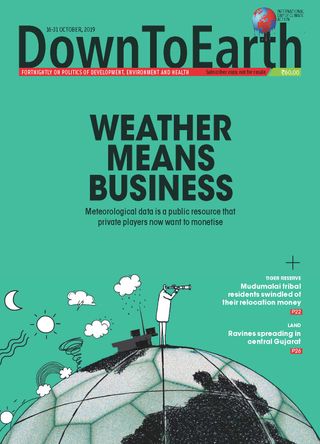
There will be heavy rainfall in... (subscribe to read on). That’s how all weather information will be delivered in the future, if private players are allowed to have their way. The chase to control and commodify forecast data is heating up. Competition could lead to greater accuracy in predictions, but it might also corrupt the public service that has so far been free.

EARLY THIS year, when information and technology behemoth IBM announced that its Weather Company had created a powerful new global weather forecasting system, it evoked hope and fear at the same time. The company claims that its new Global High-Resolution Atmospheric Forecasting System, or graf, will provide the “most accurate local weather forecasts ever seen worldwide” and can predict something as small as thunderstorms or as fickle as tropical cyclones that keep meteorologists on their toes till making the landfall.
Every day at Weather Company’s office in Brookhaven, in US’ state of Georgia, some 600 meteorologists, data analysts and a supercomputer analyse weather-related information gathered by governments and intergovernmental agencies through their weather stations, sophisticated radars, aeroplanes and spy satellites, and feed those into graf. To ensure that the forecasts reflect localised and near-real-time atmospheric, land and oceanic conditions, the team also harnesses data from some 270,000 personal weather stations (PWS) run by weather enthusiasts across the world and from hundreds of millions of smartphones, whose “pressure” and “location” sensors keep relaying data even as the user is on the move, talking or taking a nap. These data are then processed by the artificial intelligence-powered graf to issue 12 trillion pieces of forecast information for virtually every 3 sq km patch of the globe on an hourly basis. By comparison, the best available government or intergovernmental models have a resolution of 13 sq km and can update forecasts only once in every six hours.
“The information we generate and distribute consists of observations (realtime and historical), short- and longterm, seasonal and impact-based information, such as how crop yields or power generation will be impacted by weather,” says Kevin Petty, director of science and forecast operations at IBM.

Cette histoire est tirée de l'édition October 16, 2019 de Down To Earth.
Abonnez-vous à Magzter GOLD pour accéder à des milliers d'histoires premium sélectionnées et à plus de 9 000 magazines et journaux.
Déjà abonné ? Se connecter
PLUS D'HISTOIRES DE Down To Earth
Down To Earth
Popular distrust
THE WORLD seems to be going through a period of stasis despite facing an unfathomable polycrisis.

2 mins
February 01, 2026
Down To Earth
CONSERVE OR PERISH
Periyar Tiger Reserve has rewritten Indian conservation by turning poachers into protectors and conflict into coexistence
5 mins
February 01, 2026

Down To Earth
'Rivers need to run free'
From Tibet to West Bengal, the Brahmaputra is the pulse of communities and ecosystems along its course. But what are the risks the river faces through human interventions, particularly dams, discusses journalist, author and filmmaker SANJOY HAZARIKA in his new book, River Traveller.
4 mins
February 01, 2026

Down To Earth
India is facing up to its innovation lag
There are signs now that India is acknowledging the superior strides made by China in a frontier technology like Al
4 mins
February 01, 2026

Down To Earth
Competing concerns
What are the repercussions of the EU-Mercosur pact that have made European farmers protest against the free trade agreement?
4 mins
February 01, 2026

Down To Earth
From fryer to flight
Sustainable fuel made from used cooking oil can play a pivotal role in helping India achieve its aviation emission reduction goals. Measures to collect this oil must be revamped
4 mins
February 01, 2026

Down To Earth
ACCESS OPEN
An amendment to India's nodal forest conservation law opens up forests across India to commercial exploitation by the paper industry
6 mins
February 01, 2026
Down To Earth
DRINK FROM TAP CAN BE A REALITY
As cities across India struggle to supply safe piped water, Odisha offers a success story
2 mins
February 01, 2026

Down To Earth
GREAT DRYING
The Earth is hotter than at any point in the past 100,000 years, with 2023-25 becoming the warmest three-year period on record and also breaching the 1.5°C threshold for the first time. One fallout is dwindling freshwater.
22 mins
February 01, 2026

Down To Earth
Green redemption
Restoration of grasslands of Kerala's Pampadum Shola National Park, once dominated by invasive Australian wattles, see a return of streams and native species
1 mins
February 01, 2026
Translate
Change font size