Essayer OR - Gratuit
Debunking Myths On Migration
Down To Earth
|November 01, 2019
ABHIJIT V BANERJEE and ESTHER DUFLO, who jointly won the 2019 Nobel Prize in Economic Sciences recently, say that wage differences between countries have little to do with whether or not people migrate. In fact, evidence suggests that migration makes both migrants and local people better off
-

MIGRATION IS big news, big enough to drive the politics of much of Europe and the United States. Between President Donald Trump’s imaginary but enormously consequential hordes of murderous Mexican migrants and the anti-foreigner rhetoric of the Alternative for Germany, the French Rassemblement National, and the Brexit crew, not to mention the ruling parties in Italy, Hungary, and Slovakia, it may be the single most influential political issue in the world’s richest countries. Even politicians from the mainstream European parties are struggling to reconcile the liberal traditions they want to uphold with the threat they see across their shores. It is less visible in the developing world, but the fights over Zimbabwean refugees in South Africa, the Rohingya crisis in Bangladesh, and the citizenship bill in Assam, India, have been equally frightening for those who are its targets.
Why the panic? The fraction of international migrants in the world population in 2017 was roughly what it was in 1960 or in 1990: 3 percent. The European Union (EU) on average gets between 1.5 million and 2.5 million non-EU migrants every year from the rest of the world. Two and a half million is less than one half of one percent of the EU population. Most of these are legal migrants, people with job offers, or those who arrive to join their families. There was an unusual influx of refugees in 2015 and 2016, but by 2018 the number of asylum seekers to the EU was back to 638,000, and only 38 percent of the requests were granted. This represents about one for every twenty-five hundred EU residents. That’s it. Hardly a deluge.
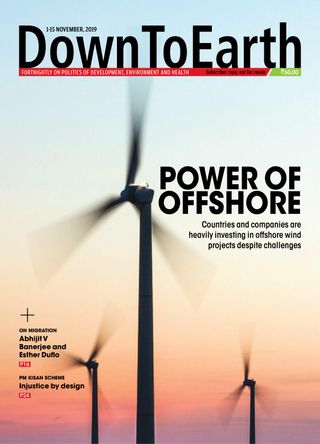

Cette histoire est tirée de l'édition November 01, 2019 de Down To Earth.
Abonnez-vous à Magzter GOLD pour accéder à des milliers d'histoires premium sélectionnées et à plus de 9 000 magazines et journaux.
Déjà abonné ? Se connecter
PLUS D'HISTOIRES DE Down To Earth
Down To Earth
Popular distrust
THE WORLD seems to be going through a period of stasis despite facing an unfathomable polycrisis.

2 mins
February 01, 2026

Down To Earth
CONSERVE OR PERISH
Periyar Tiger Reserve has rewritten Indian conservation by turning poachers into protectors and conflict into coexistence
5 mins
February 01, 2026

Down To Earth
'Rivers need to run free'
From Tibet to West Bengal, the Brahmaputra is the pulse of communities and ecosystems along its course. But what are the risks the river faces through human interventions, particularly dams, discusses journalist, author and filmmaker SANJOY HAZARIKA in his new book, River Traveller.
4 mins
February 01, 2026

Down To Earth
India is facing up to its innovation lag
There are signs now that India is acknowledging the superior strides made by China in a frontier technology like Al
4 mins
February 01, 2026

Down To Earth
Competing concerns
What are the repercussions of the EU-Mercosur pact that have made European farmers protest against the free trade agreement?
4 mins
February 01, 2026

Down To Earth
From fryer to flight
Sustainable fuel made from used cooking oil can play a pivotal role in helping India achieve its aviation emission reduction goals. Measures to collect this oil must be revamped
4 mins
February 01, 2026

Down To Earth
ACCESS OPEN
An amendment to India's nodal forest conservation law opens up forests across India to commercial exploitation by the paper industry
6 mins
February 01, 2026
Down To Earth
DRINK FROM TAP CAN BE A REALITY
As cities across India struggle to supply safe piped water, Odisha offers a success story
2 mins
February 01, 2026

Down To Earth
GREAT DRYING
The Earth is hotter than at any point in the past 100,000 years, with 2023-25 becoming the warmest three-year period on record and also breaching the 1.5°C threshold for the first time. One fallout is dwindling freshwater.
22 mins
February 01, 2026

Down To Earth
Green redemption
Restoration of grasslands of Kerala's Pampadum Shola National Park, once dominated by invasive Australian wattles, see a return of streams and native species
1 mins
February 01, 2026
Translate
Change font size