Essayer OR - Gratuit
AN AGRARIAN BIOPSY
Down To Earth
|February 16, 2021
The widespread protests by farmers across India have forced us to probe the fundamentals of the farm economy

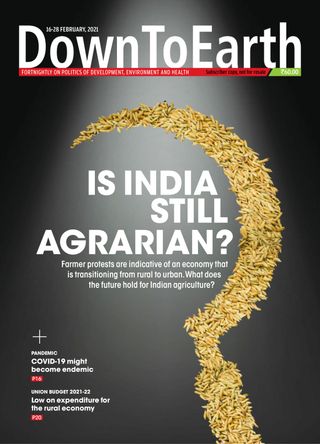
IT IS a crisis the country needed to experience. Agriculture as an issue had never attracted such attention. Currently, all the pillars of our governance system are engaged in dealing with the fast-spreading farmers’ protests across the country—from the legislative to the executive to the judiciary. Farmers are continuing their protests against the recently adopted farm laws. As more and more people throng the borders of the national capital, there have been over 300 protests from across the country in support of those camping in Delhi. Agriculture is emerging as the axis of polarisation among political parties. Moreover, India never experienced such farmers’ agitations; not even during the extreme agrarian crises like the crippling droughts of the 1960s or even in the early 1990s when India joined the World Trade Organization (wto) regime. These were just episodes of protests; governments declaring reactive policies and programmes; and, periodically waiving off farm loans. But now, the national slogan of “Jai Jawan, Jai Kisan” is prickling the conscience of people. The farmer is emerging as the polarising figure. Among political parties, there is a subtle, but swift narrative being scripted: “Are those protesting the real farmers?” This narrative has an unusual spin as well: “rich” v “poor” farmers in the ongoing debate over farmers’ protests. Nevertheless, farms and farmers—the theatre and the protagonist of an agrarian country—are defining the current political discourse. It is also time we raise some fundamental questions over this very existential occupation.
WHO IS AN INDIAN FARMER?
• 120 million households depend on agriculture
• 54.6% of India’s workforce is in agriculture
• India has more farm labourers than cultivators

Cette histoire est tirée de l'édition February 16, 2021 de Down To Earth.
Abonnez-vous à Magzter GOLD pour accéder à des milliers d'histoires premium sélectionnées et à plus de 9 000 magazines et journaux.
Déjà abonné ? Se connecter
PLUS D'HISTOIRES DE Down To Earth

Down To Earth
BEYOND COLLATERAL DAMAGE
Recent geopolitical conflicts are urging a reconsideration of what constitutes environmental harm in war and the limits of existing legal frameworks

3 mins
April 01, 2026

Down To Earth
Masterstroke
Residents of a small Kerala town reject an inadequate state-led development blueprint and create their own master plan that prioritises protection of historic water systems and urban commons
4 mins
April 01, 2026

Down To Earth
Rethinking E20
It is pertinent to explore potential of ethanol as high-value industrial feedstock
4 mins
April 01, 2026
Down To Earth
Food in the age of climate change
WHEN WE eat, we contribute to climate change. But food is also about livelihoods, about nutrition and about nature.
3 mins
April 01, 2026

Down To Earth
FADING WINTER
India's winters are warming, becoming shorter, shifting and spilling beyond their traditional bounds. The consequences are already evident in meltwater availability, forest-fire intensity and changes in flowering cycles and insect behaviour.
20 mins
April 01, 2026
Down To Earth
War on Iran strikes India's pharmaceuticals sector
Shortages of critical raw materials and rising input costs for the drug industry will have global consequences
4 mins
April 01, 2026

Down To Earth
POWER IN AN AGE OF INSECURITY
Energy transition is no longer solely about emission reduction but also about energy security
3 mins
April 01, 2026
Down To Earth
Re-discovery of fuelwood
THE WEST Asia conflict has made visible a multi-billion dollar energy market in India.
2 mins
April 01, 2026

Down To Earth
A CASE THAT RESHAPED INDIA'S ENVIRONMENT
The case of MC Mehta v Union of India stands as proof that a proactive judiciary can accelerate action even when the executive drags its feet
4 mins
April 01, 2026
Down To Earth
FOREVER DEPENDENT
India depends on global fertiliser supply chains for 70 per cent of its needs, leaving its food security exposed to geopolitical disruptions
6 mins
April 01, 2026
Translate
Change font size