
Passez à l'illimité avec Magzter GOLD
Obtenez un accès illimité à plus de 9 000 magazines, journaux et articles Premium pour seulement
Essayer OR - Gratuit
A Contentious Solicitation
Down To Earth
|September 16, 2018
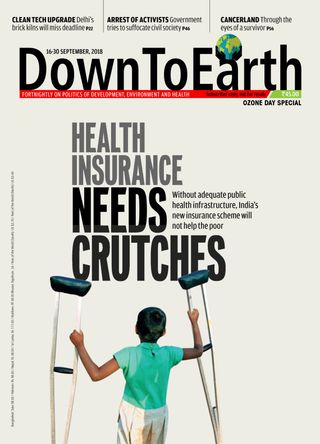
India's most ambitious health insurance scheme, Pradhan Mantri Jan Arogya Yojana, is definitely a lure. Millions of Indians bleed to pay their ever-increasing medical expenses in private healthcare and end up becoming even poorer. Experiences of public-funded health insurance schemes in the last decade show that these initiatives have not been effective as they are not supported by the proportionate creation of public health systems. India simply doesn't have enough well-equipped public health infrastructure. So what does this new scheme mean for millions of poor and sick people? KUNDAN PANDEY travels to Rajasthan, Tamil Nadu, Haryana, Telangana and Kerala to understand what the new scheme needs to be cautious about.

ON AUGUST 15, Karishma acquired a new identity. By lottery, she was chosen as the first beneficiary of the world’s largest government health insurance scheme—Pradhan Mantri Jan Arogya Yojana (PMJAY). “First claim raised under #AyushmanBharat. A baby girl is born through caesarean section at Kalpana Chawla Hospital in Haryana. Claim of R9000 paid to the hospital by Ayushman Bharat-Haryana…,” tweeted Dinesh Arora, deputy chief executive officer, Ayushman Bharat, under which PMJAY will be implemented. Her family is already basking in the glory of this superlative. Every breath of Karishma will be now tracked, literally.
Her family’s new-found happiness represents what a health insurance scheme means to an economically challenged household. For such families, 70 per cent of spells of ailment are treated in the private sector, which is three times more expensive than treatment in public sector hospitals. It must be remembered that 86 per cent of India’s rural population is not covered under any health expenditure support, according to the National Sample Survey Office’s (NSSO’S) 71st round of survey on health. The ₹9,000 reimbursement to the hospital, where Karishma was born, is a huge sum given that India’s per capita annual expenditure on healthcare is ₹13,000.

Cette histoire est tirée de l'édition September 16, 2018 de Down To Earth.
Abonnez-vous à Magzter GOLD pour accéder à des milliers d'histoires premium sélectionnées et à plus de 9 000 magazines et journaux.
Déjà abonné ? Se connecter
PLUS D'HISTOIRES DE Down To Earth

Down To Earth
THINK TWICE BEFORE FELLING SAL TREES
Many trees considered to be affected by sal borer in the 1990s are still alive today

1 mins
February 16, 2026

Down To Earth
EDGE OF SURVIVAL
Caste divides deny marginalised communities land, resources and essential aid, leaving them more vulnerable to climate disasters
6 mins
February 16, 2026

Down To Earth
A WISH LIST?
Union Budget for 2026-27 conveys the impression of a roll-call of intentions and ambitious proposals, with little detail on their formulation
6 mins
February 16, 2026
Down To Earth
Break down the gender wall
THE RULING National Democratic Alliance (NDA) government has been heavily invested in the goal to make India a developed economy by 2047.
2 mins
February 16, 2026

Down To Earth
MENSTRUAL HEALTH, NOW A FUNDAMENTAL RIGHT
In a landmark judgement, the Supreme Court has recognised menstrual health and hygiene as a fundamental right under Article 21 of the Constitution of India, which guarantees the right to life and dignity.
8 mins
February 16, 2026

Down To Earth
Of devolution and new disasters
The 16th Finance Commission pushes for changes in view of new fiscal and climatic conditions
11 mins
February 16, 2026
Down To Earth
Rising risks of plastics
NEGATIVE IMPACTS on human health due to emissions linked to the plastic lifecycle could double by 2040, according to a study published in The Lancet Planetary Health in January.
1 min
February 16, 2026

Down To Earth
GAP BETWEEN EPIDEMICS NARROWING
A watershed-based and landscape-level approach is needed to address forest degradation
2 mins
February 16, 2026
Down To Earth
WAITING TO STRIKE
Sal heartwood borer is considered the biggest threat to forestry in India, especially to the sal tree, where it lives and breeds.
11 mins
February 16, 2026

Down To Earth
A SPRING DELIGHT
Mustard flowers are not meant only for the eyes. Invite them to your plate once in a while
3 mins
February 16, 2026
Translate
Change font size