Essayer OR - Gratuit
How to build a webcamscope
BBC Sky at Night Magazine
|July 2022
Construct a simple and cost-effective imaging device for capturing bright targets
-

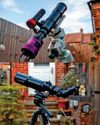
A webcamscope provides a simple and cheap introduction to astrophotography. As its name suggests, it's built around the sort of webcam you might buy for Zoom meetings, rather than a DSLR camera. The components you need to make a webcamscope are widely available and, whether you choose brand-new or second-hand parts, they won't cost much. You may even have some of them in a spare drawer. I paid £11 for the webcam and £16 for the 200mm M42 lens on eBay, while the eyepiece adaptor, which replaces the webcam's lens, was £10.
Second-hand M42 lenses are commonly available and, as they use a screw thread rather than a bayonet fitting, you can make a mount for one from an old rear lens cap. Lenses can be heavy, though, so you can adapt the wooden mount to incorporate a cradle to support the front part as well.
When building your webcamscope, it's important to get the correct distance between the backplate of the lens and the surface of the sensor in your webcam (the registration distance). For M42 lenses, the registration distance is 45.5mm. If you vary this by too much, you might not be able to focus. I drilled a 32mm-diameter hole through the wooden mount to hold the webcam adaptor, with a wider recess for the M42 rear lens cap, so the webcam and camera lens were held close together. A little masking tape wrapped around the adaptor stops it slipping out.

Cette histoire est tirée de l'édition July 2022 de BBC Sky at Night Magazine.
Abonnez-vous à Magzter GOLD pour accéder à des milliers d'histoires premium sélectionnées et à plus de 9 000 magazines et journaux.
Déjà abonné ? Se connecter
PLUS D'HISTOIRES DE BBC Sky at Night Magazine
BBC Sky at Night Magazine
The Giant Leap: Why Space is the Next Frontier in the Evolution of Life
“Earth is the cradle of humanity, but one cannot live in the cradle forever,” wrote Konstantin Tsiolkovsky in 1911.

1 mins
February 2026
BBC Sky at Night Magazine
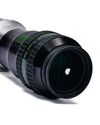
Tele Vue Nagler Type-7 series eyepieces
These premium optics were inspired by Apollo - and deliver a giant leap to your views
4 mins
February 2026
BBC Sky at Night Magazine
Once Upon a Time in Space
While the Space Race of the Cold War years was ultimately a geopolitical contest between the USA and the Soviet Union, the rivalry sparked rapid innovation and inspired multiple generations to look skyward.
1 mins
February 2026
BBC Sky at Night Magazine
The Multiverse: When One Universe Isn't Enough
The concept of a 'multiverse' – the idea that our Universe may be just one of many – is widespread in science fiction and a common thread of online discussions.
1 mins
February 2026
BBC Sky at Night Magazine
Q&A WITH A GAMMA RAY SPECIALIST
In 2025, astronomers detected a blast from space that lasted seven hours. Now they're uncovering the strange processes behind the exceptional outburst
3 mins
February 2026
BBC Sky at Night Magazine
Astronomy Photographer of the Year
The world-leading astrophotography competition returns. Could your image take the top prize of £10,000?
2 mins
February 2026
BBC Sky at Night Magazine
MOONWATCH
February's top lunar feature to observe
2 mins
February 2026
BBC Sky at Night Magazine
NOVAStar Scarlet A62Q 62mm f/8.4 quadruplet achromatic refractor
Well-built and capable, this beginner scope punches well above its bargain price
4 mins
February 2026
BBC Sky at Night Magazine
STAR OF THE MONTH
Rasalas, Leo the Lion's metal-rich crown
1 min
February 2026
BBC Sky at Night Magazine
Comet 24P/Schaumasse
Having reached perihelion on 8 January, comet 24P/ Schaumasse is now fading. Starting the month at a small-telescope-friendly mag. +10.5, it dims throughout February to below 12th magnitude.
1 min
February 2026
Translate
Change font size