Essayer OR - Gratuit
The Explainer: Why Are Mountains So Formidable?
BBC Focus - Science & Technology
|July 2021
The explainer

HOW DO MOUNTAINS FORM?
Most mountains owe their existence to the movement of tectonic plates, vast sections of the Earth’s crust. Where two tectonic plates converge, they buckle and fold, resulting in the most common type: fold mountains. The Himalayas, for example, result from the Asian and Indian plates slowly colliding. Block mountains are created when the pressures between plates allow cracks (faults) to appear, with huge slabs of rock being thrust upwards.
Volcanic activity can also produce mountains. As a volcano erupts,the buildup of molten rock can form peaks. Sometimes, the rising magma can remain trapped underground, causing the surface to swell in a dome shape.
With tectonic plates typically moving just three to five centimetres per year, mountains slowly take shape over tens or hundreds of millions of years. The oldest mountain range in the world is the Barberton Greenstone Belt in South Africa, with some mountains estimated at 3.5 billion years old.
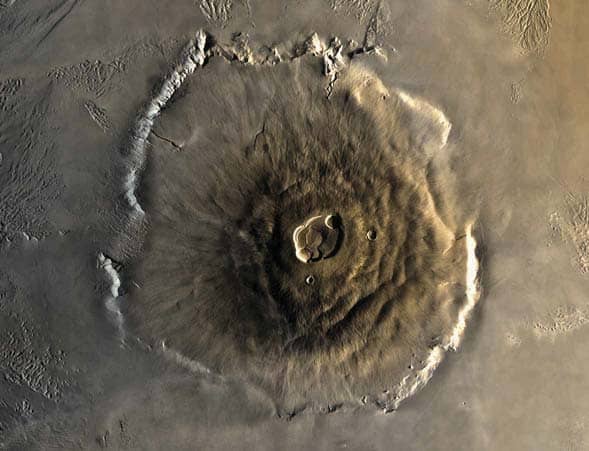
WHAT’S THE BIGGEST MOUNTAIN IN THE SOLAR SYSTEM?

Cette histoire est tirée de l'édition July 2021 de BBC Focus - Science & Technology.
Abonnez-vous à Magzter GOLD pour accéder à des milliers d'histoires premium sélectionnées et à plus de 9 000 magazines et journaux.
Déjà abonné ? Se connecter
PLUS D'HISTOIRES DE BBC Focus - Science & Technology

BBC Science Focus
HEALTH: Eating oats could lower your cholesterol in just two days
The health benefits of a two-day porridge diet lasted for weeks afterwards

1 mins
April 2026

BBC Science Focus
Most people are too sure they can identify fake human faces
Even 'super recognisers' struggle with the challenge. Can you do better?
1 min
April 2026

BBC Science Focus
WHAT'S THE WORST THING YOU CAN DO FOR THE PLANET ONLINE?
Human beings can barely move a muscle without some kind of deleterious effect on the environment around us.
2 mins
April 2026

BBC Science Focus
A bug in the system
The complex arrangement of equipment you see here is part of a particle accelerator.
1 min
April 2026

BBC Science Focus
Snug as a bug in a rug
At first glance, you might feel envious of this little leafhopper, swaddled beneath the folds of what appears to be a luxurious fur blanket.
1 min
April 2026

BBC Science Focus
WHY DO WE ROOT FOR THE VILLAIN IN MOVIES?
Whether it's Darth Vader or Cruella de Vil, we all have a favourite movie villain.
1 mins
April 2026

BBC Science Focus
A TURN TO DISPERSE
Why a fart walk after dinner does more than release your gas
3 mins
April 2026

BBC Science Focus
Hatching a nebula
Welcome to the Egg Nebula, an enigmatic structure formed by ejected stardust in the Cygnus constellation around 1,000 light-years from Earth.
1 min
April 2026

BBC Science Focus
7 TIMES AI GOT IT SPECTACULARLY WRONG
For the past four years, AI has been reshaping how we work and live. But its failures are proving just as transformative as its triumphs
8 mins
April 2026

BBC Science Focus
CHARLES ADCOCK, VIA EMAIL: COULD DARK MATTER BE ALL AROUND PLANET EARTH BUT UNDETECTABLE?
Astronomers have gathered overwhelming evidence that 80 per cent of all matter in the Universe is invisible.
1 min
April 2026
Translate
Change font size