Essayer OR - Gratuit
CORONAVIRUS TRANSMISSION: SHOULD WE ALL WEAR FACE MASKS?
BBC Focus - Science & Technology
|May 2020
Several countries, such as the US, Austria and the Czech Republic, now recommend wearing face masks to stop the spread of COVID-19, but the UK government does not. Why don’t all governments agree?
-

Visit the BBC’s Reality Check website at bit.ly/reality_check_ or follow them on Twitter @BBCRealityCheck
At the time of writing, the World Health Organization (WHO) recommends that, outside of health professionals, people should only wear masks if they display symptoms of COVID-19 or are taking care of someone who does. However, more and more countries now recommend that people wear face masks in public places, and WHO is reconsidering its advice based on new evidence.
Prof Jonathan Van-Tam, England’s deputy chief medical officer and a specialist in epidemiology and pandemic preparedness, said in a briefing on 3 April: “…there is no evidence that general wearing of face masks by the public who are well affects the spread of the disease in our society. What matters right now, of course, is social distancing.”
CAN FACE MASKS STOP THE SPREAD OF COVID-19?
“The problem with the new coronavirus is that there’s too little information about exactly how it’s spread, because it’s so new,” says Dr Alexander Edwards, associate professor at the School of Pharmacy at the University of Reading. We don’t know if it’s spread more effectively through contact or coughs and sneezes, he adds.
It is not ethical to expose someone to COVID-19 to study the transmission. Instead, biologists have to make do with other methods. One study from MIT used high-speed cameras to track the droplets expelled in coughs and sneezes. They found that puffs of air carry droplets for up to six or eight metres, for coughs and sneezes respectively. Another study, conducted by aerosol specialist Dr Boris Gorbunov, found that taking wind conditions into account could bring the distance a cough travels up to 25 metres.
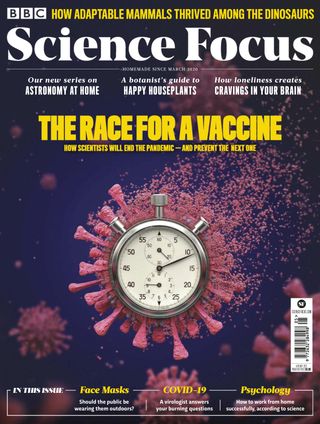

Cette histoire est tirée de l'édition May 2020 de BBC Focus - Science & Technology.
Abonnez-vous à Magzter GOLD pour accéder à des milliers d'histoires premium sélectionnées et à plus de 9 000 magazines et journaux.
Déjà abonné ? Se connecter
PLUS D'HISTOIRES DE BBC Focus - Science & Technology

BBC Science Focus
World's biggest cobweb is home to 100,000 spiders
Spiders don't normally create such large colonies, so there's no need to worry about finding one in your basement

1 min
February 2026

BBC Science Focus
A dementia vaccine could be gamechanging – and available already
Getting vaccinated against shingles could protect you from getting dementia, or slow the progression of the disease
1 mins
February 2026

BBC Science Focus
DATA IN SPACE
An unusual spacecraft reached orbit in November 2025, one that might herald the dawn of a new era.
7 mins
February 2026

BBC Science Focus
Climate change is already shrinking your salary
No matter where you live, a new study has found warmer temperatures are picking your pocket
4 mins
February 2026

BBC Science Focus
A MENTAL HEALTH GLOW-UP
Forget fine lines. Could Botox give you an unexpected mental health tweakment?
3 mins
February 2026
BBC Science Focus
Most people with high cholesterol gene don't know they have it
Standard testing struggles to detect the condition
1 mins
February 2026

BBC Science Focus
HOW CAN I BOOST MY IQ?
If you're serious about getting smarter, it's time to ditch the brain-training apps
4 mins
February 2026

BBC Science Focus
Humans are absolutely terrible at reading dogs' emotions
Think you can tell how our furry friends are feeling? Think again
1 mins
February 2026

BBC Science Focus
HOW TO TEACH AI RIGHT FROM WRONG
If we want to get good responses from AI, we may need to see what it does when we ask it to be evil
3 mins
February 2026

BBC Science Focus
What Australia's social media ban could really mean for under-16s
Many people think social media is bad for our kids. Australia is trying to prove it
5 mins
February 2026
Translate
Change font size