
Passez à l'illimité avec Magzter GOLD
Obtenez un accès illimité à plus de 9 000 magazines, journaux et articles Premium pour seulement
COOPERATION IN Nature
Heartfulness eMagazine
|July 2022
ELIZABETH DENLEY is an ecologist, who has spent most of her life learning from the natural world. Here she explores cooperation in Nature, and what we can learn from this very common behavior, if we are to continue to survive on planet Earth.

Up until the second half of the 20th century, most scientists thought that the relationships between species in the natural world were conflictual. They assumed that plants and animals either competed for resources or ate each other. The world was painted as an aggressive place, “red in tooth and claw.” That all changed around 60 years ago, when naturalists and ecologists started to notice just how many species cooperate and collaborate.
This shift in worldview also coincided with a shift away from colonialism and toward a more collaborative vision for human societies. We are still in a transition phase, as the older structures and belief systems have not fully disappeared. I find it very helpful to explore friendship and cooperation in Nature, to see if we can learn a thing or two about how it operates at a very fundamental evolutionary level.
It turns out that we had a very narrow understanding of the Darwinian concept of “the evolution of the fittest.” “Fittest” doesn’t have to mean competitive advantage over others, climbing the ladder of success. That is a very outdated notion. “Fittest” can be the most effective collaborators, those who create a robust interdependent web of existence.
Naturalists use the word “symbiosis” to describe the relationships between species in ecosystems, and the most common types of symbiosis are:
Mutualism – a mutually beneficial relationship.
Commensalism – a relationship where one species benefits while the other is not harmed.
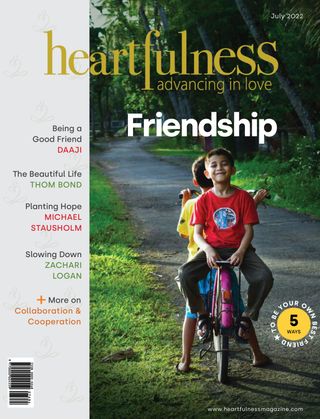

Cette histoire est tirée de l'édition July 2022 de Heartfulness eMagazine.
Abonnez-vous à Magzter GOLD pour accéder à des milliers d'histoires premium sélectionnées et à plus de 9 000 magazines et journaux.
Déjà abonné ? Se connecter
PLUS D'HISTOIRES DE Heartfulness eMagazine

Heartfulness eMagazine
A Touch of Heaven
Irish singer and teacher, EILISH BUTLER, combines the mystical chant of Saint Hildegard von Bingen (1098-1176) with the evolutionary path of Uncovering the Voice, satisfying her passion for mystical spirituality and music.

2 mins
November 2025

Heartfulness eMagazine
FROM INNER STILLNESS TO OUTER AGENCY:
How Heartfulness Builds an Internal Locus of Control and Workplace Success
3 mins
November 2025

Heartfulness eMagazine
Virtual Intelligence
Author and cultural commentator CHARLES EISENSTEIN extends last month's argument about virtual substitutes hollowing out reality-this time to Al's imitation of intimacy-and points to what only embodied relationships can restore.
10 mins
November 2025

Heartfulness eMagazine
Grace Is the Creative Spark
Do you sometimes feel that life is blessed and things are unfolding effortlessly, without force or struggle? Some people say it is because of “grace” or “God’s grace.
5 mins
November 2025
Heartfulness eMagazine
Zuri's Guiding Light
A luminous fable from LIAA KUMAR on self-trust, belonging, and inner guidance.
3 mins
November 2025

Heartfulness eMagazine
I AM
In a quiet meditation on desire, stillness, and the witnessing Self, JARNA KHIMANI traces the shift from seeking to being.
3 mins
November 2025

Heartfulness eMagazine
Courage: From Relief to Presence
JASON NUTTING on why relief is temporary-and how courage, rooted in the heart, endures.
3 mins
November 2025

Heartfulness eMagazine
Embracing The Value Within
DR. ROXANNE M. ST. CLAIR on seeing the value in you—and in others—and making it a daily practice.
4 mins
November 2025
Heartfulness eMagazine
Gratitude's Gift
A Creston woman recently recounted her experience in a checkout line.
2 mins
November 2025

Heartfulness eMagazine
HAPPINESS and Gut Health
Q: How does gut health influence mental well-being, and can practices like meditation actively support a healthier digestive system? The gut is often called the second brain because it has over 500 million neurons that constantly talk to the brain through the vagus nerve.
2 mins
November 2025
Translate
Change font size