Essayer OR - Gratuit
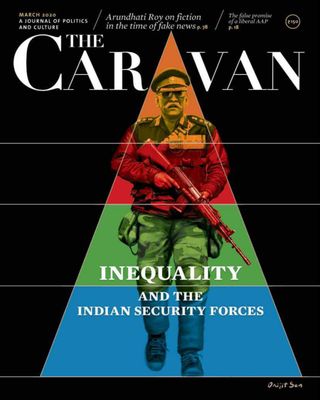
BENEATH THE UNIFORM
The Caravan
|March 2020
The casteist and racist origins of the Indian Army’s recruitment policies

THE PRESIDENT’S BODYGUARD—a unit of the Indian Army—is considered one of the most prestigious postings within the armed forces. In 2018, one Gaurav Yadav from Haryana’s Revari district filed a public-interest litigation in the Delhi High Court, alleging that the recruitment policy of the President’s Bodyguard discriminated by caste. The unit, as Yadav correctly pointed out, only recruits from three castes—Rajputs, Hindu Jats and Sikh Jats. According to Yadav, these three castes are being given “preferential treatment” to the detriment of other citizens of the country. A bench of the Delhi High Court, hearing the petition, asked the defence ministry and several senior army officials to file their counter affidavits on the issue by 9 May 2019.
Both the army and the government have exceeded the deadline, and are yet to file their responses.
This is not the first time the army’s recruitment policy has been challenged in court. In 2012, IS Yadav, an Uttar Pradesh-based doctor, filed a petition in the Supreme Court, seeking an end to recruitment in the army on the basis of caste, region and religion.
“In the army alone there are caste, religion and region-based regiments such as the Jat Regiment, Sikh Regiment, Mahar Regiment, Gorkha Rifles, Garhwal Regiment, Dogra Regiment, etc,” Yadav’s petition said, “and hence recruitment to these regiments is primarily based on caste, region and religion.”
The petition also questioned the existence of two separate regiments for Sikhs—one for Jat Sikhs, and a different one for Mazhabi and Ramdasia Sikhs, who were formerly considered untouchables. The petitioner urged the court to end discrimination in recruitment to the army and to frame a new hiring policy for the force.

Cette histoire est tirée de l'édition March 2020 de The Caravan.
Abonnez-vous à Magzter GOLD pour accéder à des milliers d'histoires premium sélectionnées et à plus de 9 000 magazines et journaux.
Déjà abonné ? Se connecter
PLUS D'HISTOIRES DE The Caravan
The Caravan
FACE PALM
Why the Congress keeps losing elections

33 mins
January 2025

The Caravan
The Great Transformation
Challenges facing independent news outlets in the digital age/Media
6 mins
January 2025

The Caravan
The Mob Comes for Film Critics
Dhurandhar and the manufacture of a national consensus
11 mins
January 2025
The Caravan
Memories Are Made of This
FOOD IN DALIT AND ADIVASI WRITING
15 mins
January 2025
The Caravan
To Be or Not to Be a Tribe
The new Scheduled Tribe classification in Assam is political eyewash/Communities
11 mins
January 2025

The Caravan
"A Surgical Strike on Employment Guarantee"
Jean Drèze on the Modi government's new rural employment bill
11 mins
January 2025
The Caravan
Starting Fires at Thirupparankundram
Judicial overreach and Sangh mobilisation bring Ayodhya to Tamil Nadu
44 mins
January 2025
The Caravan
ANY RESEMBLANCE TO ACTUAL EVENTS IS NOT COINCIDENTAL
INTERFAITH ROMANCE FICTION IN THE ERA OF LOVE JIHAD
31 mins
December 2025
The Caravan
Manufacturing Legitimacy
How a Washington Post columnist laundered the Sangh's violent history
7 mins
December 2025

The Caravan
DEATH of REPORTAGE
THE DISMANTLING OF OUTLOOK'S LEGACY
32 mins
December 2025
Translate
Change font size