Essayer OR - Gratuit
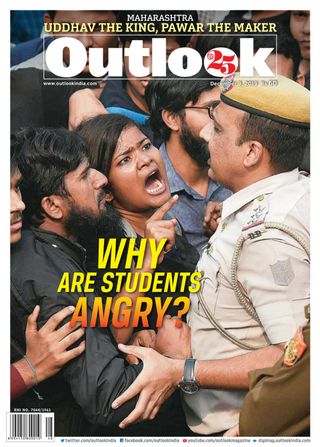
Why Are Students Angry?
Outlook
|December 09, 2019
Behind the rage of the young in India’s campuses is a conflict over the fate of public-funded higher education

They are a bunch of vandals. They are the spring itself. They are freeloaders and parasites. They are the gene map of the future, of possible futures. They are an unruly, seditious mob. No, they really are the ones who bring life to democracy, the ones in whom freedom breathes its purest air.... Students! It’s often with a note of exasperation or scorn— one that hides a deep suspicion, even dread—that the world outside looks at university campuses. For all the belittling, nothing outside of war and religious/cultural animus seems to bring about such stark binaries of opinion as the image of protest ing students. Why? Each day now brings profoundly troubling news. Something or the other is in deep crisis—the Constitution, political morality, entire sectors of the economy, the climate, and all of them at once. But if you looked at mainstream or social media, it would appear as if the biggest question in front of the nation is a bunch of students protesting. Why? Because it is war. Of another sort. The image of angry, dissenting students has come like a regular punctuation mark, an irritating comma, in recent years. That too in a field of seeming unanimity otherwise, whether in terms of electoral politics or mainstream headlines. It happened first on the FTII campus in Pune, then the Rohith Vemula suicide capped an extraordinary season of defiance in Hydera bad. It takes JNU, however, to get the citizenry really upset. The question everyone asks is: why are the students angry? Almost, how dare they protest? And, shouldn’t they be studying and getting a job instead?

Cette histoire est tirée de l'édition December 09, 2019 de Outlook.
Abonnez-vous à Magzter GOLD pour accéder à des milliers d'histoires premium sélectionnées et à plus de 9 000 magazines et journaux.
Déjà abonné ? Se connecter
PLUS D'HISTOIRES DE Outlook
Outlook
Turbulence in Tehran
To ignore or lampoon the attempts in Iran against the rule of clerics shrinks the space for the anti-imperialist Left to challenge other political ideologies, such as Hindutva

5 mins
March 21, 2026
Outlook
Not in Our Name
HE should have first corrected his own vices and then given us advice”.
3 mins
March 21, 2026
Outlook
Epic Faux Pas
For Iran, survival is victory. The martyrdom of Khamenei has had a rallying effect, and its strategy is built on domestic civil-military endurance and regional-global deterrence
6 mins
March 21, 2026

Outlook
'Winter Will One Day be Past'
This book is a true testament of friendship and an act of solidarity
4 mins
March 21, 2026
Outlook
‘Nolite Te Bastardes Carborundorum (Don't let the bastards grind you down)
\"There is more than one kind of freedom,\" said Aunt Lydia. \"Freedom to and freedom from.
4 mins
March 21, 2026

Outlook
Zan. Zendegi. Azadi
Are Trump and Netanyahu really interested in liberating Iranian women through this war?
5 mins
March 21, 2026
Outlook
Bruno ki Betiyaan
Whether future regimes sustain, reshape, or compete with Bihar's maternal welfare architecture will determine how deeply Nitish Kumar's political legacy shapes the state's democratic future
4 mins
March 21, 2026
Outlook
Capitalism Redux
The Global South must learn from the West Asian crisis that the persistence of neoliberalism alongside hyper-nationalism leads to brutality and genocidal war
4 mins
March 21, 2026
Outlook
The JNU Files
The immediate backdrop to the recent showdown at Jawaharlal Nehru University lay in earlier tensions
7 mins
March 21, 2026

Outlook
What is Trump's Endgame?
The Iran war looks like a high-stakes attempt by the US and Israel to reshape the balance of power in West Asia
6 mins
March 21, 2026
Translate
Change font size