Essayer OR - Gratuit
‘Politicians want media to discuss issues they throw at us'
Outlook
|March 02, 2020
The Caravan has attracted attention in recent years, both for shining the torch on media itself and for its dogged pursuit of ‘tough’ stories. The magazine’s executive editor Vinod K. Jose talks about the state of journalism and what drives the magazine in an interview to Puneet Nicholas Yadav.

Is the Indian media becoming increasingly polarised on ideological lines?
The world over, how the institution of journalism has evolved over the past 450 years or so, you’ll see a pattern of media entrenchment with one set of values or the other. What is expected in a democracy is for journalism to be entrenched with democratic principles. As the fourth pillar (of democracy), the natural cause for journalism is to be aligned with truth and justice, against any form of injustice, and speak truth to power. This is a model of people in positions of power —corporate or political—always find a nuisance. In India, this has happened from time to time: whether during the Emergency or now. Alongside this, we have also seen an evolving pattern of heightened self-censorship and ownership-related issues over the past 7-8 years.
Are the curbs today the same as those during the Emergency or are we worse off?
I think we are losing the plot of how journalism must contribute to strengthening the democratic space. The difference between the Emergency-era curbs and today, perhaps, is that three interests—corporate, political and a much larger ideological divide—are working in tandem to exert pressure on the institution of journalism. During the Emergency, the news was being suppressed and some organizations were happy carrying just what Indira Gandhi or her government wanted. Now we have gone a step ahead: the media space is being cleverly destroyed by making owners and leaders in the professional allies of the government. These owners and professional leaders are now stakeholders in power and act like an ideologically committed extension of the government. We are moving towards a totalitarian model of journalism; the model in a democracy ought to be either that of social responsibility or libertarian.
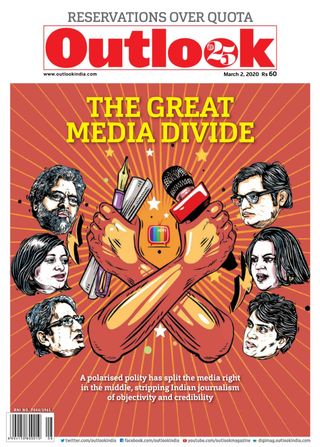

Cette histoire est tirée de l'édition March 02, 2020 de Outlook.
Abonnez-vous à Magzter GOLD pour accéder à des milliers d'histoires premium sélectionnées et à plus de 9 000 magazines et journaux.
Déjà abonné ? Se connecter
PLUS D'HISTOIRES DE Outlook

Outlook
'Why GDP Growth Doesn't Always Translate Into Votes'
The recent election results have once again shown that economic growth alone does not guarantee electoral victory.

3 mins
June 06, 2026

Outlook
Lights, Camera, Othering
The establishment of Israel has been accompanied by a national cinema devoted to negating and erasing the Palestinian Other
5 mins
June 06, 2026

Outlook
Goodbye to All That
Booker-winning British author Julian Barnes' Departure(s) is a unique hybrid work: playful, philosophical, whimsical
4 mins
June 06, 2026

Outlook
Collapse of Trust
As the NEET-UG 2026 paper leak forced the cancellation of India’s biggest medical entrance exam, more than 22 lakh aspirants find themselves trapped in uncertainty
11 mins
June 06, 2026

Outlook
NO LONGER A TWELFTH MAN
Bihar cricket, which has languished in the shadows for long, is all set to improve its strike rate, thanks to Vaibhav Sooryavanshi, the new Bihari kid on the block
5 mins
June 06, 2026

Outlook
BLAZE OF GLORY
The challenges of being a celebrity cricketer at a young age can be tough to handle
5 mins
June 06, 2026

Outlook
THE SWASHBUCKLERS
A new generation of fearless stars is emerging and finding its feet at the very top of an extremely competitive cricketing environment
5 mins
June 06, 2026

Outlook
THE TEEN TORNAD
At the age of 15, Vaibhav Sooryavanshi is already a cricketing legend
10 mins
June 06, 2026

Outlook
A Journey to Remember
The prerecorded message crackled over the din in the compartment: ‘Welcome to the Shatabdi Express.
4 mins
June 06, 2026

Outlook
Crossing Borders
Ruth Martin is the translator of German-Iranian author Shida Bazyar’s novel The Nights are Quiet in Tehran (originally written in German), which has been shortlisted for the 2026 International Booker Prize.
4 mins
June 06, 2026
Translate
Change font size