
Passez à l'illimité avec Magzter GOLD
Obtenez un accès illimité à plus de 9 000 magazines, journaux et articles Premium pour seulement
Essayer OR - Gratuit
David Chalmers
Philosophy Now
|February/March 2022
David Chalmers leaves behind the hard problem of consciousness for an adventure tour of computer-simulated worlds and virtual reality. Paul Doolan interviews him about his new book, Reality+: virtual worlds and the problems of philosophy.
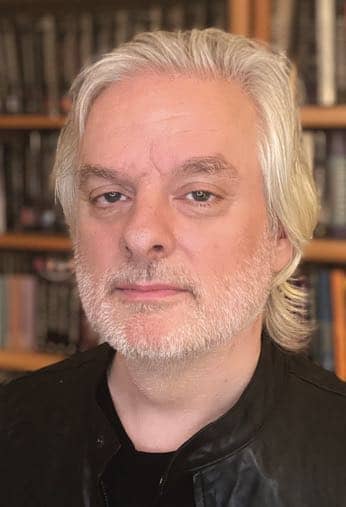
In his new book, Reality+, David Chalmers leaves the well-trampled garden of human consciousness and travels in a new direction, taking readers on a techno philosophy adventure tour of computer-simulated worlds and virtual reality. He has penned a philosophical page-turner that cascades from Aristotle to Zhuangzi, from Plato’s Cave to Robert Nozick’s Experience Machine, while wrestling with the big questions of knowledge, reality and mind. Discussions of epistemology and metaphysics are as likely to reference the Netflix drama Black Mirror, as the ideas of Daniel Dennett. The Matrix receives more attention than the works of Kant. Sci-fi classics like Snow Crash and Speak Player One stand shoulder to shoulder with Descartes’ Meditations on First Philosophy and Putnam’s History, Truth and Reason. Scores of humorous philosophical illustrations drawn by Tim Peacock help to push the argument forward. Chalmers is arguing that we should take seriously the likelihood that we are simulated beings living in a simulated universe. Our creator could be a teenage hacker one universe up from ours, although it seems more likely that some form of AI-generated our simulated universe. The fact that we are conscious beings does not negate the idea that we are sims, since consciousness is substrate independent, emerging from the organisation of a complex system, whether biologically- or silicon-based. Chalmers reveals himself to be a virtual realist, arguing that the ‘entities in virtual reality are real’ (p.105) – they are digital objects, made of information or bits. He concludes that we should not be afraid of migrating into a virtual world, as we can live genuine, fulfilling lives there. In October 2021 I met with him for a virtual (of course!) talk.


Cette histoire est tirée de l'édition February/March 2022 de Philosophy Now.
Abonnez-vous à Magzter GOLD pour accéder à des milliers d'histoires premium sélectionnées et à plus de 9 000 magazines et journaux.
Déjà abonné ? Se connecter
PLUS D'HISTOIRES DE Philosophy Now

Philosophy Now
The Possibility- Bearing Animal
Raymond Tallis explores a twilight zone.

7 mins
February/March 2026

Philosophy Now
Amazing Times at the Pub Agora
John Douglas Mullen is a philosophical bar fly on the wall.
8 mins
February/March 2026

Philosophy Now
Friedrich Nietzsche (1844-1900)
Hilarius Bogbinder considers the all too human life of the notorious iconoclast.
11 mins
February/March 2026

Philosophy Now
Heisenberg's Philosophy of Quantum Mechanics
Kanan Purkayastha explains how Werner Heisenberg's 1925 paper turned the quantum theory of the early 1900s into the quantum mechanics of today.
10 mins
February/March 2026
Philosophy Now
Cicero & the Ideal of Virtue
Abdullah Shaikh explores Cicero's ideas about the core Roman principle of virtus.
13 mins
February/March 2026

Philosophy Now
ROPE
Les Jones has a Nietzschean take on a Hitchcock thriller.
6 mins
February/March 2026
Philosophy Now
What Have the Romans Ever Done For Us?
Salve! This issue's theme is Roman Philosophy. But as the rebels in Monty Python's Life of Brian asked, what have the Romans ever done for us? The question seems relevant here; we are philosophers, not archaeologists.
2 mins
February/March 2026

Philosophy Now
Paul Guyer
Paul Guyer is an American philosopher and a leading scholar of both Immanuel Kant and aesthetics. AmirAli Maleki interviews him about Kant's political and moral vision.
9 mins
February/March 2026
Philosophy Now
Identity in the Age of Connectivity
Sara Asran explores the dynamics of identity online.
6 mins
February/March 2026
Philosophy Now
A Very Short History of Critical Thinking
Luc de Brabandere summarises a long history through key figures of thought.
7 mins
February/March 2026
Translate
Change font size