
Passez à l'illimité avec Magzter GOLD
Obtenez un accès illimité à plus de 9 000 magazines, journaux et articles Premium pour seulement
MINERALS OF THE MOON
Rock&Gem Magazine
|January 2020
THE ONGOING STORY OF THE APOLLO MOON ROCKS

Arguably the greatest mineral-collecting field trip of all time took place in July 1969, when two rockhounds gathered 48 pounds of specimens at a never-before-collected locality. Although admittedly short on aesthetic appeal, these specimens were a scientific bonanza and the most valuable mineral specimens ever collected.
The collectors were National Aeronautics and Space Administration (NASA) astronauts Neil Armstrong and Edwin E. “Buzz” Aldrin, Jr., the first humans to set foot on the Moon. The field trip was NASA’s Apollo 11 mission, and the locality was the Moon’s Sea of Tranquility. By 1972 when the Apollo program ended, 12 astronauts had walked on the Moon and collected 842 pounds of “moon rocks.” The significance of these celebrated rocks and what became of them during the half-century that followed is a fascinating tale of high security, meticulous accounting, worldwide distribution, unprecedented scientific study, and even a bit of fraud and greed.
Before Apollo, our geological and mineralogical knowledge of the Moon had amounted to educated guesswork based largely on the study of lunar meteorites. But lunar meteorites, pieces of the Moon’s surface that had been dislodged by meteoritic impacts and wound up on Earth, are rare. And their scientific value was limited because of unknown lunar geographic origin, alteration incurred in the heat of atmospheric entry, and long-term exposure to the Earth’s atmosphere.
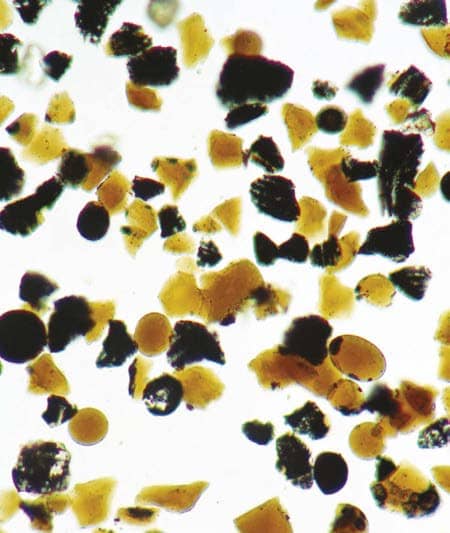
EARLY THEORIES OF ORIGINS

Cette histoire est tirée de l'édition January 2020 de Rock&Gem Magazine.
Abonnez-vous à Magzter GOLD pour accéder à des milliers d'histoires premium sélectionnées et à plus de 9 000 magazines et journaux.
Déjà abonné ? Se connecter
PLUS D'HISTOIRES DE Rock&Gem Magazine
Rock&Gem Magazine
A New Amber Locality Fills a Gap
A sandstone quarry in central Ecuador has yielded the first significant deposit of Mesozoic amber from South America.

1 min
January / February 2026
Rock&Gem Magazine
Did "Left-Handed" Fish Leave Water Earlier than Thought?
Fossil evidence suggests that fish (or \"fishapods\") dragged themselves onto land during the middle Devonian Period.
1 min
January / February 2026
Rock&Gem Magazine
"Lab Quakes” Produce Surprising Results
When faults let loose and earthquakes result, the main effect we mortals experience is the violent shaking.
1 min
January / February 2026
Rock&Gem Magazine
This Egg is No Spring Chicken
How to date a dino egg
1 min
January / February 2026
Rock&Gem Magazine
Have we Already Mined the Critical Minerals We Need
Then why are we throwing them away?!
1 min
January / February 2026
Rock&Gem Magazine
One Toxic Worm
A critter that creates & tolerates orpiment!
1 min
January / February 2026
Rock&Gem Magazine
ROCK & GEM FIELD GUIDE: Silver
Silver (Ag) is a native element and one of Earth's most prized precious metals.
2 mins
January / February 2026
Rock&Gem Magazine
DINOSAURS OF THE HELL CREEK MUSEUM
In the Badlands of South Dakota, just outside the small town of Belle Fourche—pronounced “Bell Foosh”—a new attraction has taken shape that every dinosaur enthusiast should see. The Dinosaurs of the Hell Creek Museum is part hands-on exhibit, part science center and part active research lab.
3 mins
January / February 2026
Rock&Gem Magazine
The Lost Twins of Kongsberg
A Silver Story Resurfaced
3 mins
January / February 2026
Rock&Gem Magazine
Switzerland's ICE PALACE
Walk Inside a Glacier at The Top of Europe
7 mins
January / February 2026
Translate
Change font size