Essayer OR - Gratuit
Raised by wolves
BBC History Magazine
|June 2022
Feral children have fascinated and frightened people for centuries, raising questions about what it means to be human. Richard Sugg shares the stories of some of these wild children - and explains why their return to society was not always a happy one

One of the pack
Mowgli is surrounded by wolves in a 1937 illustration from Rudyard Kipling's The Jungle Book. In the past, feral children have been found living with animals such as wolves and bears
Join me for a moment at a royal hunt in France, in 1737. Far ahead of the main pack of riders and dogs, one figure hurtles with incredible speed after fleeing hares and rabbits, bringing back prey to the main party before they can catch up. But look closer: the creature racing on all fours across the grass is not a dog but a girl of perhaps 15.
Her name was Memmie le Blanc, known as "the wild girl of Songi" after the village Songy, in north-eastern France, where she was captured in 1731. At that time, she had apparently slept easily in the branches of a tree, sung like a bird, and flown up and down tree trunks with the ease of a squirrel.
Local villagers (writes the author Michael Newton) fled from this feral child as if she were the devil itself. Meanwhile, Lord Monboddo, an early theorist of human evolution, took a more scientific interest in Memmie. When this girl learned (or recovered) language, she revealed that her wild life had not been an entirely easy one.
Ironically, though, it was her assimilation into French civilisation that nearly killed her. Wine and salt caused Memmie to lose her teeth, and heated rooms and cooked food made her dangerously ill. She recovered after a doctor prescribed live pigeons and chickens, from which she sucked the warm blood. On another occasion in a château kitchen she seized a rabbit, stripped off its skin in a flash and devoured it raw. Like other feral children wrenched into the human world, Memmie now learned shame and embarrassment chiefly from the nuns who sheltered her, and who were unable to wholly conceal their disgust at what she had been.
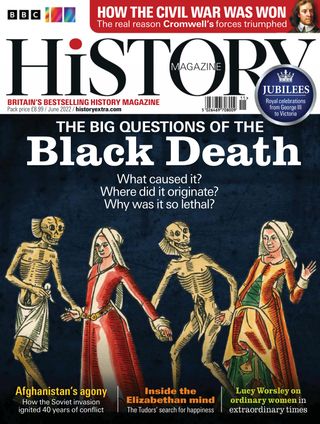

Cette histoire est tirée de l'édition June 2022 de BBC History Magazine.
Abonnez-vous à Magzter GOLD pour accéder à des milliers d'histoires premium sélectionnées et à plus de 9 000 magazines et journaux.
Déjà abonné ? Se connecter
PLUS D'HISTOIRES DE BBC History Magazine
BBC History UK
On the skids
Richard Rodgers and Oscar Hammerstein II's smash musical Oklahoma! opened on Broadway on 31 March 1943.

1 min
Christmas 2025

BBC History UK
Small pleasures
Memory is imperfect, but what if you could get a professional model maker to recreate a moment from the past?
1 min
Christmas 2025

BBC History UK
Bath in five places
In the Georgian era, Bath became arguably Britain's most fashionable destination. KIRSTEN ELLIOTT promenades five historic highlights
3 mins
Christmas 2025
BBC History UK
End times
Why do civilisations that dominated their epoch fail? In an era of autocracy, climate change, the rise of Al and a first-hand understanding of how deadly pandemics can be, it's a question that seems pertinent.
1 min
Christmas 2025
BBC History UK
What are the origins of the Yule Lads?
To learn about the Jólasveinar (Yule Lads), we must start with their mother, the terrifying ogress Grýla. Her name appeared in Icelandic texts as early as the 13th century, although it wasn’t until later that those 13 mischievous lads became associated with her. Folk tales and poems tell how she descends from the mountains with an empty sack to stuff full of children. Grýla owns the monstrous Jólaköttur (Yule Cat), which roams the countryside on Christmas Eve, searching for children to gobble up if they're not wearing new clothes.
1 mins
Christmas 2025
BBC History UK
Santa Claus v Father Christmas
The true identity of the white-bearded, red-robed figure who fills children's stockings at Christmas has long been debated. Thomas Ruys Smith sizes up the merry contenders
8 mins
Christmas 2025
BBC History UK
Frontier friction
Set in Washington Territory in 1854, The Abandons is a Western that's unusual for having two matriarchs, women whose lives become entangled, at its centre.
1 min
Christmas 2025

BBC History UK
The Last Days of Pompeii: The Immersive Experience
Delve into the culture of daily Roman life, witness the momentous eruption of Mount Vesuvius, and follow its fallout in Immerse LDN's new exhibition. In a blend of cutting-edge technology and vivid storytelling, this exhibition launches visitors into Pompeii's rich history with recreations of the ancient city's beautiful pre-eruption landscape, a 360-degree virtual reality Roman amphitheatre experience, and a digital metaverse recreating Pompeii's 'Villa of Mysteries'.
1 min
Christmas 2025
BBC History UK
Elizabeth Marsh The corsair's captive
Taken hostage by a Barbary ship's captain in the 18th century, a young Englishwoman found herself fighting for her freedom in Marrakech. ADAM NICHOLS introduces a brave captive who later wrote a book about her dramatic experiences
6 mins
Christmas 2025
BBC History UK
29 DECEMBER 1170: Thomas Becket is murdered in Canterbury
Knights loyal to Henry II rid him of the “low-born cleric”
2 mins
Christmas 2025
Translate
Change font size