Essayer OR - Gratuit
Freedom Verse
The Walrus
|November 2021
Once relegated to the literary fringes, dub poet Lillian Allen has inspired countless Canadian writers. A new book shows why

THERE IS a certain sound a raised voice can make, a raw and elemental tone that, at its most refined, exceeds the artist. I call it the sufferation tone. Well delivered, it is intense without being histrionic. Approached with insincerity, it rings hollow, and listeners immediately detect the artifice. But, if expressed from a place of genuine anguish, it can give voice to both joy and tragedy.
Great singers can produce the sufferation tone, but it is dub poets who locate it at the heart of their work. Dub evolved out of Jamaica’s reggae culture roughly fifty years ago. To dub is a recording term that roughly means to transfer audio from one medium to another, and in the case of dub poetry, the term describes a popular art form where poems are performed using words that feel like they have been imprinted on, or stamped into, an instrumental background. Incorporating reggae’s rhythms (or “ riddims”) and drawn from the Jamaican language, dub poetry grapples with the legacies of enslavement while exploring the injustice and inequality of everyday life. Oku Onuora, who grew up in Kingston, is credited with being among the first to experiment with combining music and protest lyrics, which he did while in prison for armed robbery between 1970 and 1977. (According to legend, he had attempted to redistribute funds from a post office to an impoverished youth center.) Onuora could deliver poems as a growl of fury or a howl that doubled as a battle cry. Among the poets he inspired was someone also able to shift effortlessly from lamentation to threat to celebration: Lillian Allen.
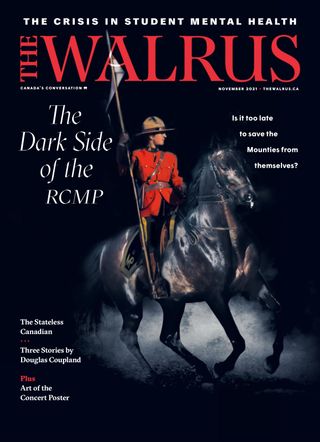

Cette histoire est tirée de l'édition November 2021 de The Walrus.
Abonnez-vous à Magzter GOLD pour accéder à des milliers d'histoires premium sélectionnées et à plus de 9 000 magazines et journaux.
Déjà abonné ? Se connecter
PLUS D'HISTOIRES DE The Walrus

The Walrus
The Lost Epic
An exclusive excerpt from Yann Martel's new novel

10 mins
March/April 2026
The Walrus
Access Denied
From endless bureaucracy to in-person requirements, universities are shutting out disabled students and staff
16 mins
March/April 2026
The Walrus
Return to Portapique
My partner murdered 22 people in a shooting rampage. Months later, I went back to our home to show police how I escaped
18 mins
March/April 2026

The Walrus
Trust Me
Evan Solomon wants Canadians to believe AI is a force for good
22 mins
March/April 2026

The Walrus
All Office, No Work
Back-to-office mandates were never about productivity. They're about control
10 mins
March/April 2026

The Walrus
How to Pronounce KING
Souvankham Thammavongsatwo-time winner of the Giller Prizedoesn't mind if you're jealous of her career
13 mins
March/April 2026

The Walrus
Face Value
What does it mean to really look at another human being?
4 mins
March/April 2026
The Walrus
MY GUILTY PLEASURE
DURING THE PANDEMIC, everyone wanted a puppy. Then people tired of their dogs. Puppy mills couldn’t find homes for their litters, and those churning out doodles had too many breeding poodles on hand. While searching for my own pandemic puppy, I stumbled upon a poodle rescue group on Facebook. From fostering a few dozen dogs annually, the rescue was, a couple of years into the pandemic, trying to find homes for more than a hundred over the course of a year.
2 mins
March/April 2026
The Walrus
The Fight Over Canada's Most Valuable Fish
Priced at thousands of dollars per kilogram, baby eels have set off a global frenzy
11 mins
March/April 2026
The Walrus
Leave the Kids Alone
The controversy over free-range parenting
20 mins
March/April 2026
Translate
Change font size