Essayer OR - Gratuit
A Chequered Past
Swarajya Mag
|June 2017
Earlier India had to accommodate the Arab-Islamic opposition to normalisation of relations with Israel, but now it is the other way around.

INDIA’S RELATIONS WITH Israel can be described within four broad historical processes that date back to the early part of the 20th century. The emergence of Jewish nationalist aspirations in Palestine coincided with the impending disintegration of the already crumbling Ottoman Empire which also had the caliph. For centuries, Indian Muslims were indifferent both to the Ottoman sultan and his caliphate, but the disappearance of the Mughal empire and its replacement by the British transformed the situation. The Ottomans being the last surviving Islamic empire galvanised a sudden interest among the Indian Muslims and culminated in the Khilafat movement.
Enter Mahatma Gandhi. He sees the Muslim agitation over a pan-Islamic issue as an opportunity to forge much needed but long absent Hindu-Muslim unity and unconditionally plunges the Congress into supporting the Khilafat struggle. Though the community unity proved short-lived and counterproductive in the long run, the phase also witnessed the emergence of rudimentary Indian position vis-à-vis the Jewish claims.
Gandhi framed Palestine within the Islamic paradigm and categorically ruled out sovereignity being granted to the non-Muslim population. Though the Congress did not go that far, the matter was settled squarely. As the political tussle between the Congress and the Muslim League intensified in the 1930s, the Palestine issue became the quid pro quo for the Congress to seek support from the Indian Muslims and wean them away from the League.
There was also an ideological compulsion. Having rejected Mohammed Ali Jinnah’s arguments of religion being the basis for nationhood, the Congress could not adopt a contrary view on the Jewish nationalism. Hence, at the ideological level, it opposed the minority nationalism both in India and in Palestine.
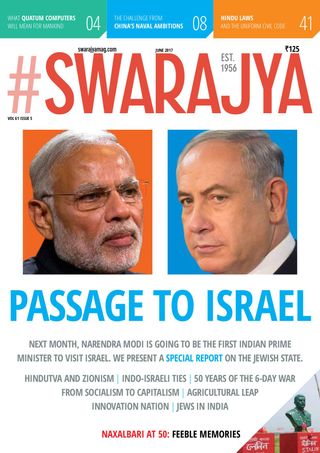

Cette histoire est tirée de l'édition June 2017 de Swarajya Mag.
Abonnez-vous à Magzter GOLD pour accéder à des milliers d'histoires premium sélectionnées et à plus de 9 000 magazines et journaux.
Déjà abonné ? Se connecter
PLUS D'HISTOIRES DE Swarajya Mag

Swarajya Mag
The Hesitant Orbit
In order to march boldly ahead into the deep space, New Delhi must work towards building a station, boost its techno-economic planning and use the Indian Space Research Organisation smartly.

4 mins
December 2017

Swarajya Mag
Nudges And Narratives
The debate surrounding Sanjay Leela Bhansali’s Padmavati brings India a complex network of portraits within a cultural world-system.
8 mins
December 2017

Swarajya Mag
The Spell Of Specialisation
THE INDIAN ADMINISTRATIVE SERVICE NEEDS AN URGENT REJIG. THE KEY TO SPEED AND EFFICIENCY LIES IN PUTTING AN END TO A GENERALIST APPROACH AND IN GOING FOR A NEW SERVICE.
7 mins
December 2017
Swarajya Mag
The Great Gamble
With demonetisation, the prime minister has taken a huge risk— both economic and political. He must succeed, because this move could transform both our economy and our society.
18 mins
December 2016

Swarajya Mag
The Lies And The Truth
The government must be bold enough to up-end the activists who are coming in the way of the nation’s agricultural progress.
7 mins
August 2017

Swarajya Mag
Figuring Out China
China’s economic footprint is being followed by its military footprint. To know that is not be belligerent but to prepare oneself adequately.
5 mins
August 2017

Swarajya Mag
Management 108
The Upanishads Have A Lot To Teach Today’s Executives When Outcomes Are Unpredictable, Relationships Complex, And Change Is The Name Of The Game.
8 mins
August 2017

Swarajya Mag
Sunny Days Ahead
THE NEW GUIDELINES FOR TAXI SERVICES ARE SENSIBLE, RATIONAL, AND MORE THAN WELCOME.
6 mins
August 2017

Swarajya Mag
The Cultural World-System
Despite much talk of “soft power”, the fact is that whichever way you slice it, Indian culture fares poorly at seeking or exercising it
6 mins
October 2017

Swarajya Mag
The Hard Way Forward
India has been focused on software, but there are large opportunities to be seized in hardware. A primer, and some busting of myths.
10 mins
October 2017
Translate
Change font size