
Mit Magzter GOLD unbegrenztes Potenzial nutzen
Erhalten Sie unbegrenzten Zugriff auf über 9.000 Zeitschriften, Zeitungen und Premium-Artikel für nur
Versuchen GOLD - Frei
Leveraging AI and ML for a future-fit industry
PCQuest
|January 2023
Modern technologies like Al and ML help businesses analyze risk cases and identify early signs of potential future issues. These are accelerating digitization and, eliminating silos and manual operations

Technology and innovation are reinventing how banks, insurance companies and financial institutions continue to operate. Modern processes, empowered by Artificial Intelligence (AI) are accelerating the digitisation of every financial service, one product at a time while augmenting revenues substantially. In a recent insights report, Mckinsey estimated that Al can generate up to $1 trillion additional value annually for the global banking industry.
Banks aiming to upgrade their personalization initiatives, improve conversions, eliminate silos and manual operations, are increasingly leaning towards advanced AI and Machine Learning (ML) technologies and platforms to achieve this.
Looking forward with Al and ML
If Banking, Financial Services and Insurance (BFSI) companies seek to thrive in the new economy, they must leave behind cycles of unproductive efforts using legacy systems and rather invest in integrated and agile data accelerator, data processing models, and algorithms that are easy to navigate and share. By adopting an Al-first mindset in the long run, banking and financial service institutions can overcome traditional holdbacks and gain the necessary technical edge required to succeed in fast-paced ecosystems.
One of the key challenges for financial service enterprises is to identify, target and reach the segment of customers most likely to be interested in the products being offered. Highly automated Al and ML models, improve customer engagement, only with a few steps, enabling BFSI businesses to anticipate customer needs and behaviours effectively, and enhance customer interactions.
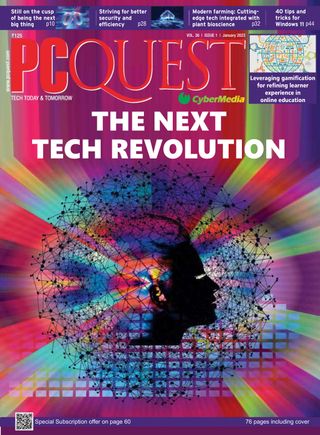

Diese Geschichte stammt aus der January 2023-Ausgabe von PCQuest.
Abonnieren Sie Magzter GOLD, um auf Tausende kuratierter Premium-Geschichten und über 9.000 Zeitschriften und Zeitungen zuzugreifen.
Sie sind bereits Abonnent? Anmelden
WEITERE GESCHICHTEN VON PCQuest

PCQuest
When Software Drives the Machine Need for Enterprise-Grade Software
Cars used to fail because of broken parts.Now they fail because of broken code. As vehicles become rolling computers, enterprise-grade software, ruthless testing, and fail-safe architecture decide one thing: whether a car keeps moving safely at 100 km/h

2 mins
March 2026

PCQuest
AI on the ground Practical use cases of AI in large enterprise operations
AI isn't a side project anymore, it's the quiet operator inside global giants. It reads invoices, senses machine fatigue, tailors every customer moment, flags risk in real time, and feeds leaders sharper instincts. Scale just got smarter
3 mins
March 2026

PCQuest
From AI experiments in 2025 to enterprise scale in 2026: Why data foundations will decide the winners
Everyone's betting big on Al, but most are burning cash instead of building value. The hidden culprit? Dirty data, clunky processes, and missing context. What if fixing your foundation, not your algorithms, was the real AI game-changer?
4 mins
March 2026

PCQuest
How automation at the periphery is accelerating digital transformation
Digital transformation is not tearing down the core anymore. It is happening at the edges. With AI and automation layered onto existing systems, companies are cutting costs, boosting productivity by up to 40%, and scaling smarter without risking operational chaos
2 mins
March 2026

PCQuest
When AI moves from chips to racks
AI performance is no longer just about faster chips. It is about how racks, power, networking, and orchestration work together. As agentic AI grows, infrastructure must become predictable, open, and built for scale from day one
4 mins
March 2026

PCQuest
Designing enterprise AI systems that stay fair
In 2026, bias is no longer treated as a communications issue or a public relations headache.
6 mins
March 2026

PCQuest
HALO smart sensor
What if bathrooms, locker rooms, and isolated spaces could become safer without adding cameras?
2 mins
March 2026

PCQuest
Building enterprise AI that doesn't discriminate
Bias in enterprise AI is not a side issue. It starts in data pipelines, training systems, product design, and engineering workflows. As AI scales, fairness, transparency, and accessibility are becoming core software requirements
4 mins
March 2026
PCQuest
Bias travels faster than code
Bias in enterprise AI is not a surface issue. It enters through data, features, model training, APIs, and UI logic, then spreads across the stack. The technical response is shifting from audits to architecture, observability, and deployment controls
6 mins
March 2026

PCQuest
How hospitals can use AI without risking patient data
With the fast pace of adoption of Artificial Intelligence (AI) and digital health systems in Indian hospitals, issues related to the security of patient data are also increasing at an equal rate.
2 mins
March 2026
Translate
Change font size