
Mit Magzter GOLD unbegrenztes Potenzial nutzen
Erhalten Sie unbegrenzten Zugriff auf über 9.000 Zeitschriften, Zeitungen und Premium-Artikel für nur
Versuchen GOLD - Frei
How Agentic AI adapts to legacy and leads the way
PCQuest
|July 2025
What if Al didn’t just assist but worked like a team? In finance, Agentic Al is doing just that: teaming up, factchecking, adapting to legacy systems, and transforming workflows without making a sound. The bots aren’t coming. They've already clocked in
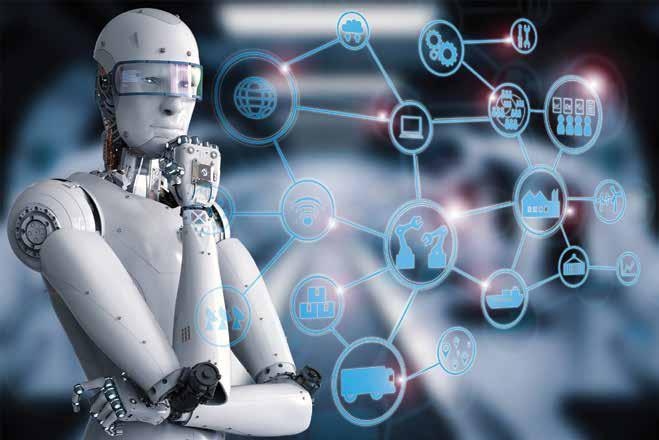
When we spoke with Jon O’Donnell, Chief Operating Officer, Acuity Knowledge Partners, the conversation quickly moved past the buzzwords. No hype, no generic “Al will change everything” fluff. Instead, what unfolded was a grounded, detailed look at how Agentic Al, an emerging architecture of autonomous, collaborative Al agents, is quietly transforming the way financial services firms operate.
“We started with copilots,” O’Donnell explained, “but quickly realized the future wasn’t about single tools. It was about teams, AI agents that collaborate like humans, validate each other's work, and adapt to real-world data complexities.”
And just like that, the frame shifts: from AI as an assistant, to AI as a workforce.
 Not just Al: An entire workforce of algorithms
Artificial intelligence is changing. Not in the look, it can summarize a PDF, it let meme behave like a team of analysts, collaborate, flag inconsistencies, and generate outputs at scale. Welcome to the world of Agentic AI. This new approach doesn't rely on one large model answering all your questions. Instead, it mimics how human teams operatewith specialization, coordination, checks, and balances. In sectors like banking, asset management, and private equity, where accuracy and trust are nonnegotiable, this model is starting to reshape how work gets done.
From copilots to digital departments
Earlier generations of enterprise AI systems were linear. A prompt in, a response out. At the best, they behaved like copilots, offering suggestions, finishing sentences, and surfacing data, etc. But today's leading financial services firms are experimenting with something more sophisticated: AI “fleets” made up of semi-autonomous agents, each trained for a specific role.

Diese Geschichte stammt aus der July 2025-Ausgabe von PCQuest.
Abonnieren Sie Magzter GOLD, um auf Tausende kuratierter Premium-Geschichten und über 9.000 Zeitschriften und Zeitungen zuzugreifen.
Sie sind bereits Abonnent? Anmelden
WEITERE GESCHICHTEN VON PCQuest

PCQuest
AI on the ground Practical use cases of AI in large enterprise operations
AI isn't a side project anymore, it's the quiet operator inside global giants. It reads invoices, senses machine fatigue, tailors every customer moment, flags risk in real time, and feeds leaders sharper instincts. Scale just got smarter

3 mins
March 2026

PCQuest
From AI experiments in 2025 to enterprise scale in 2026: Why data foundations will decide the winners
Everyone's betting big on Al, but most are burning cash instead of building value. The hidden culprit? Dirty data, clunky processes, and missing context. What if fixing your foundation, not your algorithms, was the real AI game-changer?
4 mins
March 2026

PCQuest
How automation at the periphery is accelerating digital transformation
Digital transformation is not tearing down the core anymore. It is happening at the edges. With AI and automation layered onto existing systems, companies are cutting costs, boosting productivity by up to 40%, and scaling smarter without risking operational chaos
2 mins
March 2026

PCQuest
When AI moves from chips to racks
AI performance is no longer just about faster chips. It is about how racks, power, networking, and orchestration work together. As agentic AI grows, infrastructure must become predictable, open, and built for scale from day one
4 mins
March 2026

PCQuest
Designing enterprise AI systems that stay fair
In 2026, bias is no longer treated as a communications issue or a public relations headache.
6 mins
March 2026

PCQuest
HALO smart sensor
What if bathrooms, locker rooms, and isolated spaces could become safer without adding cameras?
2 mins
March 2026

PCQuest
Building enterprise AI that doesn't discriminate
Bias in enterprise AI is not a side issue. It starts in data pipelines, training systems, product design, and engineering workflows. As AI scales, fairness, transparency, and accessibility are becoming core software requirements
4 mins
March 2026

PCQuest
Bias travels faster than code
Bias in enterprise AI is not a surface issue. It enters through data, features, model training, APIs, and UI logic, then spreads across the stack. The technical response is shifting from audits to architecture, observability, and deployment controls
6 mins
March 2026

PCQuest
How hospitals can use AI without risking patient data
With the fast pace of adoption of Artificial Intelligence (AI) and digital health systems in Indian hospitals, issues related to the security of patient data are also increasing at an equal rate.
2 mins
March 2026

PCQuest
DeFi in 2026: The rise of liquidity, privacy and decentralized exchanges
DeFi's teenage years are over. Liquidity now behaves like infrastructure, privacy is baked in with zero-knowledge math, and DEXS hum like borderless trading engines. What once felt scrappy now resembles parallel financial system-without gatekeepers
3 mins
March 2026
Listen
Translate
Change font size