
Mit Magzter GOLD unbegrenztes Potenzial nutzen
Erhalten Sie unbegrenzten Zugriff auf über 9.000 Zeitschriften, Zeitungen und Premium-Artikel für nur
Versuchen GOLD - Frei
Addressing key cybersecurity challenges and best practices
PCQuest
|July,2023
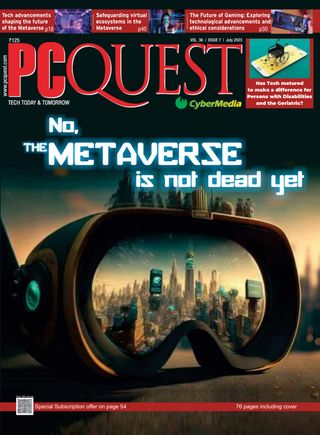
Understanding and adopting best practices in cybersecurity is crucial for protecting personal and organizational data within the evolving platform of the Metaverse

The Metaverse presents a new and evolving platform that brings unique cybersecurity challenges. Understanding these challenges and adopting best practices is crucial to safeguarding individuals and organizations from potential risks. In an interview with Pankit Desai, CO-Founder & CEO of Sequretek, we explore the key cybersecurity challenges unique to the Metaverse and discuss preventive measures to ensure digital safety within virtual ecosystems.
Unique Cybersecurity Challenges in the Metaverse
The Metaverse is a new and evolving platform, which means that it presents some unique cybersecurity challenges. These challenges include:
• Identity spoofing and impersonation: In the Metaverse, users can create avatars that can be used to represent themselves in virtual worlds. This makes it difficult to verify the identity of other users, which can lead to identity spoofing and impersonation attacks.
• Data security: The Metaverse is a data-intensive platform, which means that there is a lot of sensitive data that is stored and processed in the Metaverse. This data is vulnerable to a variety of cyberattacks, such as data breaches, malware attacks, and ransomware attacks.
• Security of VR and AR headsets: VR and AR headsets are powerful devices that can collect a lot of personal data about users. This data is vulnerable to cyberattacks, and it is also possible for VR and AR headsets to be hacked and controlled by unauthorized users.

Diese Geschichte stammt aus der July,2023-Ausgabe von PCQuest.
Abonnieren Sie Magzter GOLD, um auf Tausende kuratierter Premium-Geschichten und über 9.000 Zeitschriften und Zeitungen zuzugreifen.
Sie sind bereits Abonnent? Anmelden
WEITERE GESCHICHTEN VON PCQuest

PCQuest
When Software Drives the Machine Need for Enterprise-Grade Software
Cars used to fail because of broken parts.Now they fail because of broken code. As vehicles become rolling computers, enterprise-grade software, ruthless testing, and fail-safe architecture decide one thing: whether a car keeps moving safely at 100 km/h

2 mins
March 2026

PCQuest
AI on the ground Practical use cases of AI in large enterprise operations
AI isn't a side project anymore, it's the quiet operator inside global giants. It reads invoices, senses machine fatigue, tailors every customer moment, flags risk in real time, and feeds leaders sharper instincts. Scale just got smarter
3 mins
March 2026

PCQuest
From AI experiments in 2025 to enterprise scale in 2026: Why data foundations will decide the winners
Everyone's betting big on Al, but most are burning cash instead of building value. The hidden culprit? Dirty data, clunky processes, and missing context. What if fixing your foundation, not your algorithms, was the real AI game-changer?
4 mins
March 2026

PCQuest
How automation at the periphery is accelerating digital transformation
Digital transformation is not tearing down the core anymore. It is happening at the edges. With AI and automation layered onto existing systems, companies are cutting costs, boosting productivity by up to 40%, and scaling smarter without risking operational chaos
2 mins
March 2026

PCQuest
When AI moves from chips to racks
AI performance is no longer just about faster chips. It is about how racks, power, networking, and orchestration work together. As agentic AI grows, infrastructure must become predictable, open, and built for scale from day one
4 mins
March 2026

PCQuest
Designing enterprise AI systems that stay fair
In 2026, bias is no longer treated as a communications issue or a public relations headache.
6 mins
March 2026

PCQuest
HALO smart sensor
What if bathrooms, locker rooms, and isolated spaces could become safer without adding cameras?
2 mins
March 2026

PCQuest
Building enterprise AI that doesn't discriminate
Bias in enterprise AI is not a side issue. It starts in data pipelines, training systems, product design, and engineering workflows. As AI scales, fairness, transparency, and accessibility are becoming core software requirements
4 mins
March 2026

PCQuest
Bias travels faster than code
Bias in enterprise AI is not a surface issue. It enters through data, features, model training, APIs, and UI logic, then spreads across the stack. The technical response is shifting from audits to architecture, observability, and deployment controls
6 mins
March 2026

PCQuest
How hospitals can use AI without risking patient data
With the fast pace of adoption of Artificial Intelligence (AI) and digital health systems in Indian hospitals, issues related to the security of patient data are also increasing at an equal rate.
2 mins
March 2026
Translate
Change font size