
Mit Magzter GOLD unbegrenztes Potenzial nutzen
Erhalten Sie unbegrenzten Zugriff auf über 9.000 Zeitschriften, Zeitungen und Premium-Artikel für nur
Versuchen GOLD - Frei
Open Source Tools: Helping to Build Al-Powered Edge Intelligence
Open Source For You
|November 2025
As systems grow in complexity and data sizes become unmanageable, it is Al-powered edge intelligence that will help loT devices perform efficiently. And this technology, not surprisingly, is evolving with the help of a range of open source tools.
-

By 2030, the global edge AI market is projected to exceed US$ 200 billion, driven by one fundamental constraint: latency.
When a manufacturing robot needs to detect a defect, an autonomous vehicle must avoid a collision, or a medical device requires real-time patient monitoring, sending data to the cloud and waiting for a response isn't just inefficient—it's dangerous.
Yet, despite this explosive growth, most organisations struggle with a critical question: How do we build production-ready, AI-powered IoT systems that are both cost-effective and secure?
The answer lies in open source. Let's explore proven architectural patterns, open source tools, and real-world implementation strategies that bridge the gap between proof-of-concept and production deployment.
The cloud bottleneck
Traditional IoT architectures relied heavily on sending raw sensor data to centralised cloud infrastructure for processing and decision-making. This model performed adequately when handling periodic updates and non-time-critical applications. However, as IoT deployments scale and use cases demand real-time responsiveness, the limitations of cloud-first approaches become huge barriers to innovation and efficiency as can be seen in Table 1.
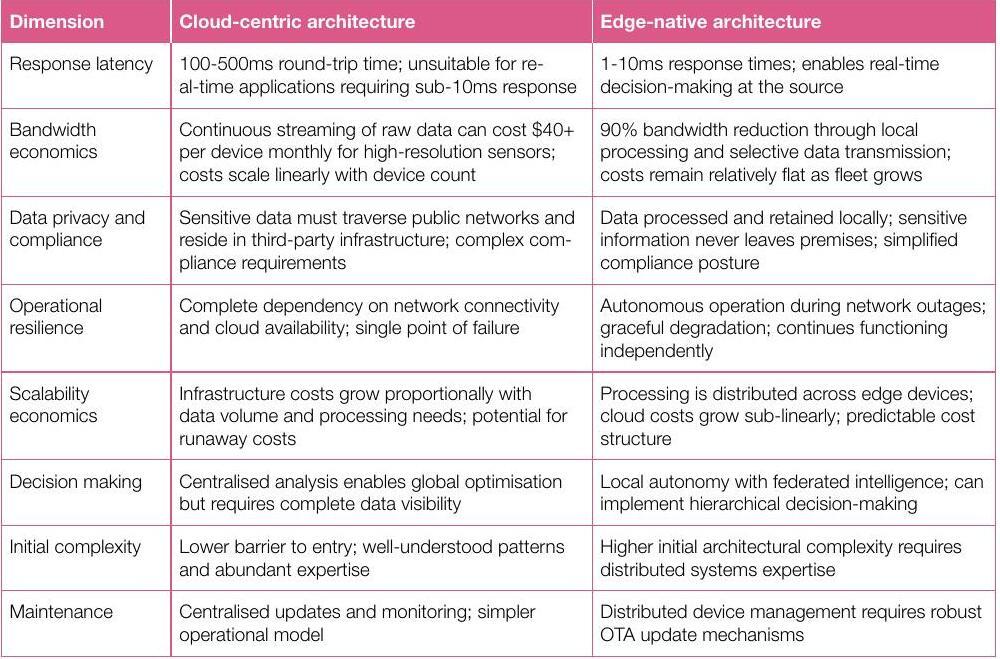 The comparison reveals that edge intelligence isn't simply 'better' than cloud computing—rather, it addresses a fundamentally different set of requirements. The optimal architecture often employs a hybrid approach, leveraging edge computing for real-time, latency-sensitive operations while utilising cloud resources for long-term analytics, model training, and enterprise-wide insights. Understanding when and where to apply each paradigm becomes the critical architectural decision that separates successful deployments from failed experiments.

Diese Geschichte stammt aus der November 2025-Ausgabe von Open Source For You.
Abonnieren Sie Magzter GOLD, um auf Tausende kuratierter Premium-Geschichten und über 9.000 Zeitschriften und Zeitungen zuzugreifen.
Sie sind bereits Abonnent? Anmelden
WEITERE GESCHICHTEN VON Open Source For You

Open Source For You
Apple acquires open source photonics startup invrs.io and hires its founder
Open source technology sits at the heart of Apple's latest acquisition.

1 min
April 2026
Open Source For You
OpenClaw adoption wave lifts China's tech stocks
OpenClaw, an open source autonomous AI agent, is driving a wave of investor enthusiasm in mainland China's stock markets, lifting shares of companies linked to the technology even as broader market sentiment remains subdued.
1 min
April 2026

Open Source For You
NVIDIA's NemoClaw could power Al-based warfare for India
NVIDIA has introduced NemoClaw, an open source, chip-agnostic AI platform designed to deploy agentic AI systems.
1 min
April 2026

Open Source For You
Microsoft flags fake Next.js repos are embedding staged backdoors inside build scripts
Attackers are seeding the open source ecosystem with malicious yet legitimatelooking Next.js repositories that embed staged backdoors inside build scripts and Microsoft dependencies, according to Microsoft.
1 min
April 2026

Open Source For You
NeoNephos expands its open source cloud ecosystem with new members
NeoNephos Foundation has expanded its pan-European open source cloud coalition with the addition of BWI GmbH as a Premier Member, SUSE LLC as a General Member, and Fraunhofer ISST as an Associate Member.
1 mins
April 2026

Open Source For You
Meta's Manus AI allows users to operate its agents through Telegram
The rise of OpenClaw is reshaping the AI agent market, compelling closed platforms to mirror features first popularised in the open source community. The latest example: Manus AI has introduced Telegrambased mobile control, a capability long central to OpenClaw's messaging-first approach.
1 min
April 2026

Open Source For You
China's DeepSeek has more than 75 million downloads on Hugging Face
Chinese AI lab DeepSeek is turning open source momentum into hardware leverage, with more than 75 million downloads of its models on Hugging Face helping Chinese AI releases surpass every other country on the platform.
1 min
April 2026

Open Source For You
Fractal's LLM Studio will help build domain-specific AI models
Fractal Analytics has launched LLM Studio, an enterprise platform designed to build, evaluate, and operate domain-specific language models using open source foundations, marking a shift away from closed, API-led AI approaches.
1 min
April 2026

Open Source For You
Monitoring Machine Learning in Production
Discover the concepts of drift and data skew, and explore online monitoring techniques that keep your machine learning model relevant.
5 mins
April 2026

Open Source For You
Managing Multi-Cloud Infrastructure: The Way Forward
Kubernetes and open source control planes make multi-cloud operations easier and help organisations build scalable and cloudagnostic infrastructure platforms.
7 mins
April 2026
Listen
Translate
Change font size