
Mit Magzter GOLD unbegrenztes Potenzial nutzen
Erhalten Sie unbegrenzten Zugriff auf über 9.000 Zeitschriften, Zeitungen und Premium-Artikel für nur
Versuchen GOLD - Frei
AI vs CLIMATE CHANGE CAN INTELLIGENCE SAVE THE PLANET?
Exhibit
|April 2026
How artificial intelligence is helping scientists, governments, and industries predict environmental risks, reduce emissions, and design smarter solutions for a sustainable future.

Climate change is one of the biggest challenges humanity has ever faced.
Rising global temperatures, extreme weather events, melting glaciers, and rising sea levels are clear signs that the planet is under stress. Scientists across the world agree that human activities such as burning fossil fuels, deforestation, and industrial emissions are the primary drivers of this crisis. As governments and organizations search for solutions, a powerful new tool has entered the fight: artificial intelligence.
Artificial intelligence, often referred to as AI, is the ability of machines to process large amounts of data, learn patterns, and make predictions. Unlike traditional software, AI systems can analyze complex datasets at a scale that humans simply cannot manage. This capability is particularly valuable in climate science, where researchers work with massive amounts of environmental data collected from satellites, weather stations, ocean sensors, and climate models.
One of AI's biggest contributions to climate action is improving climate prediction. Climate systems are extremely complex, involving interactions between the atmosphere, oceans, land, and ice. Traditional climate models often take weeks to process and still carry significant uncertainties. AI can analyze historical weather patterns, satellite imagery, and environmental data to generate faster and more accurate predictions. This helps scientists understand how the climate might change in the coming decades.
Early warning systems powered by AI are already saving lives. Machine learning models can analyze weather patterns to predict hurricanes, floods, droughts, and heatwaves earlier than before. These predictions give governments more time to prepare disaster response strategies and evacuate communities in high-risk areas.
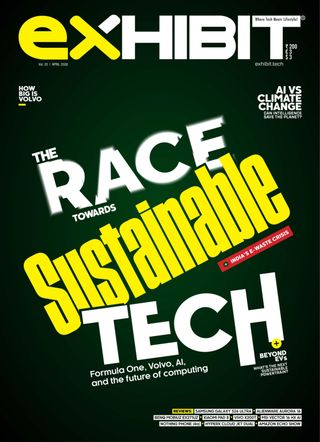

Diese Geschichte stammt aus der April 2026-Ausgabe von Exhibit.
Abonnieren Sie Magzter GOLD, um auf Tausende kuratierter Premium-Geschichten und über 9.000 Zeitschriften und Zeitungen zuzugreifen.
Sie sind bereits Abonnent? Anmelden
WEITERE GESCHICHTEN VON Exhibit

Exhibit
BEYOND EVS
The Race for the Next Sustainable Powertrain

5 mins
April 2026

Exhibit
HOW SUSTAINABILITY IS SHAPING FORMULA 1
Sustainability enters the fast lane
3 mins
April 2026

Exhibit
TATA ALTROZ LONG-TERM REVIEW SETTLING INTO THE DAILY RHYTHM
Living with the Tata Altroz in its Accomplished Plus (Petrol DCA) guise has been a reminder of how quickly a car can become part of your daily routine when the fundamentals are right.
2 mins
April 2026

Exhibit
A BLUETOOTH HELMET THAT SWIPES BACK
Bluetooth-enabled helmets have quietly carved out a niche in the riding gear space over the past few years.
2 mins
April 2026

Exhibit
WATER TECH 2.0: INDIA'S NEW INFRASTRUCTURE GOLD RUSH
A new generation of Indian startups is turning water infrastructure into intelligent, data-driven technology platforms.
4 mins
April 2026

Exhibit
TATA PUNCH EV
Range, reality and restraint, driving Tata's latest electric commuter
3 mins
April 2026
Exhibit
AI IMPACT SUMMIT 2026 A DEFINING MOMENT FOR INDIA'S AI LEADERSHIP
How New Delhi became the centre of global artificial intelligence policy, innovation, investment and debate
5 mins
April 2026

Exhibit
THE RIGHT TO REPAIR
Fixing What's Broken in Our Throwaway World
4 mins
April 2026

Exhibit
HOW BIG IS VOLVO?
The Swedish giant redefining sustainable mobility
7 mins
April 2026

Exhibit
Can Gadgets Ever Be Truly Sustainable
Exploring the Environmental Cost of Technology and the Race Toward Greener Electronics
7 mins
April 2026
Listen
Translate
Change font size