Versuchen GOLD - Frei
BESS becoming the backbone of power capacity additions
EPR Magazine (Electrical & Power Review)
|December 2025
India is undergoing a rapid clean energy revolution, aiming to deploy 500 GW of non-fossil capacity by 2030, of which it has already reached 250 GW. The country has pledged to reduce the emission intensity of its GDP by 45 percent by 2030, relative to 2005 levels. The incorporation of a significant amount of variable and intermittent renewable energy into the energy mix presents a challenge for maintaining grid stability and an uninterrupted power supply. The challenge with renewable energy sources arises from their varying nature over time, climate, seasons, or geographic location.
-
The growth in power capacity has exposed critical grid stress points: Curtailment and congestion: Many states are experiencing curtailment of solar output, resulting in financial losses largely due to grid bottlenecks.
Balancing and flexibility gaps: With solar surging midday and demand peaking in the evening, coal plants are forced to ramp down and then ramp back up, reducing efficiency and lifespan. To address this, India is piloting BESS at coal plants to absorb excess solar energy during midday and release it later.
Storage mismatch: Current battery storage is minimal, falling drastically short of the estimated 61 GW by 2030 and 97 GW by 2032 needed. (Refer figure 1)
Cost and efficiency imperative: Yet, storage is becoming increasingly viable. Projects combining solar and storage now deliver firm power at ₹3-3.5/kWh and, with battery prices down 65 percent since 2021, co-located systems are cheaper and quicker to build than new thermal plants.
The details of India's total installed capacity as of August 2025 are shown in Table 1 below.
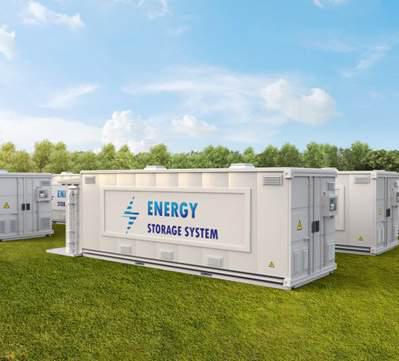
Energy Storage Systems (ESS) can store energy from renewable sources and be used during peak hours of the day.
Battery Energy Storage System (BESS)
A Battery Energy Storage System (BESS) is a technology that stores electrical energy as chemical energy and releases it when needed. It plays a vital role in modern power systems, particularly in integrating renewable energy sources such as solar and wind.
Purpose of BESS
BESS provides several key functions: Energy arbitrage - storing energy during low-demand (cheap) periods and supplying it during high-demand (expensive) periods.
Grid stability and frequency regulation - balancing supply and demand to maintain grid frequency.
Backup power - ensuring uninterrupted power during outages.
Battery cells/modules: The core component where energy is stored chemically.


Diese Geschichte stammt aus der December 2025-Ausgabe von EPR Magazine (Electrical & Power Review).
Abonnieren Sie Magzter GOLD, um auf Tausende kuratierter Premium-Geschichten und über 9.000 Zeitschriften und Zeitungen zuzugreifen.
Sie sind bereits Abonnent? Anmelden
WEITERE GESCHICHTEN VON EPR Magazine (Electrical & Power Review)

EPR Magazine (Electrical & Power Review)
Wirepas certification a major step toward India's upcoming phase of AMI deployments
The Wirepas Certified programme is a major advancement for India's massive AMI deployments. This affirms device suitability for the diverse and challenging environments in the country. Teppo Hemiä, CEO of Wirepas discusses more with EPR.

2 mins
December 2025
EPR Magazine (Electrical & Power Review)
BESS becoming the backbone of power capacity additions
India is undergoing a rapid clean energy revolution, aiming to deploy 500 GW of non-fossil capacity by 2030, of which it has already reached 250 GW.
6 mins
December 2025

EPR Magazine (Electrical & Power Review)
Transformer industry undergoes evolution to meet capacity addition
The projected increase of over 433,000 MVA in substation capacity nationwide has served as a guiding force for the transformer sector. Amit Varshney shares his expertise in talks with EPR.
3 mins
December 2025

EPR Magazine (Electrical & Power Review)
RenewSys elevates solar module reliability with advanced encapsulant technologies
To enhance the efficiency and reliability of its products, RenewSys has introduced advanced encapsulants and backsheets, including AA EVA (Anti-Acid) to combat internal corrosion, ENT POE to guarantee PID-free performance, and environmentally friendly options like the Green Backsheet.
2 mins
December 2025
EPR Magazine (Electrical & Power Review)
REC facilitates MoU between MePDCL and CPRI for quality testing in Meghalaya
REC Limited, a Maharatna Public Sector Enterprise under the Ministry of Power and a leading NBFC, has successfully mediated a crucial Memorandum of Understanding (MoU) between Meghalaya Power Distribution Corporation Limited (MePDCL) and the Central Power Research Institute (CPRI).
1 min
December 2025

EPR Magazine (Electrical & Power Review)
SECI, Andhra finalise 1200 MWh BESS and 50 MW hybrid project
Solar Energy Corporation of India Limited (SECI), a Navratna CPSU under the Ministry of New & Renewable Energy (MNRE), Government of India, has exchanged Government Orders (GOs) with the Government of Andhra Pradesh for the development of a 1200 MWh Battery Energy Storage System (BESS) at Nandyal and a 50 MW Hybrid Solar Project.
1 min
December 2025

EPR Magazine (Electrical & Power Review)
Convergence of digitalisation, automation, and electrification is the foundation of next-gen infra
Panasonic Life Solutions India is on a mission to contribute to reliable, sustainable electrification across various sectors in the country. Shahab Naqvi shares insights about the company's strategies in talks with EPR. Let us know more from him.
3 mins
December 2025

EPR Magazine (Electrical & Power Review)
FY26 to attract $20-25 bn in renewable investments in India
The renewable energy sector in India has just hit a turning point. Between April and August 2025, the country added a record 20.1 gigawatts (GW) of renewable power capacity, a 123 per cent increase compared to the same period last year, when additions totalled just 9 GW. According to data from the Ministry of New and Renewable Energy (MNRE) and market observers like ICRA, this pace positions India to cross 35 GW of new capacity by the end of FY26, the highest annual addition in its clean-energy history.
3 mins
December 2025

EPR Magazine (Electrical & Power Review)
Wirepas certification a major step toward India's upcoming phase of AMI deployments
This certification provides DISCOMs and AMISPs with confidence that a device has passed the toughest real-world tests for scalability, interoperability and reliability.
2 mins
December 2025
EPR Magazine (Electrical & Power Review)
Renewable surge strains the grid as storage strengthens stability
The CEA mandates co-located ESS (approx. 2 hours) for new solar projects, aiming to reach 60 GW of storage by FY 2032 (including 42 GW of BESS and 19 GW of pumped hydro).
3 mins
December 2025
Listen
Translate
Change font size