Versuchen GOLD - Frei
MASTER THE UNIVERSE
The Week Junior Science+Nature UK
|April 2025
Stuart Dredge tells the blockbusting story of the computer game Minecraft, and discovers how its creators put the power to create epic worlds at your fingertips.
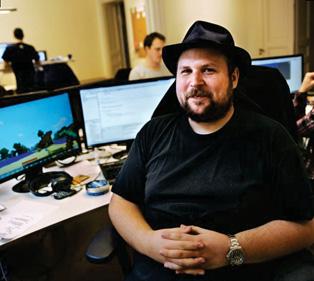
In 2009, Swedish games developer Markus "Notch" Persson posted on an internet forum about a new game he was working on. He called it "Cave Game" and Notch wanted people to try it out and tell him what they thought. Although the game only included grass and cobblestone blocks, it was the first-ever version of Minecraft. From this quiet beginning, a massive success story began.
From its official release in November 2011, Minecraft was a hit, and its popularity has lasted.
Minecraft has sold more than 300 million copies across consoles, PCs and mobile devices. It has also spawned spin-off games, including Minecraft Dungeons and Minecraft Legends, and has been made into Lego kits, plushies, pyjamas and even remote-controlled flying Ghasts. This April, the first official Minecraft film will be hitting cinemas around the UK.
No limits
Minecraft is what's known as a sandbox game. This means that instead of following a set path or storyline, you can play creatively at your own pace. In this instance, the game gives you the power to build epic worlds out of blocks.
In Creative Mode, you can build with infinite blocks, while not having to worry about being killed or hurt by mobs (monsters). There are no limits set by the game's programming, beyond the basic physics that is coded into the Minecraft universe.
Survival Mode does have goals - to collect resources and fight (or avoid) mobs, and eventually reach "The End" to defeat the game's "Ender dragon" boss.
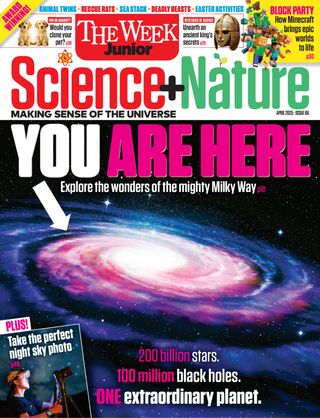

Diese Geschichte stammt aus der April 2025-Ausgabe von The Week Junior Science+Nature UK.
Abonnieren Sie Magzter GOLD, um auf Tausende kuratierter Premium-Geschichten und über 9.000 Zeitschriften und Zeitungen zuzugreifen.
Sie sind bereits Abonnent? Anmelden
WEITERE GESCHICHTEN VON The Week Junior Science+Nature UK

The Week Junior Science+Nature UK
Girl rescues rare axolotl
When 10-year-old Evie Hill told her mother that she'd seen an axolotl while she was playing under a bridge in Wales, her mum thought it was probably just a newt.

1 min
June 2026

The Week Junior Science+Nature UK
Why do people have baby teeth and adult teeth?
Your jaw changes size as you grow, which is why you need two sets of teeth.
3 mins
June 2026

The Week Junior Science+Nature UK
MISSION TO THE MOON
The successful Artemis 2 mission has launched an exciting new age of space exploration. Climb on board the tiny capsule with Daisy Dobrijevic as we blast off to the Moon.
5 mins
June 2026

The Week Junior Science+Nature UK
Bot is a table tennis ace
A robot called Ace is beating some of the world's best table tennis players.
1 min
June 2026
The Week Junior Science+Nature UK
Wildlife watch
As summer starts, Jenny Ackland takes a walk on the wild side to spot nature’s best wonders.
1 mins
June 2026

The Week Junior Science+Nature UK
Looking after the ocean
Hop on board a floating lab that protects the blue planet.
1 mins
June 2026

The Week Junior Science+Nature UK
Saffie's sight restored
And new therapy has helped a six-yearold girl from Stevenage, England, to see better.
1 min
June 2026
The Week Junior Science+Nature UK
Can we send our rubbish into space?
If we run out of room for our trash, is sending it into space the answer? You decide.
1 mins
June 2026
The Week Junior Science+Nature UK
Into the deep
Join Matt Ralphs on a journey to the dark, cold and mysterious depths of the ocean.
5 mins
June 2026

The Week Junior Science+Nature UK
Who killed Ötzi the Iceman?
We're on the trail of a killer in the Alps. Let's investigate one of history's coldest cases.
2 mins
June 2026
Listen
Translate
Change font size