
Mit Magzter GOLD unbegrenztes Potenzial nutzen
Erhalten Sie unbegrenzten Zugriff auf über 9.000 Zeitschriften, Zeitungen und Premium-Artikel für nur
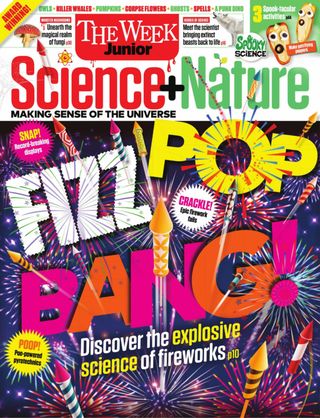
FIZZ POP BANG!
The Week Junior Science+Nature UK
|November 2025
Peter Gallivan explores the explosive power of fireworks. It's going to go with a bang!
-
Picture the scene: a large crowd gathers Plooking expectantly up at a clear and dark sky. Suddenly, with a deafening bang, the sky explodes in a burst of colours. The crowd “oohs” and “aahs”, because watching a firework display is breathtaking. While modern rockets produce a riot of colours, the basic mixture of chemicals inside them is more or less the same as it was 1,000 years ago.
Lucky accidents
The earliest fireworks were created around AD800 in China. The story goes that they were invented by someone who was trying to create a potion for eternal life, but instead ended up with an exploding mixture. These first bangers were powered by poop. They contained three chemicals - potassium nitrate, which was extracted from animal dung and human poo, charcoal (from burnt wood) and sulfur (an element that occurs naturally in rocks). The potassium nitrate was scraped off the side of communal toilets. When packed inside a hollow bamboo tube and set alight, this poo-powered mixture exploded with a loud and smoky (and probably quite smelly) bang.
The mixture, called black powder, forms the basis of all modern fireworks. It is made up of 75% potassium nitrate, 15% charcoal and 10% sulfur. Setting fire to a pile of black powder gives a little bit of a surprising result. You get a quick flash of fire and a quiet fizz - definitely not the loud bang associated with a firework. The boom only happens if the black powder is packed inside something - in the case of a rocket this is usually a thick cardboard tube.
Explosive chemistry

Diese Geschichte stammt aus der November 2025-Ausgabe von The Week Junior Science+Nature UK.
Abonnieren Sie Magzter GOLD, um auf Tausende kuratierter Premium-Geschichten und über 9.000 Zeitschriften und Zeitungen zuzugreifen.
Sie sind bereits Abonnent? Anmelden
WEITERE GESCHICHTEN VON The Week Junior Science+Nature UK

The Week Junior Science+Nature UK
FIGHTING THE FREEZE
Claire Karwowski uncovers nature's wildest ways of fighting the winter freeze.

6 mins
Christmas 2025
The Week Junior Science+Nature UK
Cook up bioplastic decorations
Make your own eco-friendly ornaments.
1 min
Christmas 2025

The Week Junior Science+Nature UK
Should we switch off Christmas lights?
They brighten up the festive season, but they can have a negative impact on the environment.
1 mins
Christmas 2025
The Week Junior Science+Nature UK
Three spectacular illuminations
Glow Wild, Wakehurst
1 min
Christmas 2025

The Week Junior Science+Nature UK
THE LAST DAYS OF POMPEII
For the first time, an immersive exhibition about the destruction of the ancient Roman city of Pompeii has opened in London.
1 min
Christmas 2025
The Week Junior Science+Nature UK
Wildlife watch
Jenny Ackland unveils a winter wonderland of natural delights this festive season.
1 mins
Christmas 2025
The Week Junior Science+Nature UK
Make Snow globes
Create the perfect Christmas gift.
1 min
Christmas 2025

The Week Junior Science+Nature UK
Maggie Aderin-Pocock
Meet the scientist \"blasting off into space\" at the Christmas Lectures.
3 mins
Christmas 2025
The Week Junior Science+Nature UK
Make vegan eggnog
Whip up a dairy-free festive winter warmer that is perfect for cold nights.
1 min
Christmas 2025
The Week Junior Science+Nature UK
Octopuses
Meet the colour-changing, shape-shifting, fortune-telling aliens of the seas.
2 mins
Christmas 2025
Listen
Translate
Change font size