Versuchen GOLD - Frei
Your Al Therapist
Scientific American
|November 2025
The dangers of using artificial-intelligence chatbots for therapy
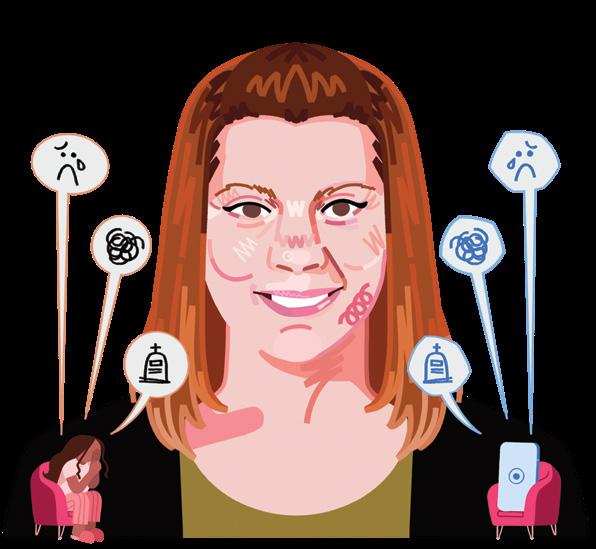
ARTIFICIAL-INTELLIGENCE CHATBOTS don't judge. Tell them the most private, vulnerable details of your life, and most of them will validate you and possibly even provide advice. For this reason, many people are turning to applications such as OpenAI's ChatGPT for life guidance.
But AI "therapy" comes with significant risks. In late July, OpenAI CEO Sam Altman warned ChatGPT users against using the chatbot as a "therapist" because of privacy concerns. The American Psychological Association (APA) has claimed that AI chatbot companies and their products are using "deceptive practices" by "passing themselves off as trained mental health providers." It has called on the Federal Trade Commission to investigate them, citing two ongoing lawsuits in which parents alleged that chatbots brought harm to their children. In some of these high-profile cases, parents allege that their child committed suicide following conversations with an AI.
"What stands out to me is just how humanlike it sounds," says C. Vaile Wright, a licensed psychologist and senior director of the APA's Office of Health Care Innovation, which focuses on the safe and effective use of technology in mental health care. "The level of sophistication of the technology, even relative to six to 12 months ago, is pretty staggering. And I can appreciate how people kind of fall down a rabbit hole."
SCIENTIFIC AMERICAN spoke with Wright about how AI chatbots used for therapy could potentially be dangerous and whether it is possible to engineer one that is reliably both helpful and safe. An edited transcript of the interview follows.
What have you seen happening with AI in the world of mental health care in the past few years?


Diese Geschichte stammt aus der November 2025-Ausgabe von Scientific American.
Abonnieren Sie Magzter GOLD, um auf Tausende kuratierter Premium-Geschichten und über 9.000 Zeitschriften und Zeitungen zuzugreifen.
Sie sind bereits Abonnent? Anmelden
WEITERE GESCHICHTEN VON Scientific American

Scientific American
Dirty Little Secrets
Extremophile molds are invading art museums and devouring their collections. Stigma and climate change have fueled their spread

16 mins
February 2026
Scientific American
Archaeology Is Reviving the Smell of History
How reconstructing long-lost smells connects us to the past
6 mins
February 2026

Scientific American
Heal Injuries Faster
Toss out the old advice that rest is the best recovery strategy
4 mins
February 2026

Scientific American
Can a Time Capsule Outlast Geology?
A ridiculous but instructive thought experiment involving deep time, plate tectonics, erosion and the slow death of the sun
17 mins
February 2026

Scientific American
Fiery Amoeba
A newfound organism thrives in record-breaking heat
2 mins
February 2026

Scientific American
50, 100 & 150 Years
GIANT ATOMS
3 mins
February 2026

Scientific American
Nature's Tile Shop
Life keeps evolving these geometric patterns
2 mins
February 2026
Scientific American
Battle of the Breeds
A large dataset shows that some dog stereotypes are based in reality, and others might be unfair characterizations
1 min
February 2026

Scientific American
The Milky Way's Disk Keeps Getting Weirder
The disk of our galaxy is not flat but warped and waving
5 mins
February 2026
Scientific American
A Winning Loser
If the cards shown here are rearranged to form four new poker hands of five cards each, what is the low- est possible winning or tying hand?
1 min
February 2026
Listen
Translate
Change font size