Versuchen GOLD - Frei
Small Acts of Joy Bring Big Gains
Scientific American
|December 2025
A community science project finds that modest reminders to find joy in the day can have benefits on a par with those of more ambitious well-being interventions

THERE IS NO SHORTAGE of programs or practices that promise to increase happiness. People may meditate for 30 minutes every morning, block off full evenings to deeply connect with close friends or commit to a 12-week daily gratitude journaling exercise. Some of these activities, which emerged from the field of positive psychology, can reliably and sustainably boost psychological well-being, a technical term for happiness. But let's be honest. Most people feel too busy, tired or overwhelmed to add on—and then keep up with—new and demanding routines in day-to-day life.
What if finding more happiness did not require a major time commitment or lifestyle overhaul? What if instead it could come from simple, brief actions such as texting a genuine “thank you” to a colleague, asking a friend to share something that made them feel proud, looking at the sky's vastness with wonder or marveling at the intricate details of a wildflower?
We set out to explore this question by investigating whether brief daily activities, or “micro acts,” can affect overall happiness in life. We also aimed to investigate how doing happiness-promoting micro acts might ripple outward in ways that enhance mutual care, compassion and generosity.
Our research began as a spin-off from the 2021 film Mission: Joy—Finding Happiness in Troubled Times, in which the 14th Dalai Lama and the late archbishop Desmond Tutu talk about their friendship and offer lessons on creating joy for oneself and others regardless of circumstances. Producer and co-director Peggy Callahan and impact producer Jolene Smith teamed up with psychologist Elissa Epel and one of us (Simon-Thomas) to develop a meaningful way for people to act on the film's messages.
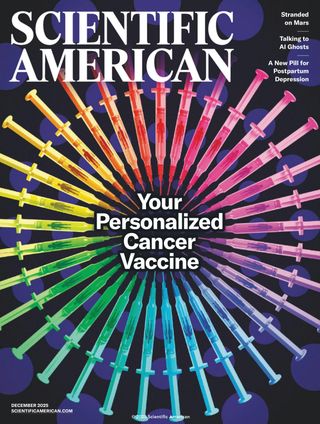

Diese Geschichte stammt aus der December 2025-Ausgabe von Scientific American.
Abonnieren Sie Magzter GOLD, um auf Tausende kuratierter Premium-Geschichten und über 9.000 Zeitschriften und Zeitungen zuzugreifen.
Sie sind bereits Abonnent? Anmelden
WEITERE GESCHICHTEN VON Scientific American

Scientific American
Probiotic Hope and Hype
Despite their popularity, supplements with billions of \"good\" microbes help only a few illnesses, research shows

3 mins
January 2026

Scientific American
Mondays Really Are More Stressful
The start of the workweek can be a biologically measurable stressor, with consequences for long-term health that can stretch into retirement
4 mins
January 2026
Scientific American
Tiny Display
An e-paper breakthrough brings extremely high-resolution color
2 mins
January 2026
Scientific American
Fine-Feathered Snack
A bat's tracker documents a dramatic midair hunt
2 mins
January 2026

Scientific American
OUR ROBOTIC PICTURE
Will mechanical helpers ever be commonplace at home, at work and beyond?
11 mins
January 2026

Scientific American
"Use Your Words" Can Be Good for Kids' Health
Writing or expressing feelings can help adults mentally and physically. Kids are no different
5 mins
January 2026

Scientific American
Distant Diplomacy
Unrelated species “talk” and understand one another to avoid threats
2 mins
January 2026
Scientific American
Behind the Nobel
A 2025 winner reflects on the mysterious T cells that won him the prize
5 mins
January 2026
Scientific American
A Suite of Killers
Heart ailments, kidney diseases and type 2 diabetes actually may be part of just one condition. It's called CKM syndrome
10 mins
January 2026
Scientific American
Static Launch
Tiny worms leap toward their fruit fly hosts with an electric “tractor beam”
3 mins
January 2026
Listen
Translate
Change font size