Versuchen GOLD - Frei
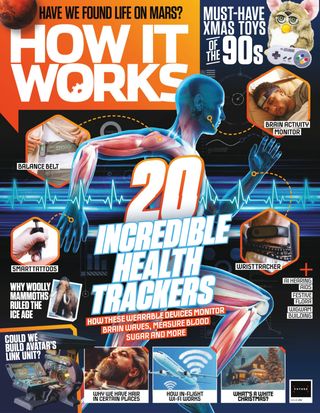
COULD WE BUILD... AVATAR'S LINK UNIT?
How It Works UK
|Issue 210
Projecting our consciousness into other bodies and walking on alien worlds might not be such a far-flung concept
What will the world look like in 2154? Will we have depleted resources here on Earth and need to board interstellar spaceships to hunt for new ones, much like the Resources Development Administration (RDA) in James Cameron's record-breaking movie Avatar? Journeying to the fantastical landscape of Pandora, a fictional moon found in the very real Alpha Centauri system around 4.3 light years away, the RDA seeks out a rare and highly coveted material called unobtanium.
In Cameron's cinematic universe, unobtanium is a room-temperature superconductor. On Earth, superconductors are used to make powerful magnets and computer chips. In normal metals, flowing electrons collide with metal atoms and lose their energy, referred to as electrical resistance. In a superconductor, those electrons couple up to form what's referred to as 'Cooper pairs', which prevent collisions for the most efficient power transmission and generation of magnetic fields. However, real-world superconductors need to be cooled close to absolute zero at -269 degrees Celsius to have zero electrical resistance. While Earth boasts many different superconductors, such as rare-earth barium copper oxide, one that offers zero electrical resistance at room temperature does not yet exist. But we are getting closer to making one. In April 2025, a group of international researchers found a new superconducting state called Cooper-pair density modulation. The phenomenon shows areas where there are 'energy gaps' in possible materials that could one day be exploited to make superconductors.

Diese Geschichte stammt aus der Issue 210-Ausgabe von How It Works UK.
Abonnieren Sie Magzter GOLD, um auf Tausende kuratierter Premium-Geschichten und über 9.000 Zeitschriften und Zeitungen zuzugreifen.
Sie sind bereits Abonnent? Anmelden
WEITERE GESCHICHTEN VON How It Works UK

How It Works UK
20 WEARABLE HEALTH TRACKERS
Whether you strap a wellness coach to your wrist or weave subtle sensors into your clothes, these devices are revolutionising how we track our health

9 mins
Issue 210
How It Works UK
SUPERPOWERED PLANTS
The world of plants is vibrant and diverse, just like this book.
1 min
Issue 210
How It Works UK
SECRET STORIES OF LOST BEASTS
We're all aware of the mighty dinosaurs that once roamed Earth, but there are so many weird and wonderful species that have been lost to time.
1 min
Issue 210

How It Works UK
ALL ABOUT BLIMPS
Is it a bird? Is it a spaceship? No... it's a non-rigid airship
2 mins
Issue 210
How It Works UK
SUPER QUESTERS MISSION: RAINFOREST MAGIC
Join adventurers Leo, Lilli and Bea as they transform into superheroes and journey to the rainforest in the pursuit of knowledge.
1 min
Issue 210
How It Works UK
HOW THE MIGHTY MAMMOTH RULED THE ICE AGE
Meet the prehistoric giants that roamed the Arctic Circle thousands of years ago
4 mins
Issue 210
How It Works UK
Have they found LIFE ON MARS?
Although it's by no means certain, scientists are slowly accumulating evidence that life once existed on the Red Planet
2 mins
Issue 210
How It Works UK
HOW FAST DO GLACIERS MOVE?
The speed at which a glacier flows depends on its mass, the depth and slope of the underlying rock bed and friction.
1 min
Issue 210

How It Works UK
HOW IN-FLIGHT WI-FI WORKS
This technology allows you to scroll to your heart's content while killing time at cruise altitude
3 mins
Issue 210
How It Works UK
HOW WIGWAMS WERE BUILT
Discover the construction and living conditions inside these traditional domed dwellings
1 mins
Issue 210
Listen
Translate
Change font size