
Mit Magzter GOLD unbegrenztes Potenzial nutzen
Erhalten Sie unbegrenzten Zugriff auf über 9.000 Zeitschriften, Zeitungen und Premium-Artikel für nur
Versuchen GOLD - Frei
WATER SCARREDCITY
Down To Earth
|April 01, 2024
Bengaluru's water crisis was long in the making. The city has grown at the cost of its lakes and ponds that are key to its water security. Over 93 per cent of the city is built-up, which makes groundwater recharge difficult. Inadequate sewage systems pollute the limited water available. Over the decades, the city has become dependent on the Cauvery, 100 km away, for 70 per cent of its water needs. This makes water unaffordable. It's time Bengaluru broadened its water resource base beyond the Cauvery and focused on recharging groundwater and reusing treated wastewater.

SAUBHAGYA MISHRA, who works for an outsourcing major in Karnataka's capital city Bengaluru, manages distribution mechanism for many water utilities in Australia and the US. "I have coded flawless mechanism to deliver water to thousands of houses thousands of kilometres away from here. But in February, I got a notice from my apartment management informing complete cessation of water supply. This was a first for me," he says. "Without water, what supply solution can one think of?" he says.
In mid-March, Mishra sent his wife and daughter to their hometown Lucknow, Uttar Pradesh. With the family gone, he could bring down water use by two-thirds. He somehow procures 10-15 litres of "mineral water" from a vendor daily that he uses for all purposes. But he has worries: "How long the crisis would continue? More importantly, why did it happen?"
India's prime information-technology hub and the country's third most populated city, Bengaluru is facing its worst water shortage. On March 18, after a high-level meeting on the crisis, Karnataka Chief Minister Siddaramaiah told the media that the city was facing a water shortage of 500 million litres per day (MLD) against a daily demand of 2,600 MLD. Of the 14,000 government-registered borewells in Bengaluru, some 6,900 had dried, said Siddaramaiah.
A total of 257 areas in the city have been identified as water stressed. Besides, 55 of 110 villages under the Bruhat Bengaluru Mahanagara Palike (BBMP) face water crisis.
A week before, on March 12, the Bangalore Water Supply and Sewerage Board (BWSSB) reduced water supply to major consumers companies, hospitals, railways and airports in the city by 20 per cent. Previously, it had been supplying them 95-100 per cent of their allotted quota of water.
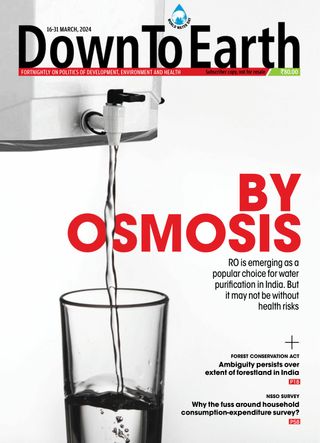

Diese Geschichte stammt aus der April 01, 2024-Ausgabe von Down To Earth.
Abonnieren Sie Magzter GOLD, um auf Tausende kuratierter Premium-Geschichten und über 9.000 Zeitschriften und Zeitungen zuzugreifen.
Sie sind bereits Abonnent? Anmelden
WEITERE GESCHICHTEN VON Down To Earth

Down To Earth
THINK TWICE BEFORE FELLING SAL TREES
Many trees considered to be affected by sal borer in the 1990s are still alive today

1 mins
February 16, 2026
Down To Earth
EDGE OF SURVIVAL
Caste divides deny marginalised communities land, resources and essential aid, leaving them more vulnerable to climate disasters
6 mins
February 16, 2026

Down To Earth
A WISH LIST?
Union Budget for 2026-27 conveys the impression of a roll-call of intentions and ambitious proposals, with little detail on their formulation
6 mins
February 16, 2026
Down To Earth
Break down the gender wall
THE RULING National Democratic Alliance (NDA) government has been heavily invested in the goal to make India a developed economy by 2047.
2 mins
February 16, 2026

Down To Earth
MENSTRUAL HEALTH, NOW A FUNDAMENTAL RIGHT
In a landmark judgement, the Supreme Court has recognised menstrual health and hygiene as a fundamental right under Article 21 of the Constitution of India, which guarantees the right to life and dignity.
8 mins
February 16, 2026

Down To Earth
Of devolution and new disasters
The 16th Finance Commission pushes for changes in view of new fiscal and climatic conditions
11 mins
February 16, 2026
Down To Earth
Rising risks of plastics
NEGATIVE IMPACTS on human health due to emissions linked to the plastic lifecycle could double by 2040, according to a study published in The Lancet Planetary Health in January.
1 min
February 16, 2026

Down To Earth
GAP BETWEEN EPIDEMICS NARROWING
A watershed-based and landscape-level approach is needed to address forest degradation
2 mins
February 16, 2026
Down To Earth
WAITING TO STRIKE
Sal heartwood borer is considered the biggest threat to forestry in India, especially to the sal tree, where it lives and breeds.
11 mins
February 16, 2026

Down To Earth
A SPRING DELIGHT
Mustard flowers are not meant only for the eyes. Invite them to your plate once in a while
3 mins
February 16, 2026
Listen
Translate
Change font size