Versuchen GOLD - Frei
SAINTLY GUARDIANS
Down To Earth
|March 01, 2026
For over 20 years, residents of Mudh village in eastern Ladakh have been protecting the ruddy shelduck that visits their mountains to breed
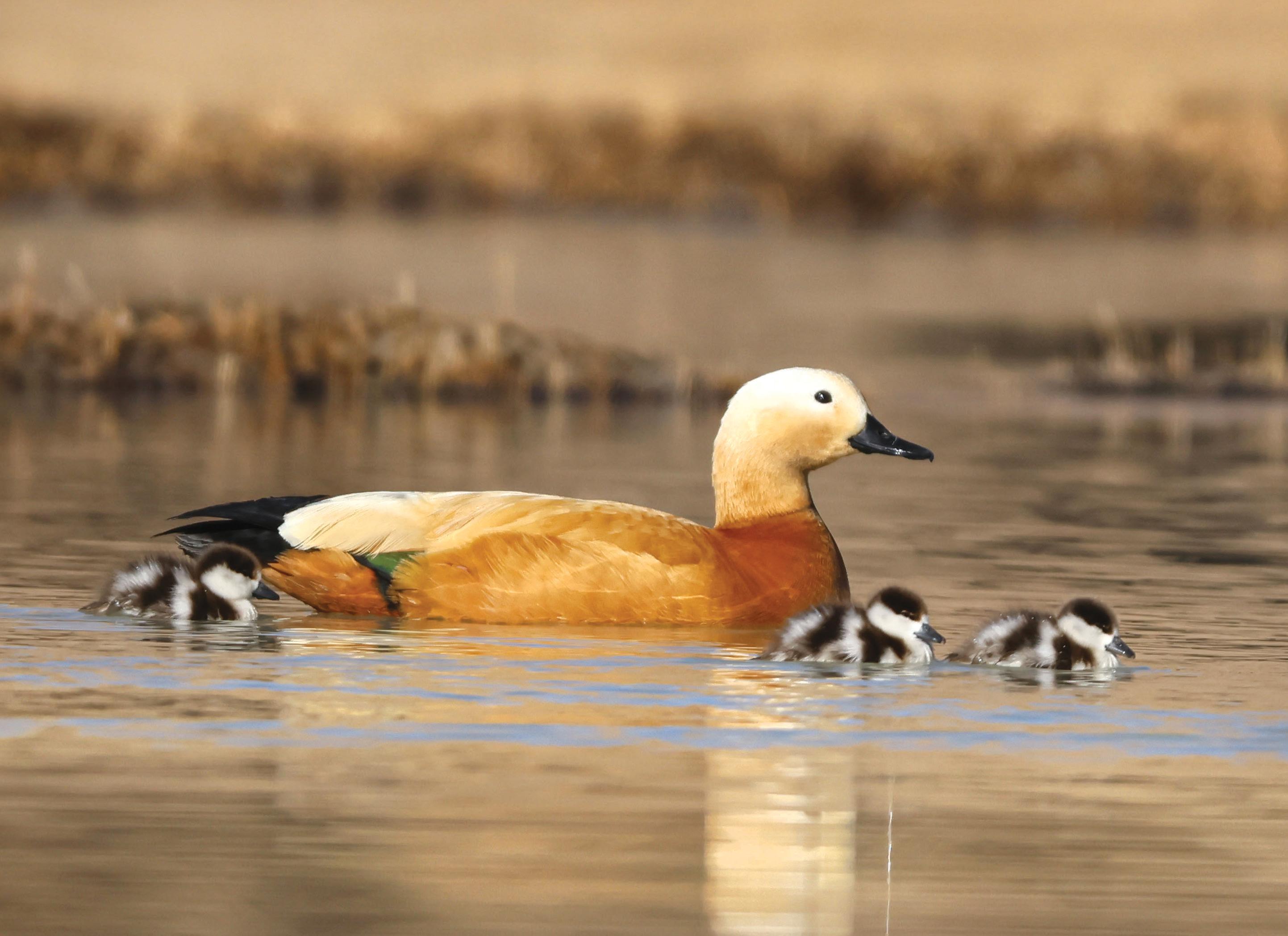
IS a sight any bird enthusiast would consider themselves lucky to behold: A pair of ruddy shelducks, beckoning their young fledglings to follow them to the river.
One adult leads the group, while the other follows. Both have flame-hued feathers and creamy white heads, though the male can be distinguished through a dark ring around its neck. The small, precocial chicks, covered in white and black mottled down, walk in the middle.
This journey occurs in the Mudh valley in Ladakh, from where the ducks go down to the Indus river. The entire journey takes three to six hours, but is sometimes shorter if the fledglings are grown adequately and are able to walk easily. However, it is extremely challenging to witness—just as Cha Tsogspa prefers. For two decades, this group comprising 12 residents from Mudh village, 2 km from the valley, has been keeping an eye on the ruddy shelducks that come to Ladakh, their only breeding site in India, from June to August every year.
“It is on auspicious days that we escort the fledglings from the valley to the Indus river. From there, they cross the river on their own,” explains Thinless Namgyal, vice president of Cha Tsogspa.
Also known as the Brahminy duck or Tadorna ferruginea in scientific lexicon, the ruddy shelduck is found across Europe and Central Asia, migrating to South Asia during the winter months. In the International Union for Conservation of Nature (IUCN) Red List of Threatened Species, the species is classified under “Least Concern”. Cha Tsogspa aims to ensure that this status does not change.


Diese Geschichte stammt aus der March 01, 2026-Ausgabe von Down To Earth.
Abonnieren Sie Magzter GOLD, um auf Tausende kuratierter Premium-Geschichten und über 9.000 Zeitschriften und Zeitungen zuzugreifen.
Sie sind bereits Abonnent? Anmelden
WEITERE GESCHICHTEN VON Down To Earth

Down To Earth
THE GREAT PIVOT
China's moves to transition to clean energy offer critical lessons to India

4 mins
March 01, 2026

Down To Earth
COAL V CORRIDOR
A proposal to mine coal along a corridor that links two tiger reserves in central India is a step away from getting final clearance. The move could affect movement and genetic diversity of tiger populations in the region
8 mins
March 01, 2026

Down To Earth
India's challenging AI predicament
Hobbled by lack of innovation and AI skills in its crucial technology sector, India is focusing on a ruinous plan to host data centres
4 mins
March 01, 2026
Down To Earth
China to implement zero tariffs across Africa
CHINA ON February 14 announced that it will implement zero tariffs for imports from all the 53 African nations it has diplomatic relations with, starting from May 1.
1 min
March 01, 2026
Down To Earth
Poverty, sans the threshold
MEASUREMENT OF poverty is a fundamental exercise, needed to direct development programmes.
2 mins
March 01, 2026

Down To Earth
A bridge across forever
For two decades, a Chhattisgarh village remains stuck in a loop of building temporary river crossings to access markets and sell forest produce
4 mins
March 01, 2026
Down To Earth
Liveable cities need a new model
CRY FOR my Delhi. This is my city—my family records many generations who have lived here.
3 mins
March 01, 2026

Down To Earth
Real impacts of the changing seasons
This refers to the article \"1,500 days, and an alarm for new climate\" (1-15 December, 2025).
1 mins
March 01, 2026

Down To Earth
‘It’s a systematic effort by US to dismantle climate policy’
The US, the world's largest historical emitter of greenhouse gases, has overturned its “endangerment finding”, the legal foundation for regulating emissions under the Clean Air Act since 2009.
4 mins
March 01, 2026
Down To Earth
Amazon turned carbon source in 2023 drought
EXTREME DROUGHT and a prolonged heatwave in 2023 pushed parts of the Amazon rainforest from acting as a carbon sink to becoming a carbon source for three months, according to a February 13 study published in the journal AGU Advances of the American Geophysical Union.
1 min
March 01, 2026
Listen
Translate
Change font size