Versuchen GOLD - Frei
CAN AGROFORESTRY CREDITS BE SAVED?
Down To Earth
|March 01, 2025
Ensure that farmers benefit from the carbon revenue and stay protected against market failure
-
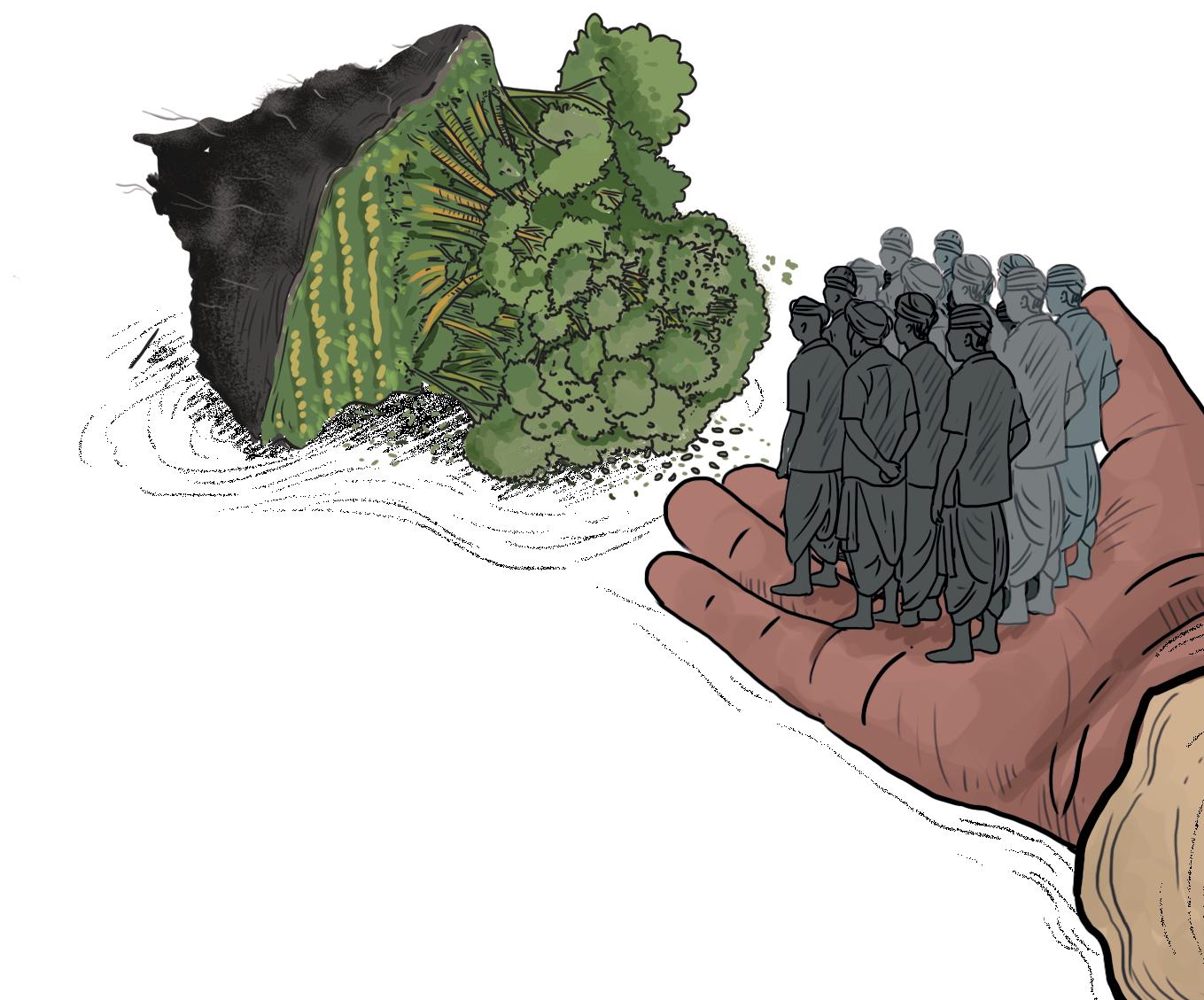
THE INDIAN government is keen on using agroforestry to meet its climate goals, introduce regulation in voluntary carbon market (VCM) projects in the agriculture sector, including agroforestry, and incentivise farmers to switch to sustainable farming practices, Suresh Kumar Chaudhari, deputy director general (natural resource management) at the Indian Council of Agricultural Research (ICAR), tells DTE. "We would like to explore how VCM can be used to meet our Nationally Determined Contributions (NDCS) and sell the rest in the international market," Chaudhari adds.
As per India's NDC, submitted to the UN Framework Convention on Climate Change (UNFCCC), the government aims to create additional carbon sinks of 2.5 to 3 billion tonnes of CO₂e through increased forest and tree cover by 2030. The 2023 India State of Forest Report (ISFR) shows that India's carbon stock in forests and tree cover has reached 30.43 billion tonnes of CO₂e. Compared to the base year of 2005, when the carbon stock was 28.14 billion tonnes CO₂e, the country has created 2.29 billion tonnes of additional carbon sink and "is on track to meet its 2030 target", states the report. The tree green cover under agroforestry, whose share has increased by over 20 per cent between 2013 and 2023, appears to have played a significant role in reaching this goal. Agroforestry is also one of the potential areas for carbon credits in the framework for the domestic VCM in the agriculture sector, introduced by the Union agriculture ministry in January 2024.

Diese Geschichte stammt aus der March 01, 2025-Ausgabe von Down To Earth.
Abonnieren Sie Magzter GOLD, um auf Tausende kuratierter Premium-Geschichten und über 9.000 Zeitschriften und Zeitungen zuzugreifen.
Sie sind bereits Abonnent? Anmelden
WEITERE GESCHICHTEN VON Down To Earth

Down To Earth
BEYOND COLLATERAL DAMAGE
Recent geopolitical conflicts are urging a reconsideration of what constitutes environmental harm in war and the limits of existing legal frameworks

3 mins
April 01, 2026

Down To Earth
Masterstroke
Residents of a small Kerala town reject an inadequate state-led development blueprint and create their own master plan that prioritises protection of historic water systems and urban commons
4 mins
April 01, 2026

Down To Earth
Rethinking E20
It is pertinent to explore potential of ethanol as high-value industrial feedstock
4 mins
April 01, 2026
Down To Earth
Food in the age of climate change
WHEN WE eat, we contribute to climate change. But food is also about livelihoods, about nutrition and about nature.
3 mins
April 01, 2026

Down To Earth
FADING WINTER
India's winters are warming, becoming shorter, shifting and spilling beyond their traditional bounds. The consequences are already evident in meltwater availability, forest-fire intensity and changes in flowering cycles and insect behaviour.
20 mins
April 01, 2026

Down To Earth
War on Iran strikes India's pharmaceuticals sector
Shortages of critical raw materials and rising input costs for the drug industry will have global consequences
4 mins
April 01, 2026

Down To Earth
POWER IN AN AGE OF INSECURITY
Energy transition is no longer solely about emission reduction but also about energy security
3 mins
April 01, 2026
Down To Earth
Re-discovery of fuelwood
THE WEST Asia conflict has made visible a multi-billion dollar energy market in India.
2 mins
April 01, 2026

Down To Earth
A CASE THAT RESHAPED INDIA'S ENVIRONMENT
The case of MC Mehta v Union of India stands as proof that a proactive judiciary can accelerate action even when the executive drags its feet
4 mins
April 01, 2026
Down To Earth
FOREVER DEPENDENT
India depends on global fertiliser supply chains for 70 per cent of its needs, leaving its food security exposed to geopolitical disruptions
6 mins
April 01, 2026
Listen
Translate
Change font size