Versuchen GOLD - Frei
THE SECRETS OF THE INNER EARTH
BBC Science Focus
|April 2025
Deep beneath our feet, at the border between Earth’s core and the mantle above, scientists are discovering a hidden world — another landscape with a surface almost as dynamic, dramatic and diverse as the one we live on
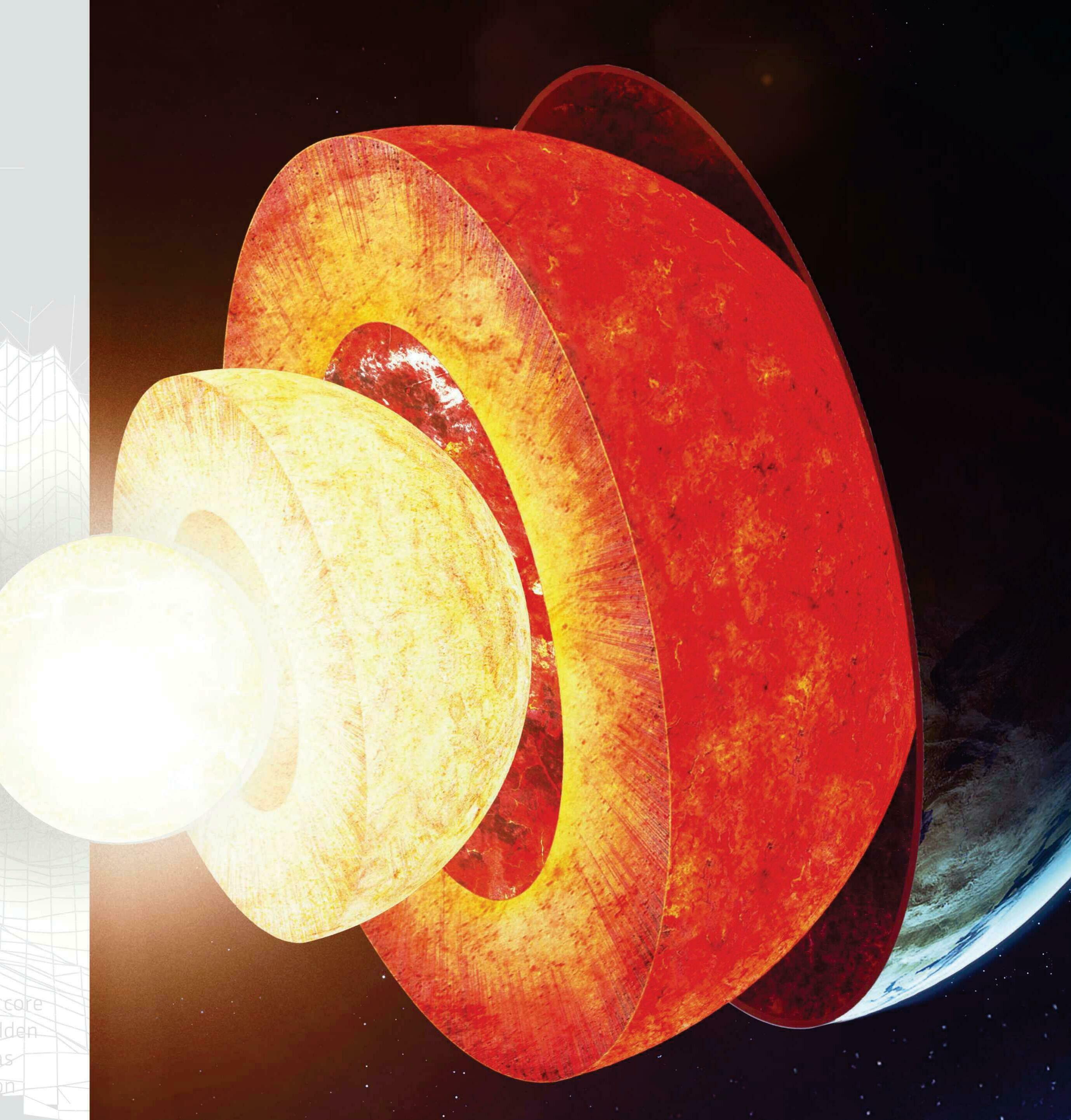
When we learn about Earth’s core at school, it looks like a calm sphere. One that's smooth, unperturbed and as round as a ping-pong ball. It sits cosily at the bottom of several layers that encase one another like a set of nesting dolls.
Of course, we’ve long known that the real picture is a lot more complicated than that. Earth’s iron-rich core generates a magnetic field that’s so strong it projects outwards beyond the planet’s surface and into space. There it reacts with the Sun’s solar winds to reveal what we call the magnetosphere. Our observations of this projection of Earth’s core tell us that it’s constantly moving and nothing like a glowing ping-pong ball.
In fact, recent studies of seismic waves travelling through Earth’s layers paint a picture of the core’s edges so dramatic that it rivals the topology of the surface. Indeed, the core seems to have its own landscape, with mountains, valleys, landslides and perhaps even volcanoes changing the core’s surface as we map it.
Amazingly, studies of seismic waves have revealed giant structures projecting into the lower mantle that are significantly taller than Mount Everest (almost 9km or 5.5 miles). These ‘mountains’ are taller than any of the more traditional — surface — peaks in the Solar System, including the gigantic 22km-high (14 miles) Olympus Mons, a large shield volcano on Mars. The mountains soaring upwards from Earth’s core can reach staggering heights of 1,000km (620 miles). That’s more than 100 times the height of Mount Everest.
As scientists discover the core is a far more tumultuous place than we ever imagined, they’re naturally starting to ask if it has always been like this. That's the key question at the heart of a handful of projects using seismic waves to chart the core’s changing surface. But what’s more exciting is that for every mystery they appear to solve, another anomaly seems to surface in their findings.
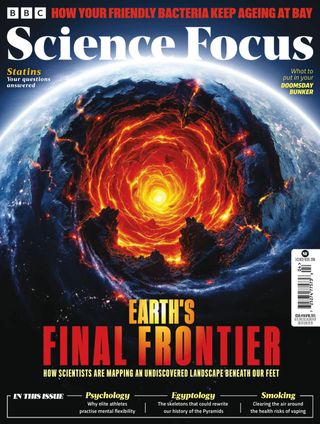

Diese Geschichte stammt aus der April 2025-Ausgabe von BBC Science Focus.
Abonnieren Sie Magzter GOLD, um auf Tausende kuratierter Premium-Geschichten und über 9.000 Zeitschriften und Zeitungen zuzugreifen.
Sie sind bereits Abonnent? Anmelden
WEITERE GESCHICHTEN VON BBC Science Focus

BBC Science Focus
DOES MY DOG HAVE ADHD?
Officially, Attention-Deficit Hyperactivity Disorder (ADHD) is a human condition. People are diagnosed with it. Dogs are not. Yet many of its core features, including hyperactivity, impulsivity and distractibility, can be found in dogs.

1 min
March 2026

BBC Science Focus
DOES MY BRAIN LIVE A LITTLE IN THE PAST?
Yes, your brain does live a little in the past. It can't help it. The information it receives via your senses is always a little out of date. Whether it's light entering the retinas in your eyes, or sounds vibrating the hairs in your ears, it not only takes time for the data to arrive, but your brain then has to process it.
2 mins
March 2026
BBC Science Focus
ASTRONOMY FOR BEGINNERS
RETURN OF THE EVENING STAR (VENUS)
1 mins
March 2026

BBC Science Focus
CAN YOU STOP YOUR SENSE OF TASTE DULLING AS YOU AGE?
Sometimes I hear people say that food just doesn't taste the same as they get older. It's tempting to blame this on age, but there are other factors at play, too.
1 mins
March 2026
BBC Science Focus
MICROBIOMES OF THE SUPERAGERS
BY STUDYING THE INCREASING NUMBER OF PEOPLE WHO ARE LIVING BEYOND THEIR 100TH BIRTHDAYS, SCIENTISTS ARE DISCOVERING THAT THE SECRET TO REACHING A RIPE OLD AGE IN RUDE HEALTH MIGHT LIE IN OUR GUTS
8 mins
March 2026

BBC Science Focus
HOW BIG WERE MEDIEVAL WAR HORSES?
You might picture knights charging into battle on towering steeds, but medieval horses were typically no bigger than modern-day ponies.
1 min
March 2026

BBC Science Focus
FORCES OF HABIT
Could new research on setting up healthy habits resuscitate those stuttering New Year resolutions?
3 mins
March 2026

BBC Science Focus
5 DANGERS HIDING IN YOUR PROCESSED FOOD
We all know that ultra-processed foods are bad for us, but what ingredients should we particularly try to avoid? And what are they doing to our bodies?
9 mins
March 2026
BBC Science Focus
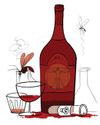
Mosquitoes are becoming thirstier for human blood
Habitat loss may be pushing mosquitoes towards human hosts with deadly consequences
1 mins
March 2026

BBC Science Focus
HOW CAN I GET OVER MY EX?
Relationship breakups can be brutal, just look at the popularity of songs like 'Someone Like You' by Adele, or all the covers of 'Cry Me a River' by Julie London.
1 mins
March 2026
Listen
Translate
Change font size