Versuchen GOLD - Frei
SAY AHHH
BBC Science Focus
|August 2023
EVERY LIVING THING HAS TO EAT SOMEHOW... WHATEVER TYPE OF MOUTH IT MIGHT HAVE. AND THERE ARE SOME TRULY BIZARRE MOUTHS IN THE ANIMAL KINGDOM. SOME OF THE MOST EXTRAORDINARY EXAMPLES ARE ENOUGH TO LEAVE YOU SLACK-JAWED

CAT GOT YOUR TONGUE?
PENGUIN
Penguins are agile predators underwater, zipping around like torpedoes as they chase down fish and squid. But how do they keep their prey from squirming out of their grasp? The answer lies in what the birds already have in their mouths.
A penguin's mouth and tongue are covered in hard, backward-pointing spines called papillae. It's the same feature that makes a cat's tongue feel like sandpaper. But you wouldn't want a penguin to lick you - the spines aren't just large, they're also sharp (a lick from one of these would easily make you bleed). The spines dig into slippery prey and help move it down the bird's throat.
A penguin's tongue is also very muscular, so is probably used to push and manipulate the food in their mouths, like humans. Unlike us, however, penguins can't taste the fish they eat, as they don't have the genes to register sweet, bitter or savoury (umani) flavours. Scientists think that penguins lost their sense of taste because they don't use it: not only do they swallow their food whole, but the proteins needed to send taste signals to the brain malfunction at cold temperatures.
RAPID INFLATION
GULPER EEL
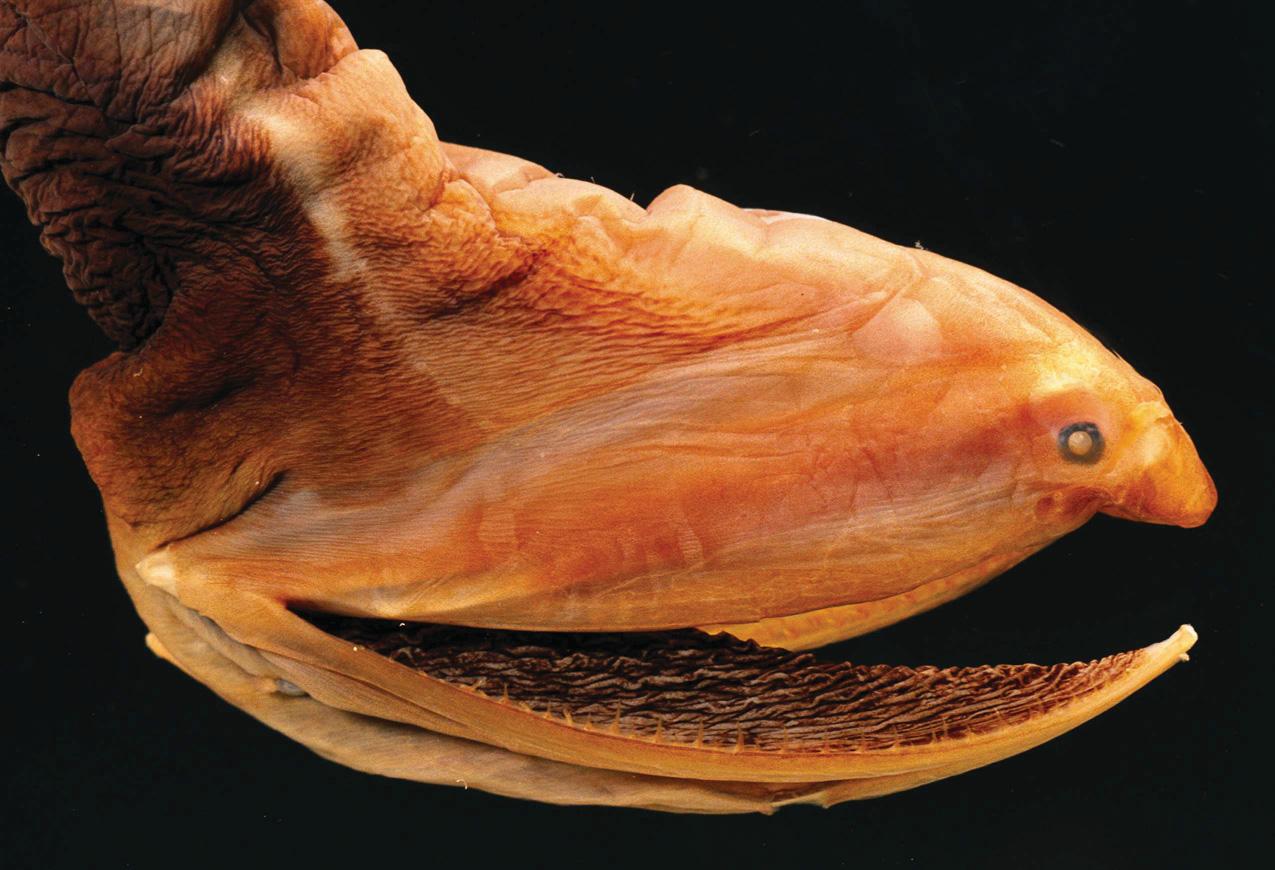
Food is scarce in the deep ocean, so animals living down there have to make every meal count. Few animals take this as seriously as the gulper eel, which is also known as the pelican eel as it shares a similar characteristic with the bird.
The gulper eel has a huge, loose-hinged mouth that's about a quarter of the length of its body. The mouth is paper-thin, fragile and unwieldy, so the eel tucks it away when it's not feeding.


Diese Geschichte stammt aus der August 2023-Ausgabe von BBC Science Focus.
Abonnieren Sie Magzter GOLD, um auf Tausende kuratierter Premium-Geschichten und über 9.000 Zeitschriften und Zeitungen zuzugreifen.
Sie sind bereits Abonnent? Anmelden
WEITERE GESCHICHTEN VON BBC Science Focus
BBC Science Focus
World's biggest cobweb is home to 100,000 spiders
Spiders don't normally create such large colonies, so there's no need to worry about finding one in your basement

1 min
February 2026

BBC Science Focus
A dementia vaccine could be gamechanging – and available already
Getting vaccinated against shingles could protect you from getting dementia, or slow the progression of the disease
1 mins
February 2026

BBC Science Focus
DATA IN SPACE
An unusual spacecraft reached orbit in November 2025, one that might herald the dawn of a new era.
7 mins
February 2026

BBC Science Focus
Climate change is already shrinking your salary
No matter where you live, a new study has found warmer temperatures are picking your pocket
4 mins
February 2026

BBC Science Focus
A MENTAL HEALTH GLOW-UP
Forget fine lines. Could Botox give you an unexpected mental health tweakment?
3 mins
February 2026
BBC Science Focus
Most people with high cholesterol gene don't know they have it
Standard testing struggles to detect the condition
1 mins
February 2026

BBC Science Focus
HOW CAN I BOOST MY IQ?
If you're serious about getting smarter, it's time to ditch the brain-training apps
4 mins
February 2026

BBC Science Focus
Humans are absolutely terrible at reading dogs' emotions
Think you can tell how our furry friends are feeling? Think again
1 mins
February 2026

BBC Science Focus
HOW TO TEACH AI RIGHT FROM WRONG
If we want to get good responses from AI, we may need to see what it does when we ask it to be evil
3 mins
February 2026

BBC Science Focus
What Australia's social media ban could really mean for under-16s
Many people think social media is bad for our kids. Australia is trying to prove it
5 mins
February 2026
Translate
Change font size