
Mit Magzter GOLD unbegrenztes Potenzial nutzen
Erhalten Sie unbegrenzten Zugriff auf über 9.000 Zeitschriften, Zeitungen und Premium-Artikel für nur
Versuchen GOLD - Frei
Satellite collisions are a disaster waiting to happen, experts warn
BBC Science Focus
|October 2024
With satellites old and new orbiting alongside each other, serious crashes are inevitable
-

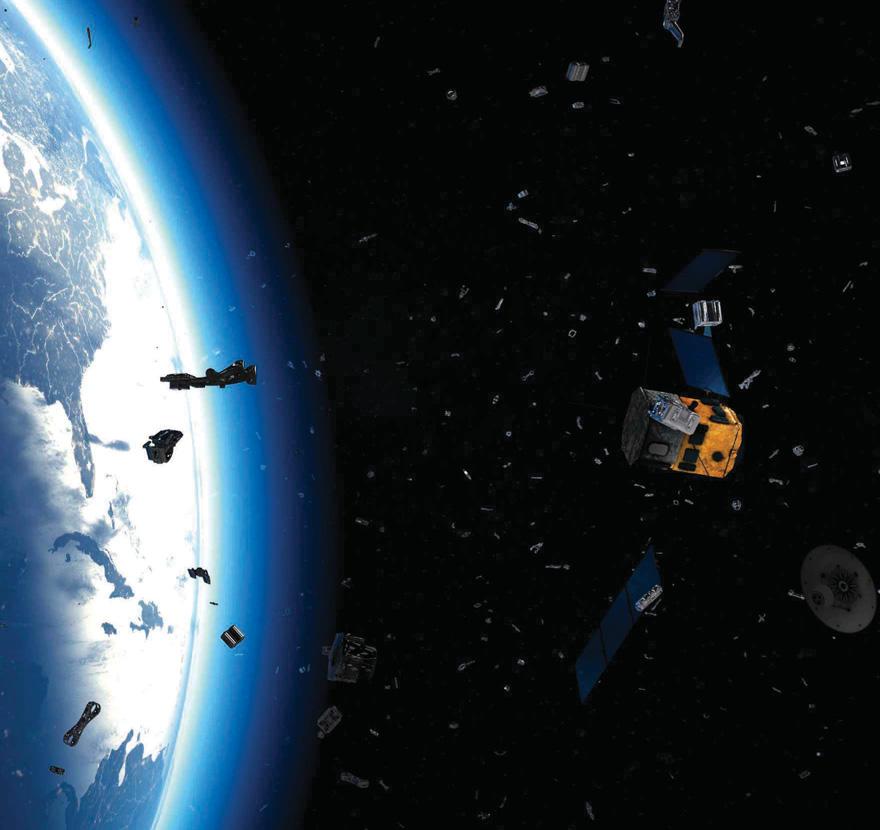
In the first half of 2024, satellites belonging to SpaceX's Starlink fleet. performed almost 50,000 collision-avoidance manoeuvres. This reflects the number of satellites orbiting Earth and raises fears about satellite collisions if we continue to launch more in an unchecked fashion. Considering how much of our telecommunications and navigation now comes from space, not to mention the observation data that informs us about climate change, fears of a catastrophic crash -triggering a loss of such essential services are understandable.
But according to Andy Lawrence, Regius Professor of Astronomy at University of Edinburgh, it's more insidious than that. "This idea that eventually there will be some sort of catastrophe is not quite right. It's more like the infamous 'boiling the frog' problem," he says.
Essentially, the idea is that if a frog were dropped into boiling water, it would instantly leap out.
 But if it were placed into cold water to which heat was gradually applied, it wouldn't perceive the danger and be boiled alive. "It's exactly like climate change. You know it's getting gradually worse, but where do you say 'stop', and how do you manage to make it stop?" says Lawrence.
To circle the Earth, a satellite has to move at a minimum of 7.8km/s (4.8 miles/s). At this velocity, collisions would release an enormous amount of energy, shattering the spacecraft involved and producing large clouds of debris that could destroy other satellites.
Such crashes have already been happening: in 2009, the functioning US satellite Iridium 33 and the inoperable Russian Cosmos 2251 collided at 11.7km/s (7.3 miles/s), producing more than 2,000 pieces of trackable debris and many smaller pieces.

Diese Geschichte stammt aus der October 2024-Ausgabe von BBC Science Focus.
Abonnieren Sie Magzter GOLD, um auf Tausende kuratierter Premium-Geschichten und über 9.000 Zeitschriften und Zeitungen zuzugreifen.
Sie sind bereits Abonnent? Anmelden
WEITERE GESCHICHTEN VON BBC Science Focus
BBC Science Focus
World's biggest cobweb is home to 100,000 spiders
Spiders don't normally create such large colonies, so there's no need to worry about finding one in your basement

1 min
February 2026

BBC Science Focus
A dementia vaccine could be gamechanging – and available already
Getting vaccinated against shingles could protect you from getting dementia, or slow the progression of the disease
1 mins
February 2026

BBC Science Focus
DATA IN SPACE
An unusual spacecraft reached orbit in November 2025, one that might herald the dawn of a new era.
7 mins
February 2026
BBC Science Focus
Climate change is already shrinking your salary
No matter where you live, a new study has found warmer temperatures are picking your pocket
4 mins
February 2026

BBC Science Focus
A MENTAL HEALTH GLOW-UP
Forget fine lines. Could Botox give you an unexpected mental health tweakment?
3 mins
February 2026
BBC Science Focus
Most people with high cholesterol gene don't know they have it
Standard testing struggles to detect the condition
1 mins
February 2026
BBC Science Focus
HOW CAN I BOOST MY IQ?
If you're serious about getting smarter, it's time to ditch the brain-training apps
4 mins
February 2026
BBC Science Focus
Humans are absolutely terrible at reading dogs' emotions
Think you can tell how our furry friends are feeling? Think again
1 mins
February 2026

BBC Science Focus
HOW TO TEACH AI RIGHT FROM WRONG
If we want to get good responses from AI, we may need to see what it does when we ask it to be evil
3 mins
February 2026

BBC Science Focus
What Australia's social media ban could really mean for under-16s
Many people think social media is bad for our kids. Australia is trying to prove it
5 mins
February 2026
Listen
Translate
Change font size