
Mit Magzter GOLD unbegrenztes Potenzial nutzen
Erhalten Sie unbegrenzten Zugriff auf über 9.000 Zeitschriften, Zeitungen und Premium-Artikel für nur
Versuchen GOLD - Frei
A NEW NUCLEAR ARMS-RACE?
Geopolitics
|February 2026
On 5th February 2026, the final remaining nuclear arms control agreement between the United States and Russia, known as the New Strategic Arms Reduction Treaty (New START), expired. Now, for the first time since the early 1970s, there are no legally binding limits on American and Russian strategic nuclear forces.
Considering the situation as really grave, “the Bulletin of the Atomic Scientists” has moved its metaphorical Doomsday Clock another notch toward “midnight” of worldwide catastrophe. It now sits closer than it ever has: 85 seconds to midnight, the closest the Clock has ever been to midnight in its history.
The Doomsday Clock time is annually determined by the Bulletin of the Atomic Scientists’ Science and Security Board (SASB) in consultation with its Board of Sponsors, which includes eight Nobel Laureates. Major factors in 2026 included growing nuclear threats, disruptive technologies such as artificial intelligence (AI), multiple biological security concerns, and the ongoing climate crisis.
The Clock’s time was last changed in January 2025, when the Doomsday Clock was set at 89 seconds to midnight.
Of course, in its statement, DOOMSDAY Clock has talked of many dangerous global developments, but in its list of dangers, “the risks of nuclear war” figure prominently. According to Jon B. Wolfsthal, director of global risk at the Federation of American Scientists (FAS) and SASB member, Bulletin of the Atomic Scientists, “In 2025, it was almost impossible to identify a nuclear issue that got better. More states are relying more intently on nuclear weapons, and multiple states are openly talking about using nuclear weapons not only for deterrence but also for coercion. Hundreds of billions are being spent to modernise and expand nuclear arsenals all over the world. More and more nonnuclear states are considering whether they should acquire their own nuclear weapons or are hedging their nuclear bets. Instead of stoking the fires of the nuclear arms competition, nuclear states are reducing their own security and putting the entire planet at risk.
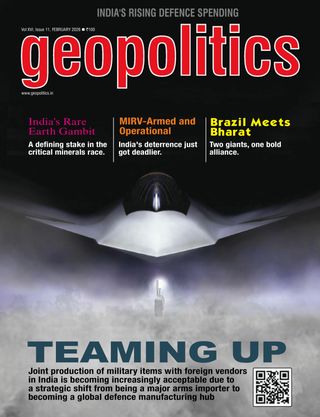

Diese Geschichte stammt aus der February 2026-Ausgabe von Geopolitics.
Abonnieren Sie Magzter GOLD, um auf Tausende kuratierter Premium-Geschichten und über 9.000 Zeitschriften und Zeitungen zuzugreifen.
Sie sind bereits Abonnent? Anmelden
WEITERE GESCHICHTEN VON Geopolitics

Geopolitics
BUYING THE IRGC TO END THE WAR IN IRAN
One is writing this after Iran launched missiles at Kuwait and Bahrain, as the US conducted new strikes on Qeshm Island.

4 mins
June 2026
Geopolitics
Maheshwarastra Seeks Deep-Strike Role
Solar Industries India Limited remains confident that confident that the Indian Army will eventually approve its proposed Maheshwarastra long-range precision rocket programme, which is being pursued under the Ministry of Defence's Make-II framework.
1 min
June 2026
Geopolitics
Zen Unveils AI Border Shield
Zen Technologies has launched India’s first Integrated Smart Border Suite (ISBS), an artificial intelligence-enabled security ecosystem designed to support the country’s transition towards technology-driven border management.
1 mins
June 2026

Geopolitics
KC-390 Pitch Targets Indian Deal
Brazilian aerospace manufacturer Embraer is mounting an aggressive campaign for the Indian Air Force’s Medium Transport Aircraft (MTA) programme, positioning its KC-390 Millennium as a cost-effective and versatile replacement for ageing transport fleets.
1 mins
June 2026
Geopolitics
IdeaForge Pursues Air-Launched Drone Swarms
IdeaForge is exploring a new concept in aerial warfare through Project ALE (Air-Launched Effects), an indigenous initiative focused on UAV-to-UAV deployment.
1 min
June 2026
Geopolitics
RusBeam Powers Aerospace Manufacturing Leap
Oussia's Rosatom has delivered Ruhe RusBeam 2800, India's largest vacuum-based electron-beam wire deposition 3D printer, providing a significant boost to advanced aerospace manufacturing capabilities.
1 min
June 2026

Geopolitics
Mountain Drone Solves Supply Gaps
Bharat Electronics Limited (BEL) has unveiled the Vahaan-50, an indigenous logistics drone designed to tackle one of the Indian military's most persistent operational challenges—sustaining troops deployed in remote, high-altitude terrain.
1 mins
June 2026
Geopolitics
Punjab Police Gets Indigenous SMGs
SSS Defence has completed another delivery of its indigenous G72 submachine guns to the Punjab Police, reinforcing the growing adoption of domestically developed small arms by Indian law-enforcement agencies.
1 mins
June 2026

Geopolitics
BluJ Advances Cargo eVTOL Programme
Hyderabad-based BluJ Aerospace has unveiled its Gen 2 electric vertical takeoff and landing aircraft, marking the first commercial-grade platform developed from its VANTIS architecture after four years of in-house research and development.
1 min
June 2026

Geopolitics
REWIRING THE NECK!
How India is rewiring its most dangerous frontier — and what it costs.
6 mins
June 2026
Listen
Translate
Change font size