
Mit Magzter GOLD unbegrenztes Potenzial nutzen
Erhalten Sie unbegrenzten Zugriff auf über 9.000 Zeitschriften, Zeitungen und Premium-Artikel für nur
Versuchen GOLD - Frei
Funding of higher education in Sri Lanka
The Island
|June 19, 2025
Prof. Kumar rightly draws attention to the precipitous decline in state funding for higher education in Sri Lanka from 4.25% of GDP in the 1960s to a mere 1.5% in 2022, and the consequential disparities in revenue-raising capacities, with the University of Colombo generating approximately 20% of its budget independently, while regional universities such as the University of Jaffna and Wayamba University operate with less than 2% (Kumar, 2025).
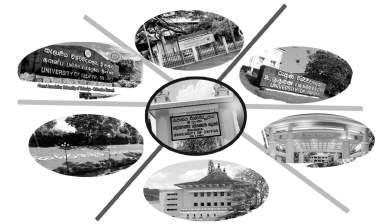
This fiscal contraction worsens structural inequities and hampers the mission of regional institutions. Ashraf et al. (2012) state that the system resource approach to organisational effectiveness highlights that an institution's ability to secure and use resources is crucial for its success. Without strategic investment and resource redistribution, less-resourced universities will continue to lag behind, perpetuating systemic inequities.
However, in this context, it is important to recognise that looking for alternative revenue sources, like increasing the number of foreign students and forming public-private partnerships, is not just a concession to the market; it is a strategic necessity. These methods can help universities diversify their funding sources, improve their resilience, and lessen their dependence on decreasing public funds. Also, attracting international students and private investment can provide essential resources for infrastructure, faculty development, and research, which supports the broader mission of higher education (British Council, 2024).
Institutional Constraints Over Full Marketisation: The Imperative of Governance Reform
The expectation that public universities transition to full self-funding is neither feasible nor equitable in the absence of substantive governance reforms. Sri Lankan universities remain entangled in rigid administrative frameworks, including protracted approvals for signing MOUs with foreign universities, foreign-funded research and Treasury-mandated procurement protocols, which severely restrict strategic autonomy (Kumar, 2025). The process approach to organisational effectiveness highlights the need for efficient internal operations, trust, and communication as key factors for institutional success (Ashraf et al., 2012). Too much bureaucracy weakens these elements, limiting innovation and responsiveness.

Diese Geschichte stammt aus der June 19, 2025-Ausgabe von The Island.
Abonnieren Sie Magzter GOLD, um auf Tausende kuratierter Premium-Geschichten und über 9.000 Zeitschriften und Zeitungen zuzugreifen.
Sie sind bereits Abonnent? Anmelden
WEITERE GESCHICHTEN VON The Island
The Island
It's Christmas time.
Yes, December is the festive month... and the lead up to Christmas, and lots of festive happenings are taking place.

1 min
December 02, 2025
The Island
COPA: Irrigation Dept. projects worth over Rs. 55,000 mn abandoned or suspended, 464 vehicles missing
The Committee on Public Accounts (COPA) has recently pointed out that 11 development projects implemented by the Department of Irrigation were either failed to achieve their intended objectives or were abandoned.
1 min
December 02, 2025

The Island
SLAF chief orders probe into chopper emergency landing in Lunuwila
Commander of the Air Force, Air Marshal Bandu Edirisinghe, has ordered the appointment of a board of inquiry to probe the emergency landing made by a Bell 212 helicopter on Sunday (30) evening that resulted in the death of a pilot.
1 min
December 02, 2025
The Island
Mahaweli flood warning extended by 48 hours: Authorities urge high alert
The Irrigation Department yesterday extended the Red-Level Flood Warning issued for the Mahaweli River Basin, cautioning residents in vulnerable areas to remain on high alert as water levels continue to rise due to persistent rainfall.
1 mins
December 02, 2025
The Island
The folly of imported ignorance: Why Sri Lanka must reject the foreign anti-vaccine delusion
For decades on end, Sri Lanka has stood as a global beacon of public health success. Our nation's commitment to comprehensive, routine immunisation has cultivated a shield against catastrophic diseases, resulting in one of the highest vaccination coverage rates in the world. This is a profound, hard-won victory, achieved through the diligent work of our healthcare professionals and the commonsense trust of the people of our nation.
6 mins
December 02, 2025

The Island
Opposition stages walkout in Parliament, claiming govt. ignored cyclone warning
A stormy scene unfolded in Parliament yesterday as the Opposition staged a walkout, accusing the government of blocking a debate on urgent policy measures, amid the worsening disaster situation. It claimed the government had ignored a warning of the Ditwah cyclone.
1 mins
December 02, 2025
The Island
Ditwah: An unusual cyclone
The increase in the temperature of the equatorial ocean is caused by climate change
3 mins
December 02, 2025
The Island
Cyclone Ditwah: 355 deaths, 366 missing as at 9 am Monday
The Disaster Management Centre (DMC) yesterday (01) reported that by 9 am, a total of 355 deaths had been confirmed and 366 persons had gone missing due to disasters triggered by Cyclone Ditwah.
1 min
December 02, 2025
The Island
Elusive unity in crisis
'Hope is said to 'spring eternal'. So, when the Opposition urged President Anura Kumara Dissanayake to declare a state of emergency and offered to cooperate with the government on disaster management, many may have thought that the NPP and its political rivals would sink their political differences and unite for the sake of the country. But the government and the Opposition went for each other's jugular soon afterwards.
2 mins
December 02, 2025
The Island
Navy rescues 309 people following Mavil Aru tank embankment breach
The Navy continues extensive rescue and relief operations in the areas affected by the flooding, triggered by the breach of a section of the Mavil Aru tank embankment in Trincomalee, on 30 November, following heavy rainfall.
1 min
December 02, 2025
Listen
Translate
Change font size