Versuchen GOLD - Frei
The Drugs Trade How Big Is The Problem-And Who Is Paying The Price?
The Guardian Weekly
|June 14, 2024
Over the past 10 years, Europe has developed a serious cocaine problem. The drug, originating in the jungles of South America, is being transported, sold and consumed across the European continent in record amounts.

The increasing demand from users - and the huge profits to be made in this booming marketplace - is reshaping the international drug trafficking trade on both sides of the Atlantic and its widespread availability is leaving a trail of addiction, organised crime and human rights abuses in its wake.
What is cocaine and how is it made? Cocaine is a highly addictive stimulant made from the leaves of the coca plant, native to Andean countries in South America, especially Colombia, Peru and Bolivia.
Usually manufactured in makeshift labs, cocaine is often cut with a variety of substances before it is sold and then distributed as a white, crystalline powder that can be snorted or injected. It can also be combined with baking soda to create a rock-like product called "crack" cocaine, which is usually smoked.
How much cocaine is coming to Europe? According to the United Nations Office on Drugs and Crime (UNODC), people in Europe accounted for 21% of all global users of cocaine in 2021.
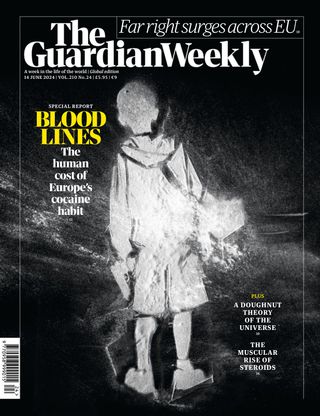

Diese Geschichte stammt aus der June 14, 2024-Ausgabe von The Guardian Weekly.
Abonnieren Sie Magzter GOLD, um auf Tausende kuratierter Premium-Geschichten und über 9.000 Zeitschriften und Zeitungen zuzugreifen.
Sie sind bereits Abonnent? Anmelden
WEITERE GESCHICHTEN VON The Guardian Weekly

The Guardian Weekly
I love when my enemies hate, me
Every day, Hasan Piker broadcasts a marathon Twitch stream, airing his views to 3 million followers. It has led to him becoming one of the biggest voices on the US left. But Piker's online fame has drawn vitriol towards him in real life

10 mins
January 02, 2026
The Guardian Weekly
Baseinstinct Why did Trump order airstrikes on Nigeria?
Claims that Christians face religious persecution overseas have become a major motivating force for Trump's base.
2 mins
January 02, 2026
The Guardian Weekly
Florence's outcasts A vivid and absorbing history of one of the first orphanages in Europe
Joseph Luzzi, a professor at Bard College in New York, is a Dante scholar whose books argue for the relevance of the Italian art and literature of the late middle ages and Renaissance to our own times.
1 mins
January 02, 2026

The Guardian Weekly
Need cheering up after a terrible year? I have just the story for you
Perhaps you are searching for reasons to be cheerful at the end of a particularly dispiriting year and the start of a new one that may well offer more of the same? In that case, read on.
4 mins
January 02, 2026
The Guardian Weekly
N347 Vegetable udon curry
You could also serve this with rice, but if you do, use only half the quantity of dashi, because this curry is made slightly soupier to go with the noodles.
1 mins
January 02, 2026
The Guardian Weekly
Warbling free The app that can tell birds by their songs
When Natasha Walter first became curious about the birds around her, she recorded their songs on her phone and arduously tried to match each song with online recordings.
2 mins
January 02, 2026
The Guardian Weekly
A soundtrack to all of humanity
The Nazis adopted Ode to Joy. Happy Birthday hides a tale of greed. And Putin has turned Shostakovich's Leningrad symphony into a call to arms. Is this the fate of musical utopias?
4 mins
January 02, 2026

The Guardian Weekly
Brigitte Bardot 1934 -2025
France's most sensational cultural export, who on screen epitomised youth, sex and modernity until politics and her campaigns for animal rights took over
3 mins
January 02, 2026

The Guardian Weekly
Who owns space? As the race starts to exploit the cosmos for commercial gains, we must act to preserve it for all humanity
If there is one thing we can rely on in this world, it is human hubris, and space and astronomy are no exception.
3 mins
January 02, 2026
The Guardian Weekly
Food for thought A personally inflected history of psychiatric ideas with flashes of anarchic humour
In 1973, US psychologist David Rosenhan published the results of an experiment.
3 mins
January 02, 2026
Listen
Translate
Change font size