Versuchen GOLD - Frei
THE NEW SCIENCE OF HISTORY
The Guardian Weekly
|March 01, 2024
How technology is opening up a new realm of knowledge about the old world

SCYTHIANS DID TERRIBLE THINGS.
Two thousand five hundred years ago, these warrior nomads, who lived in the grasslands of what is now southern Ukraine, enjoyed a truly ferocious reputation. According to the Greek historian Herodotus, the Scythians drank the blood of their fallen enemies, took their heads back to their king and made trinkets out of their scalps. Sometimes, they draped whole human skins over their horses and used smaller pieces of human leather to make the quivers that held the deadly arrows for which they were famous.
Readers have long doubted the truth of this story, as they did many of Herodotus's more outlandish tales, gathered from all corners of the ancient world. (Not for nothing was the "father of history" also known as the "father of lies" in antiquity.) Recently, though, evidence has come to light that vindicates his account. In 2023, scientists at the University of Copenhagen, led by Luise Ørsted Brandt, tested the composition of leather goods, including several quivers, recovered from Scythian tombs in Ukraine. By using a form of mass spectrometry, which let them read the "molecular barcode" of biological samples, the team found that while most of the Scythian leather came from sheep, goats, cows and horses, two of the quivers contained pieces of human skin. "Herodotus's texts are sometimes questioned for their historical content, and some of the things he writes seem to be a little mythological, but in this case we could prove that he was right," Brandt told me recently.
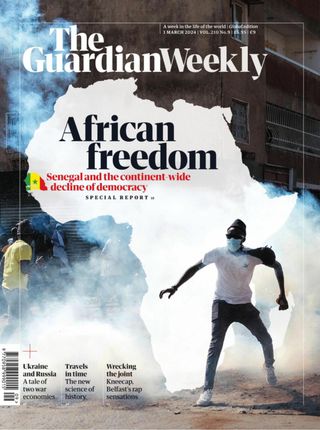

Diese Geschichte stammt aus der March 01, 2024-Ausgabe von The Guardian Weekly.
Abonnieren Sie Magzter GOLD, um auf Tausende kuratierter Premium-Geschichten und über 9.000 Zeitschriften und Zeitungen zuzugreifen.
Sie sind bereits Abonnent? Anmelden
WEITERE GESCHICHTEN VON The Guardian Weekly

The Guardian Weekly
Trump has shown there aren't any rules. We'll all regret that
I never thought it possible that you could look back on the Iraq war and feel some measure of nostalgia.

4 mins
January 09, 2026

The Guardian Weekly
The new world order 'according to Trump
With the audacious snatch and grab raid that extracted Nicolás Maduro to face trial in the United States, Washington sent a clear message to its allies and adversaries:
3 mins
January 09, 2026
The Guardian Weekly
The phone is ringing, but is it a scam? I'll ask my assistant
I am staring at my computer when my phone rings.
3 mins
January 09, 2026

The Guardian Weekly
The unlikely genius of Getdown Services
Scatological lyrics, social conscience, a commitment to fun and a shoutout from Walton Goggins - 2026 is going to be the laptop garage band's year
3 mins
January 09, 2026

The Guardian Weekly
Behind the race to get Americans back on the moon
With astronauts set to fly around the moon for the first time in more than half a century when Artemis 2 makes its ascent sometime this spring, 2026 was already destined to become a standout year in space.
3 mins
January 09, 2026
The Guardian Weekly
Striking it rich The US plan for involvement in Venezuela's 'bust' oil sector
The Venezuelan oil industry has been “a total bust” for a long time, according to Donald Trump.
2 mins
January 09, 2026

The Guardian Weekly
Life after extinction Science or science fiction?
A startup's plans for resurrecting lost creatures have caught the public's imagination but many researchers doubt that such a feat is possible
5 mins
January 09, 2026

The Guardian Weekly
It's a ridiculous time to be a man'
A group of male comedians is at the forefront of a new genre of social media comedy poking fun at our ever-shifting notions of modern masculinity
4 mins
January 09, 2026

The Guardian Weekly
Charting the global economy in 2026
With inflation predicted to cool, rising unemployment, weak growth and trade tensions pose fresh risks, while high debt and AI add to uncertainty in the year ahead
4 mins
January 09, 2026
The Guardian Weekly
High stakes for Mamdani as he must now deliver on his promises to New York
The multiple firsts achieved by New York’s new mayor, Zohran Mamdani, have been well chronicled: he is the first Muslim to occupy that role, the first south Asian and the first to be born in Africa.
2 mins
January 09, 2026
Listen
Translate
Change font size