Versuchen GOLD - Frei
Into the woods
The Guardian Weekly
|May 03, 2024
In the past 10 years the idea that trees communicate with and look after each other-dubbed the 'wood-wide web' - has gained widespread currency. But have these claims outstripped the evidence?
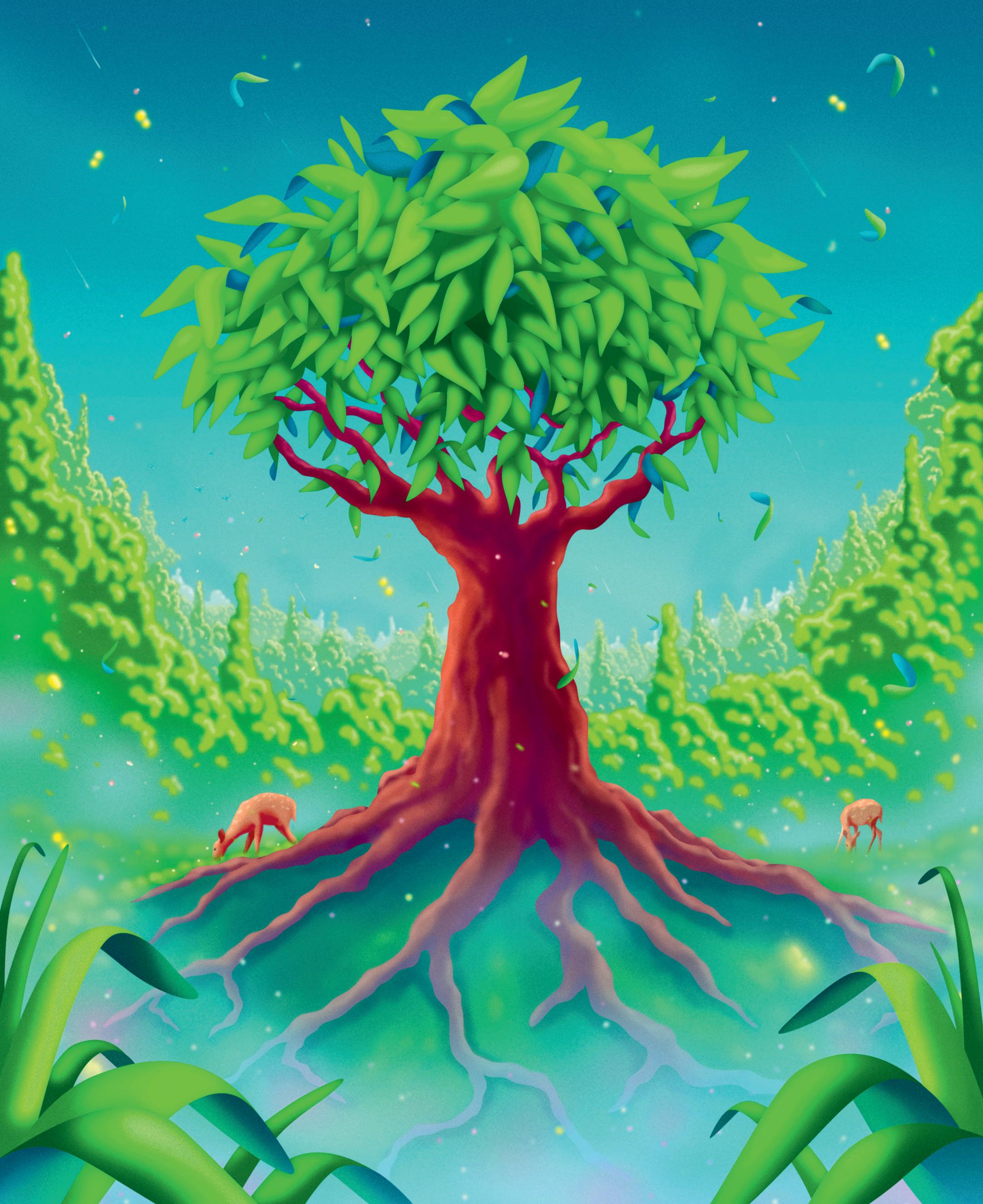
THERE ARE A LOT OF HUMANS. Teeming is perhaps an unkind word, but when 8 billion people cram themselves onto a planet that, three centuries before, held less than a tenth of that number, it seems apt. Eight billion hot-breathed individuals, downloading apps and piling into buses and shoving their plasticky waste into bins - it is a stupefying and occasionally sickening thought.
And yet, humans are not Earth's chief occupants. Trees are. There are 3tn of them, with a collective biomass thousands of times that of humanity. But although they are the preponderant beings on Earth - outnumbering us by nearly 400 to one - they're easy to miss. Show someone a photograph of a forest with a doe peeking out from behind a maple and ask what they see. "A deer," they'll exclaim, as if the green matter occupying most of the frame were mere scenery. "Plant blindness" is the name for this. It describes the many who can distinguish hybrid dog breeds yet cannot identify an apple tree.
Admittedly, trees do not draw our attention. Apart from plopping the occasional fruit upon the head of a pondering physicist, they achieve little that is of narrative interest. They are "sessile" - the botanist's term meaning incapable of locomotion. Books about trees often have a sessile quality, too; they are informative yet aimless affairs, heavy on serenity, light on plot.
Or, at least, they were until recently. The German forester Peter Wohlleben's surprise bestseller, The Hidden Life of Trees (published in English in 2016), has inaugurated a new tree discourse, which sees them not as inert objects but intelligent subjects. Trees have thoughts and desires, Wohlleben writes, and they converse via fungi that connect their roots "like fibre-optic internet cables". The same idea pervades The Overstory, Richard Powers' celebrated 2018 novel, in which a forest scientist upends her field by demonstrating that fungal connections "link trees into gigantic, smart communities".

Diese Geschichte stammt aus der May 03, 2024-Ausgabe von The Guardian Weekly.
Abonnieren Sie Magzter GOLD, um auf Tausende kuratierter Premium-Geschichten und über 9.000 Zeitschriften und Zeitungen zuzugreifen.
Sie sind bereits Abonnent? Anmelden
WEITERE GESCHICHTEN VON The Guardian Weekly

The Guardian Weekly
Do I look like a man who would buy stolen wine?
I'm walking to the station in driving rain, under a cheap umbrella I bought at a newsagent the day before - during a previous rainstorm - which is already turning up on one side.

3 mins
March 06, 2026

The Guardian Weekly
Rebel yell
Roaring into her 90s, isnow sought after by galleries worldwide and her wild, witty paintings fetch huge sums. Melissa Denes visited her studio
6 mins
March 06, 2026
The Guardian Weekly
Trump's Iran campaign is an illegal war that risks becoming the new normal
The killing of Iran’s supreme leader, Ayatollah Ali Khamenei, by a US-Israeli strike is a targeted assassination of a head of state.
2 mins
March 06, 2026

The Guardian Weekly
'Bitter news' Deadly school strike exposes human cost of US-led attack
Iran's parents had just dropped their children off at school last Saturday morning when they found themselves racing back, as bombs began to fall across the country in a joint US-Israel attack.
2 mins
March 06, 2026

The Guardian Weekly
New wave Can fishing capture Cornwall's youth?
Taster days and training offer teenagers an escape from seasonal work - and give a boost to threatened industry
4 mins
March 06, 2026
The Guardian Weekly
Geothermal plant draws on a proud mining past
Just outside the perimeter fence stand the hulking remains of grand stone engine houses, a testament to Cornwall's proud tin and copper mining history.
2 mins
March 06, 2026

The Guardian Weekly
Priorities of political elite criticised as violence grips nation
It has been described as Nigeria’s wedding of the year - and it took place only weeks into the new year.
2 mins
March 06, 2026

The Guardian Weekly
Taliban strikes In Islamabad, patience with Afghanistan finally runs out
Days after the Taliban swept to power in 2021, Pakistan’s then spymaster appeared in Kabul on what looked like a victory lap.
2 mins
March 06, 2026

The Guardian Weekly
The Guthrie case and the unseen thousands of missing
Savannah Guthrie is moving back to New York to resume anchoring NBC's Today show and acknowledges that her 84-year-old mother, Nancy, may not be found a month after she disappeared from her Tucson, Arizona, home in the middle of the night.
3 mins
March 06, 2026
The Guardian Weekly
It's a steal Game that lets players return relics
Creators say they're offering Africans a 'hopeful, utopian feeling' of retrieving objects looted by colonial armies
2 mins
March 06, 2026
Listen
Translate
Change font size