Versuchen GOLD - Frei
Apocalypse then
The Guardian Weekly
|January 03, 2025
As the year 2000 rolled in, worldwide computer chaos was predicted to follow. Billions of dollars were spent to prevent it, yet nothing terrible happened. Was the Y2K bug a hoax or did the IT experts get it horribly wrong?

Just before midnight on New Year's Eve, 25 years ago, Queen Elizabeth II stepped off a private barge to arrive at London's Millennium Dome for its grand opening ceremony. Dressed in a pumpkin-orange coat, she entered the venue with Prince Philip, taking her place alongside Tony and Cherie Blair and 12,000 guests to celebrate the dawn of a new millennium. At the stroke of midnight, Big Ben began to chime and the sky over the capital turned a radiant orange as 40 tonnes of fireworks were launched from 16 barges lined along the river. The crowd joined hands, preparing to sing Auld Lang Syne. For a few long moments, the Queen was neglected - she flapped her arms out like a toddler wanting to be lifted up, before Blair and Philip noticed her, took a hand each, and the singing began. A new century was born.
One politician who wasn't in attendance at the glitzy celebration was Paddy Tipping, a Labour MP who spent the night of the millennium in the Cabinet Office. At the time, Tipping was minister for the millennium bug. After 25 years, it might be hard to recall just how big a deal the millennium bug, now more commonly called Y2K, felt at the time. But for the last few years of the 1990s, the idea that computers would fail catastrophically as the clock ticked over into the year 2000 was near the top of the political agenda in the UK and the US. Here was a hi-tech threat that people feared might topple social order, underlining humanity's new dependence on technological systems that most of us did not understand. Though there are no precise figures, it's estimated that the cost of the global effort to prevent Y2K exceeded $560bn or $710bn today).
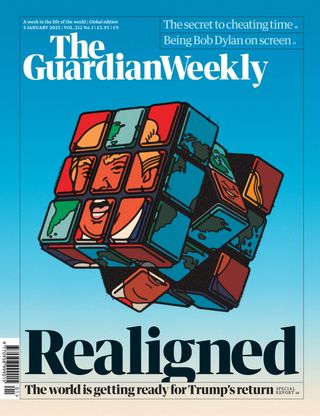

Diese Geschichte stammt aus der January 03, 2025-Ausgabe von The Guardian Weekly.
Abonnieren Sie Magzter GOLD, um auf Tausende kuratierter Premium-Geschichten und über 9.000 Zeitschriften und Zeitungen zuzugreifen.
Sie sind bereits Abonnent? Anmelden
WEITERE GESCHICHTEN VON The Guardian Weekly
The Guardian Weekly
ASSAULT ON THE SMITHSONIAN
Donald Trump has vowed to kill off 'woke' culture in his second term, and a major institution a few blocks from the White House is in his sights

16 mins
January 16, 2026

The Guardian Weekly
'Add blood, forced smile' How Grok's nudification AI tool went viral
A trend for the chatbot to alter pictures to show women in bikinis spiralled into hundreds of thousands of requests to create fake sexualised images, horrifying those targeted
5 mins
January 16, 2026
The Guardian Weekly
Two horrifying truths have been disclosed by a lying president
For a serial liar, Donald Trump can be bracingly honest. We've known about the mendacity for years - consider the 30,573 documented falsehoods from the president's first term, culminating in the big lie, his claim to have won the 2020 election - but the examples of bracing candour are fresher. Last week both began and ended with the US president speaking the shocking truth.
4 mins
January 16, 2026

The Guardian Weekly
Jude Law's Putin sent from Russia with love
Is a new film portrayal of the autocrat as a James Bond-like strategist merely swallowing Kremlin myths?
3 mins
January 16, 2026
The Guardian Weekly
The city of noodles fights for the crown
The road to ramen paradise ends in the unlikeliest of places. At Men Endo, located in a suburban street, next to a school and a low-rise apartment block, bowls of noodles disappear in a flurry of slurps, gulps and hurried but heartfelt exchanges of appreciation between customers and chefs.
3 mins
January 16, 2026
The Guardian Weekly
Rhetoric risks repeating Warsaw Pact mistakes
Donald Trump's echoing of Russia's talking points in its war against Ukraine has long been a cause for alarm and dismay in the west.
2 mins
January 16, 2026

The Guardian Weekly
Europe's options What can the EU do to counter Trump's designs on Greenland?
Diplomacy and Arctic security European governments, led by Denmark's ambassador to the US, Jesper Møller Sørensen, and Greenland's envoy, Jacob Isbosethsen, have been lobbying US lawmakers to talk Trump out of his territorial ambitions for the island.
2 mins
January 16, 2026
The Guardian Weekly
China first? Carney looks to mend broken ties with Beijing
As trade war with Washington takes its toll, Canada’s PM seeks to restore fractured relationship with China
3 mins
January 16, 2026

The Guardian Weekly
As the bombs fell, my family planted hope in a garden in Gaza
My 12-year-old brother Mazen ran into the kitchen, shouting that the aubergines were sprouting. He held up the tiny green shoots, his hands shaking. My older brother Mohammed and I rushed outside, laughing despite the fear that had become our constant companion.
2 mins
January 16, 2026

The Guardian Weekly
Can Havana's bond with Venezuela survive Trump?
On Havana's Fifth Avenue, where the trees and lawns remain groomed even as the rest of Cuba wilts, a billboard outside the Venezuelan embassy reads: “Hasta Siempre Comandante” (Until For Ever, Commander) next to a vast picture of a smiling Hugo Chávez.
3 mins
January 16, 2026
Listen
Translate
Change font size