
Mit Magzter GOLD unbegrenztes Potenzial nutzen
Erhalten Sie unbegrenzten Zugriff auf über 9.000 Zeitschriften, Zeitungen und Premium-Artikel für nur
Versuchen GOLD - Frei
The rags to riches story of a Bombay entrepreneur
Mint New Delhi
|February 28, 2026
Decades after the textile mill chimneys have faded from the Mumbai skyline, indelibly altering the demographics, architecture and culture of the city’s central districts, the fate of displaced textile workers continues to—surprisingly—animate political discussions.

A former textile factory in Colaba, Mumbai, 2010.
(GETTY IMAGES)
The campaigning for and outcome of elections to the Brihanmumbai Municipal Corporation (BMC), the country’s richest urban local body by a mile, for instance, provide insights into how the once-ubiquitous textile factory continues to haunt collective memory.
The textile factories were not mere physical symbols of industrial productivity and commerce but cradles for community development as well, providing livelihood for over 250,000 workers who had mostly migrated from rural Maharashtra. The workers and their family members tuned into the city’s rhythms to upgrade their songbooks and compose unique cultural memes; celebrations of traditional festivals turned into collective and voluntary labour, some of which have now become the city’s visible socio-cultural icons, such as the Dahi Handi festivities or Ganpati celebrations.
And then, following the prolonged textile strike of the 1980s, the mills shut down. Mill owners, with some help from the political class, were able to repurpose the land and monetise it, even though a part of the land was supposed to be used for public housing. Former mill workers, who lived near the mills in tightly knit communities, were also stakeholders because the mill land was on long lease from the city. But mill owners and political leaders successfully subverted rules and policy prescriptions. Unfortunately, even the trade unions failed these workers.
The forcible dispersal of a century-old community was turbocharged by a class angle as well: as south Mumbai got overpopulated, the wealthy and aspiring wealthy needed residential properties not too far from the original elite hub. This required overhauling the working-class character of the former textile district. End-result: out with the old textile mills, hello steel and glass skyscrapers.
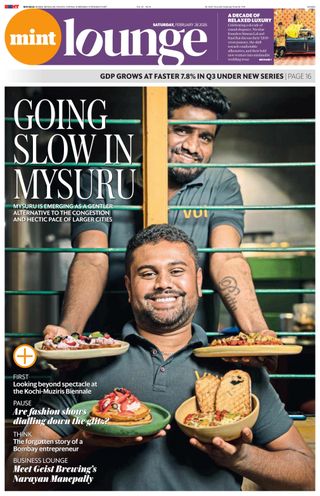

Diese Geschichte stammt aus der February 28, 2026-Ausgabe von Mint New Delhi.
Abonnieren Sie Magzter GOLD, um auf Tausende kuratierter Premium-Geschichten und über 9.000 Zeitschriften und Zeitungen zuzugreifen.
Sie sind bereits Abonnent? Anmelden
WEITERE GESCHICHTEN VON Mint New Delhi

Mint New Delhi
Paramount-Warner deal set to reshape Indian cinema
Netflix is backing away from its proposal to buy Warner Bros Discovery

2 mins
February 28, 2026

Mint New Delhi
J Dilla added innovative soul to machine-made hip-hop
LOW FIDELITY
5 mins
February 28, 2026
Mint New Delhi
Did a human write this?
As we are exposed to more and more content generated by Al, we are constantly absorbing the way it uses language
2 mins
February 28, 2026
Mint New Delhi
'Budget not a short-term trading document'
Downplaying the stock market slide on 1 February after the FY27 budget presentation, Prime Minister Narendra Modi on Friday said that the Union budget is a policy roadmap, not a short-term trading document.
1 min
February 28, 2026

Mint New Delhi
Looking beyond spectacle at Kochi
Smartphones have turned viewers of art into consumers, eager to flaunt what they've seen. Is it time for some close looking?
6 mins
February 28, 2026

Mint New Delhi
A return to the old business of fashion
As fashion keeps trying to 'break the Net', a feeling of sameness has set in. Slow shows might shake things up
3 mins
February 28, 2026

Mint New Delhi
The sexiest show on TV
STREAM OF STORIES
4 mins
February 28, 2026

Mint New Delhi
The rags to riches story of a Bombay entrepreneur
Decades after the textile mill chimneys have faded from the Mumbai skyline, indelibly altering the demographics, architecture and culture of the city’s central districts, the fate of displaced textile workers continues to—surprisingly—animate political discussions.
5 mins
February 28, 2026

Mint New Delhi
It is nice to ride a winning horse like India: SGX’s Syn
India is home to the world’s biggest derivatives market and the largest population, and is poised to become the third-largest economy by 2030, making it a market global investors cannot ignore, said Michael Syn, president of the Singapore Exchange (SGX Group).
1 mins
February 28, 2026

Mint New Delhi
SC refuses to stay ₹144.5 cr SpiceJet deposit order
In a blow to budget carrier SpiceJet, the Supreme Court (SC) on Friday refused to stay a Delhi High Court order directing the airline and its promoter Ajay Singh to deposit ₹144.51 crore in its long-running arbitration dispute with KAL Airways Pvt. Ltd and Kalanithi Maran.
1 min
February 28, 2026
Listen
Translate
Change font size