
Mit Magzter GOLD unbegrenztes Potenzial nutzen
Erhalten Sie unbegrenzten Zugriff auf über 9.000 Zeitschriften, Zeitungen und Premium-Artikel für nur
Lenders eye top table
Business Standard
|October 24, 2025
India’s state-owned banks have been set a stiff task: To see that at least two or three of them make it to the ranks of the world’s top 20 lenders. Here's how they can get there
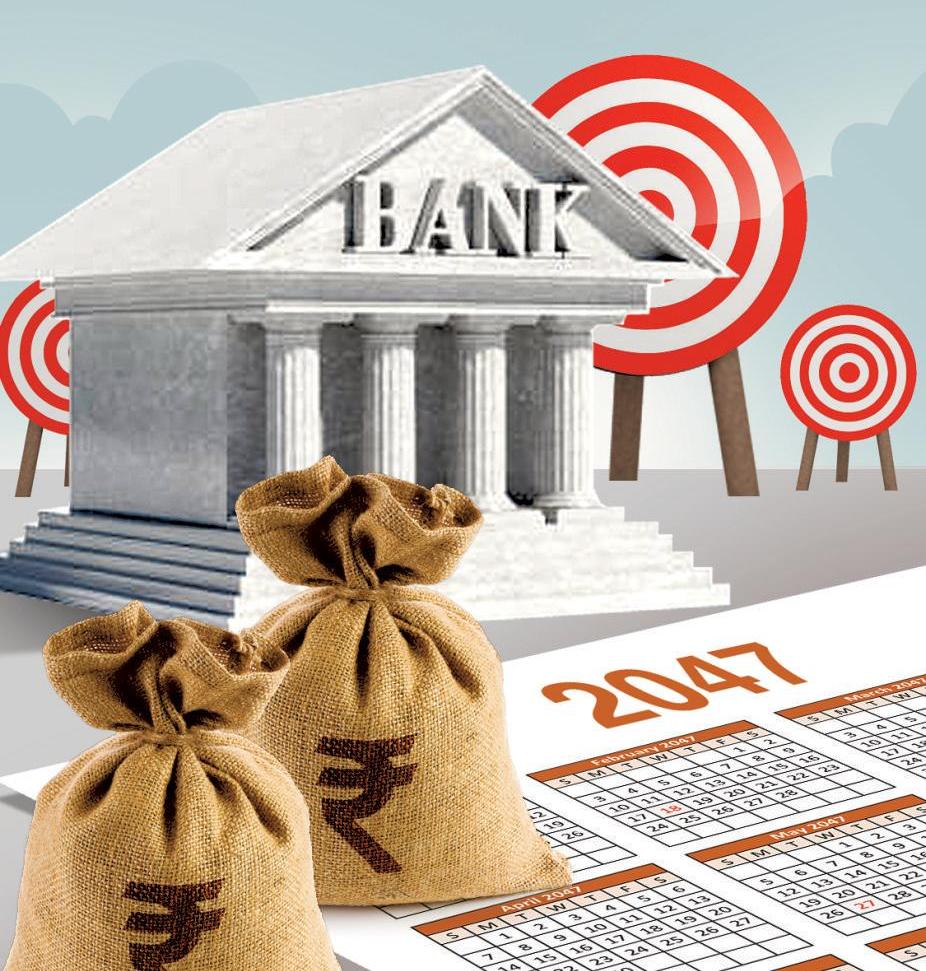
At a two-day Manthan event of public sector banks (PSBs) last month the government set an ambitious target for the senior bankers gathered for the first such summit hosted by the Department of Financial Services (DFS) since April 2022: Get at least two-to-three state-owned Indian banks placed in the world’s top-20 by 2047.
DFS secretary M Nagaraju said PSBs have moved beyond survival and stability and are now positioned to play a larger role as champions of growth, innovation and leadership in India’s march towards Viksit Bharat, or developed nation status.
India has 12 PSBs, which together accounted for 59.5 per cent of the total banking assets in India including public, private, and foreign banks in 2024. Interest income for public banks reached ₹11.1 trillion ($128.1 billion), while private banks earned ₹8,3 trillion ($95.7 billion) during the year.
State Bank of India (SBI) and HDFC Bank — the largest public and private sector lenders by market cap — are the only Indian banks in the latest S&P Global Market Intelligence ranking of the world’s 100 largest banks by assets. SBI climbed four places to 43rd, while HDFC Bank rose one place to 73rd in this year’s ranking. Chinese lenders dominated the list, occupying the top four positions, reflecting their influence in mergers and acquisitions.
Merger lessons In the biggest consolidation in Indian banking, the government in August 2019 announced four major mergers of PSBs, bringing down their total number to 12 from 27 in 2017, a move aimed at making state-owned lenders more efficient and competitive.
Bankers who witnessed the process recall that smaller banks often lost their regional customer-base, yet the consolidation also created a new generation of banking leaders. Of the 12 current PSB managing directors, four come from merged entities. Both UCO Bank's Ashwani Kumar and Punjab & Sind Bank's Swarup Kumar Saha, for instance, are from Oriental Bank of Commerce (OBC).

Diese Geschichte stammt aus der October 24, 2025-Ausgabe von Business Standard.
Abonnieren Sie Magzter GOLD, um auf Tausende kuratierter Premium-Geschichten und über 9.000 Zeitschriften und Zeitungen zuzugreifen.
Sie sind bereits Abonnent? Anmelden
WEITERE GESCHICHTEN VON Business Standard
Business Standard
PE-VC investments at $33 bn in '25
Mega deals slide slightly; IT and BFSI lead sector investments

1 mins
January 01, 2026
Business Standard
RBI red-flags bank-NBFC interlink risks
Banks acquiring 80% assets through a limited number of NBFCs
2 mins
January 01, 2026
Business Standard
Precious metals outshine stocks in 2025 amid global volatility
Nearly 60% of the top 1,000 listed stocks delivered negative returns
1 mins
January 01, 2026
Business Standard
Weakness in ₹, broader equity market shrinks India's billionaire club in 2025
Top IPO promoters
3 mins
January 01, 2026
Business Standard
EV Policy 2.0: Delhi govt to meet five auto firms, Siam
Meeting scheduled on Jan 2 as capital remains in a smog of pollution
2 mins
January 01, 2026
Business Standard
Year of hope
India must aim to sustain the growth momentum
2 mins
January 01, 2026
Business Standard
Eight more cos to get incentives under auto PLI
Three vehicle makers, five auto part makers to get benefits from FY27
2 mins
January 01, 2026
Business Standard
Centre notifies revised draft rules for labour codes, seeks stakeholders' responses
The Ministry of Labour and Employment on Wednesday notified the revised draft rules for the four new Labour Codes, providing clarity on certain provisions such as gratuity payments and retrenchment of workers.
1 mins
January 01, 2026
Business Standard
Oyo parent files for ₹6,650 cr IPO via confidential route
Oyo’s parent firm Prism has filed confidential draft red herring prospectus (DRHP) papers with the markets regulator to raise up to %6,650 crore through an initial public offering (IPO), which would be the third attempt by the global travel technology company at public listing.
2 mins
January 01, 2026
Business Standard
External uncertainties may trigger outflows, Fx rate volatility: RBI
The Reserve Bank of India (RBI) has cautioned that the country's economy faces near-term risks largely from external uncertainties, including the possibility of a sharp correction in US equities that could trigger foreign portfolio outflows, heighten exchange rate volatility and tighten domestic financial conditions.
2 mins
January 01, 2026
Listen
Translate
Change font size