Versuchen GOLD - Frei
Gold standard makes for short wars
The Light
|Issue 39: November 2023
Printing money out of nothing extends conflicts
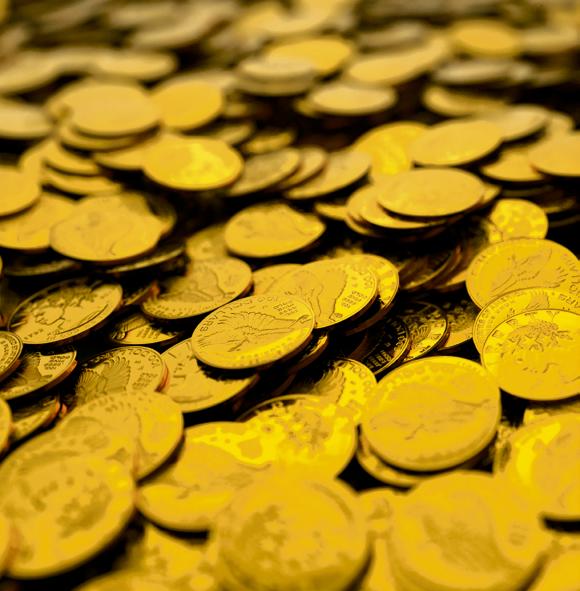
ONE of the longest and most stable monetary regimes from the 'early modern era' onward was the British pound on the classical gold standard.
It lasted about 250 years, from the mid-17th century up until the outbreak of World War One.
According to the late Ferdinand Lips, in his seminal work Gold Wars, if you index the purchasing power of the British pound vs gold starting at a value of 100 in 1664, the reading would have been 92 by 1914.
In other words, over 250 years, the purchasing power of the British pound was not only stable, it had actually increased a little.
Lips goes on to note: 'By 1900, approximately fifty countries were on a gold standard, including all industrialised nations. The interesting fact is that the modern gold standard was not planned at an international conference, nor was it invented by some genius.
It came by itself, naturally and based on experience.
'The United Kingdom went on a gold standard against the intention of its government.
Only much later did laws turn an operative gold standard into an officially sanctioned gold standard.' Pundits and the financial clerisy inform us that monetary systems must be dictated from above and governed from the centre. But it is not so. In fact, when that happens, society puts itself at the mercy of technocratic central planners, who are largely detached from reality and insulated from the consequences of their actions.
Lips goes on: 'In 1914, at the beginning of World War One, the gold standard was thrown overboard within a few weekends. In order to finance wars, the world resorted to deficit spending and paper money.
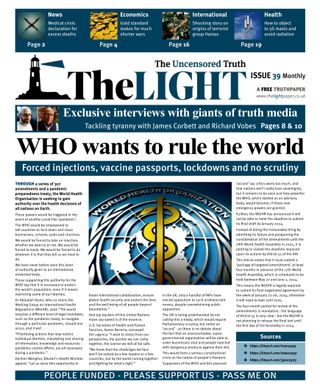

Diese Geschichte stammt aus der Issue 39: November 2023-Ausgabe von The Light.
Abonnieren Sie Magzter GOLD, um auf Tausende kuratierter Premium-Geschichten und über 9.000 Zeitschriften und Zeitungen zuzugreifen.
Sie sind bereits Abonnent? Anmelden
WEITERE GESCHICHTEN VON The Light

The Light
You can't handle the truth!
Met office caught deleting inconvenient data

2 mins
Issue 65, January/February 2026

The Light
Privacy ends in name of protection
Proposed law invites future where every device is spied on
3 mins
Issue 65, January/February 2026

The Light
Profiteers from genocide
Hunger strike exposes lack of due process in Britain
3 mins
Issue 65, January/February 2026
The Light
Involuntary slaughter?
Family-testimony book exposes 'silent killing'
2 mins
Issue 65, January/February 2026

The Light
Sex, lies and videotape
Epstein blueprint for compromising political leaders
3 mins
Issue 65, January/February 2026

The Light
Two deaths of Bin Laden
On May 2, 2011, the world was told that Osama bin Laden had been hunted down and killed in Pakistan by the elite U.S. Navy SEAL Team Six.
4 mins
Issue 65, January/February 2026
The Light
Digital currency's silver lining
Precious metal could help spark a silent revolution
4 mins
Issue 65, January/February 2026
The Light
Narcissism normalised in politics
Corporate control of party-based politics breeding creeping culture of self-entitlement
4 mins
Issue 65, January/February 2026

The Light
Humans redundant in tech takeover
THE disruptions we have seen in recent years are frequently presented as a chaotic sequence of events: a 'pandemic', inflation, energy shortages and war.
4 mins
Issue 65, January/February 2026

The Light
Green energy bubble will pop
Taxpayers footing bill for speculation on renewables
3 mins
Issue 65, January/February 2026
Translate
Change font size