Versuchen GOLD - Frei
When Robert Frost Was Bad
The Atlantic
|March 2025
Before he became America's most famous poet, he wrote some real howlers.
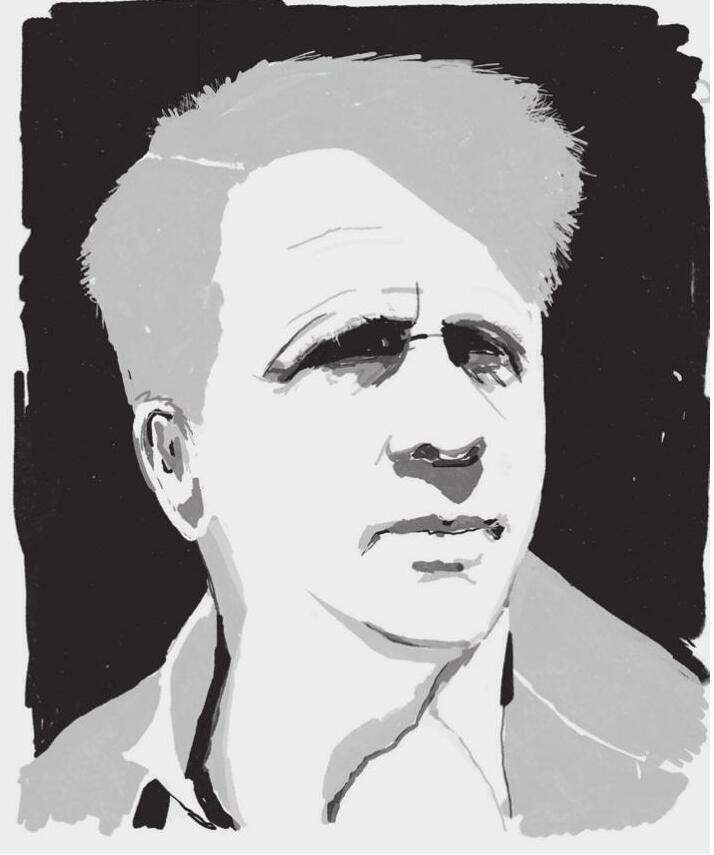
Bad poems never die, never really go away: The vigor of their badness preserves them. Up they float into bad-poem limbo, where their bad lines, loose and weedlike, drift and coil and tangle with one another eternally. Robert Frost, who turned 20 in 1894, uncertain of his gift, bouncing among stray gigs (actor's manager, repairer of lights at a wool mill) in Lawrence, Massachusetts, had written a poem called "My Butterfly." It begins like this: "Thine emulous fond flowers are dead too, / And the daft sunassaulter, he/ That frighted thee so oft..." It is what it is, a bad poem. A randomfeeling extrusion of lyrical matter, like something that might come out of the tube when you pull the lever marked POETRY.
Nevertheless, for this poem, and for the first time in his career, Frost got paid-$15, by the editor of a New York weekly called The Independent. "On reading 'My Butterfly,"" Adam Plunkett writes in his new Love and Need: The Life of Robert Frost's Poetry, "the poetry editor called the rest of the staff over to listen because she had just discovered a poet." A woman whose literary perspicacity exceeded my own, clearly. I would have left him to molder in the slush pile.

Diese Geschichte stammt aus der March 2025-Ausgabe von The Atlantic.
Abonnieren Sie Magzter GOLD, um auf Tausende kuratierter Premium-Geschichten und über 9.000 Zeitschriften und Zeitungen zuzugreifen.
Sie sind bereits Abonnent? Anmelden
WEITERE GESCHICHTEN VON The Atlantic
The Atlantic
Deadlier Than Gettysburg
How the cruelty of the Confederacy's prison camps gave rise to the rules of war

10 mins
March 2026

The Atlantic
THE MAN WHO BROKE PHYSICS
One of the pleasures of watching Ilia Malinin, apart from his indifference to gravity, is to witness him becoming.
16 mins
March 2026

The Atlantic
How Toni Morrison Saw History
In her novels, she located the missing story of Black America.
12 mins
March 2026

The Atlantic
The Madness of Lord Tennyson
The Victorian poet was startlingly modern.
5 mins
March 2026

The Atlantic
THE PLOT AGAINST THE HUMANITIES
What is the Andrew W. Mellon Foundation doing to higher education?
22 mins
March 2026

The Atlantic
Why Do Democrats Hate Winning?
Ken Martin has one of those resting dread faces, as if he's bracing for someone to dump a bucket of rocks on his head.
37 mins
March 2026

The Atlantic
ROD DREHER'S DEMONS
HE DERIDES THE ENLIGHTENMENT, SECULARISM, AND THE MODERN WORLD. CONSERVATIVES-INCLUDING THE VICE PRESIDENT-ARE JOINING HIM ON A MARCH BACK TO THE MIDDLE AGES.
20 mins
March 2026

The Atlantic
Every Nation for Itself
President Trump wants to return to the 19th century's international order. He will leave America less prosperous—and the whole world less secure.
19 mins
March 2026

The Atlantic
The Secrets of Indigenous Art
Major exhibits are upending the way people understand Native American and Aboriginal artists.
14 mins
March 2026

The Atlantic
The Novel as Extended Op-Ed
If anyone could write good fiction about immigration, it would probably be Lionel Shriver. Instead, her latest book goes off the rails.
10 mins
March 2026
Listen
Translate
Change font size