Versuchen GOLD - Frei
The President's Weapon
The Atlantic
|August 2025
Why does the power to launch nuclear weapons rest with a single American?
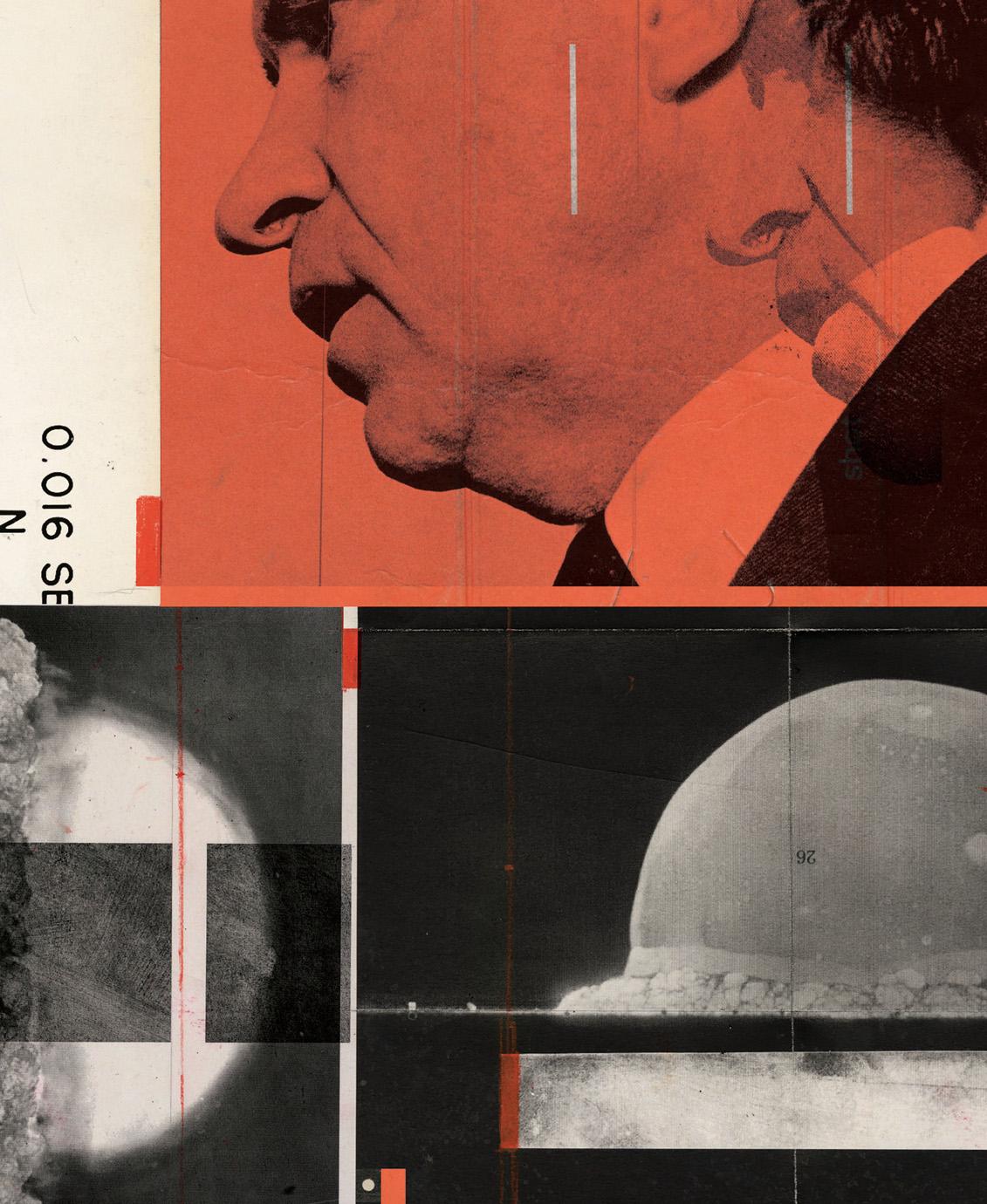
In the summer of 1974, Richard Nixon was under great strain and drinking too much. During a White House meeting with two members of Congress, he argued that impeaching a president because of “a little burglary” at the Democrats’ campaign headquarters was ridiculous. “I can go in my office and pick up the telephone, and in 25 minutes, millions of people will be dead,” Nixon said, according to one congressman, Charles Rose of North Carolina.
The 37th president was likely trying to convey the immense burden of the presidency, not issue a direct threat, but he had already made perceived irrationality—his “madman theory”—part of U.S. foreign policy. He had deployed B-52s armed with nuclear bombs over the Arctic to spook the Soviets. He had urged Henry Kissinger, his national security adviser, to “think big” by considering nuclear targets in Vietnam. Then, as his presidency disintegrated, Nixon sank into an angry paranoia. Yet until the moment he resigned, nuclear “command and control”—the complex but delicate system that allows a president to launch weapons that could wipe out cities and kill billions of people—remained in Nixon's restless hands alone, just as it had for his four post-World War II predecessors, and would for his successors.
For 80 years, the president of the United States has remained the sole authority who can order the use of American nuclear weapons. If the commander in chief wishes to launch a sudden, unprovoked strike, or escalate a conventional conflict, or retaliate against a single nuclear aggression with all-out nuclear war, the choice is his and his alone. The order cannot be countermanded by anyone in the government or the military. His power is so absolute that nuclear arms for decades have been referred to in the defense community as “the president's weapon.”

Diese Geschichte stammt aus der August 2025-Ausgabe von The Atlantic.
Abonnieren Sie Magzter GOLD, um auf Tausende kuratierter Premium-Geschichten und über 9.000 Zeitschriften und Zeitungen zuzugreifen.
Sie sind bereits Abonnent? Anmelden
WEITERE GESCHICHTEN VON The Atlantic

The Atlantic
You Had to Be There
An emerging field of history asks if we can ever really understand how our forebears experienced love, anger, fear, and sorrow.

23 mins
January 2026

The Atlantic
By the Horns
The week before the biggest bullfight of her career, in Cádiz, Spain, this past July, 24-year-old Miriam Cabas posted a carefully produced video on Instagram.
1 mins
January 2026

The Atlantic
The New German War Machine
After World War II, Germany embraced pacifism as a form of atonement. Now the country is arming itself again.
18 mins
January 2026
The Atlantic
The Eloquence
The prime minister was watching a disaster movie when we found him.
4 mins
January 2026

The Atlantic
What's for Dinner, Mom?
The women who want to change the way America eats
12 mins
January 2026

The Atlantic
How Terror Works
A 1947 German novel explores the sometimes corrosive, sometimes energizing nature of fear.
8 mins
January 2026

The Atlantic
Yesterday's Idea of a Modern Man
Sam Shepard, a self-made cowboy, was also a poet of masculine angst.
7 mins
January 2026

The Atlantic
ACCOMMODATION NATION
America's colleges have an extra-time-on-tests problem.
11 mins
January 2026

The Atlantic
Respect the Drummer
A new history of rock, told through its overlooked heroes
5 mins
January 2026

The Atlantic
THE MOST POWERFUL MAN IN SCIENCE
WHY IS ROBERT F. KENNEDY JR. SO CONVINCED HE'S RIGHT?
42 mins
January 2026
Listen
Translate
Change font size