Versuchen GOLD - Frei
The Dead Zones
The Atlantic
|December 2025
By mid-century, many places in the United States may be uninhabitable.
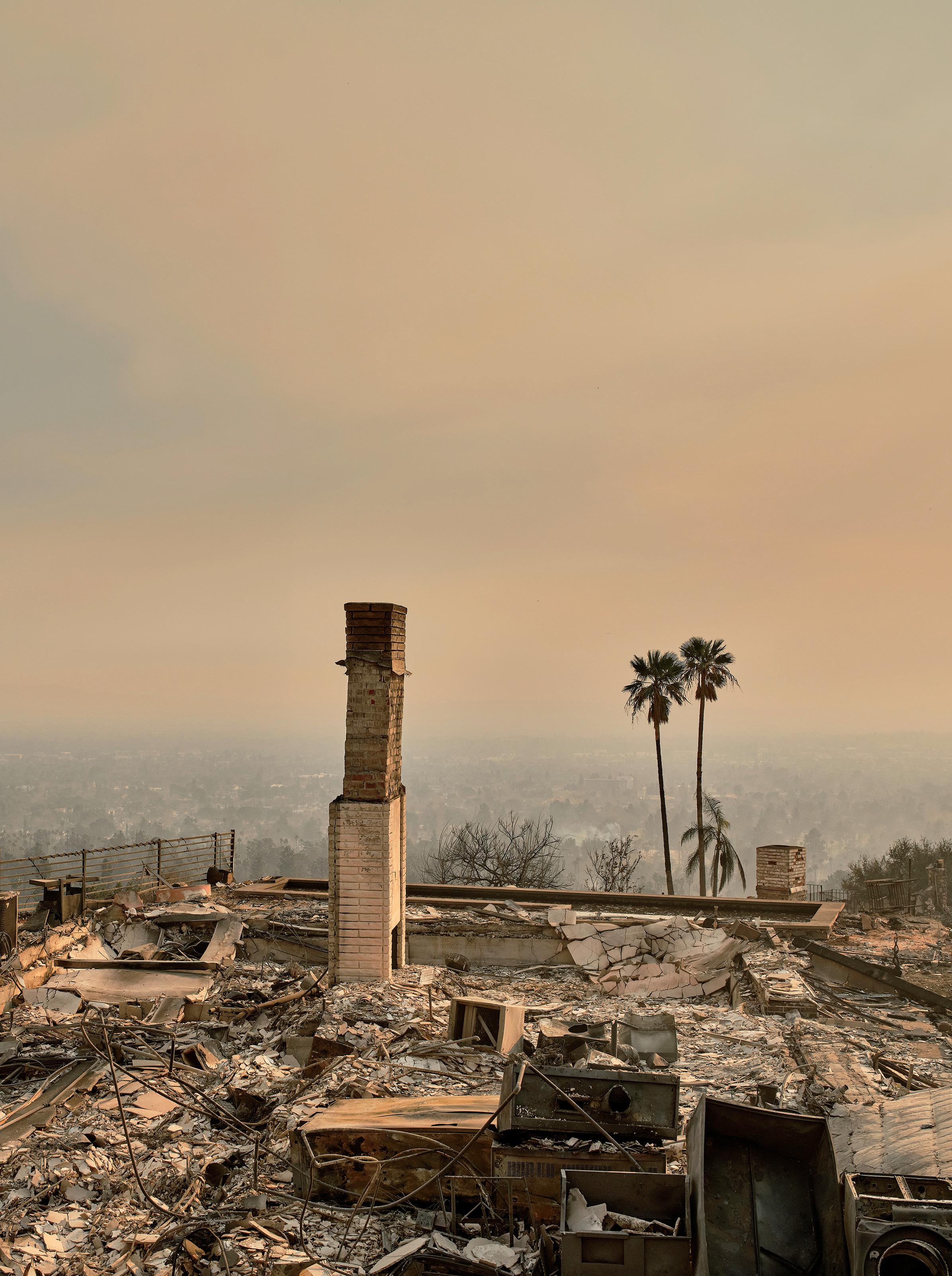
Earlier this year, in the foothills of the San Gabriel Mountains, a graveyard was spared by the fire that sent thousands of Los Angeles residents fleeing into the coal-black night. Here, in Mountain View Cemetery, lie the bones of Octavia Butler, the famed science-fiction writer who spent her life in Pasadena and Altadena, both of which had burned. Trinkets offered by fans often decorate Butler's unassuming grave. A footstone is inscribed with a quotation from her Parable of the Sower: ALL THAT YOU TOUCH, YOU CHANGE. ALL THAT YOU CHANGE, CHANGES YOU.
In that dystopian novel, published in 1993 and set in the mid-2020s, the United States still exists but has been warped by global warming, and its authoritarian government has ceded most of the administration of day-to-day matters to corrupt companies. In Butler’s neo-feudal vision, states and cities erect strict borders to deter migrants, the gap between rich and poor has widened, and massive wildfires in Southern California drive the state’s decline.
It has become commonplace to label Butler a prophet. She didn't get everything right about the United States today. But even in the things that haven't happened, exactly, one can see analogs to real life.
Butler, however, considered herself merely an analyst—a “histofuturist.” She often said that her primary skill was simply learning from the past. In her research for Parable, she studied times of rising political strife and demagoguery, along with America’s history of class and racial inequality. She studied what was at the time an emerging scientific consensus regarding global warming, a body of research that even then predicted fires and floods, and warned of political instability.
“I didn’t make up the problems,” Butler wrote in an essay for

Diese Geschichte stammt aus der December 2025-Ausgabe von The Atlantic.
Abonnieren Sie Magzter GOLD, um auf Tausende kuratierter Premium-Geschichten und über 9.000 Zeitschriften und Zeitungen zuzugreifen.
Sie sind bereits Abonnent? Anmelden
WEITERE GESCHICHTEN VON The Atlantic
The Atlantic
You Had to Be There
An emerging field of history asks if we can ever really understand how our forebears experienced love, anger, fear, and sorrow.

23 mins
January 2026

The Atlantic
By the Horns
The week before the biggest bullfight of her career, in Cádiz, Spain, this past July, 24-year-old Miriam Cabas posted a carefully produced video on Instagram.
1 mins
January 2026
The Atlantic
The New German War Machine
After World War II, Germany embraced pacifism as a form of atonement. Now the country is arming itself again.
18 mins
January 2026
The Atlantic
The Eloquence
The prime minister was watching a disaster movie when we found him.
4 mins
January 2026

The Atlantic
What's for Dinner, Mom?
The women who want to change the way America eats
12 mins
January 2026

The Atlantic
How Terror Works
A 1947 German novel explores the sometimes corrosive, sometimes energizing nature of fear.
8 mins
January 2026

The Atlantic
Yesterday's Idea of a Modern Man
Sam Shepard, a self-made cowboy, was also a poet of masculine angst.
7 mins
January 2026

The Atlantic
ACCOMMODATION NATION
America's colleges have an extra-time-on-tests problem.
11 mins
January 2026

The Atlantic
Respect the Drummer
A new history of rock, told through its overlooked heroes
5 mins
January 2026

The Atlantic
THE MOST POWERFUL MAN IN SCIENCE
WHY IS ROBERT F. KENNEDY JR. SO CONVINCED HE'S RIGHT?
42 mins
January 2026
Listen
Translate
Change font size