
Mit Magzter GOLD unbegrenztes Potenzial nutzen
Erhalten Sie unbegrenzten Zugriff auf über 9.000 Zeitschriften, Zeitungen und Premium-Artikel für nur
Versuchen GOLD - Frei
Water Equation India and the Nordics
TerraGreen
|May 2024
The Nordic countries, known for their commitment to sustainable development and environmental protection, offer invaluable knowledge and technologies to improve water management practices. From state-of-the-art water purification systems to sustainable irrigation techniques, Nordic expertise provides crucial tools to mitigate the effects of climate change on water resources. In this thought-provoking article, Biba Jasmine discusses that by utilizing the expertise and cutting-edge technologies from the Nordic region, Indian industries can enhance their water management systems, reduce pollution, and increase resource efficiency.

Water serves many purposes: it is a vital necessity, a home, a local and global resource, a transportation corridor, and a climate regulator. For some, it is the destination for pollutants released into nature, while for others, it is a newly discovered mine rich in minerals to be exploited. For us to continue to enjoy clean water and healthy oceans and rivers, we need to change the way we use and treat water.
In many ways, water is a local resource. But water is also a global commodity—a common good shared by all people and all living things on our planet. Water moves through countries and connects continents. What starts as a local problem can become one of many contributors to a larger problem.
It is crucial to emphasize the importance of remembering that the phrase ‘water for all’ embodies a fundamental principle of ensuring universal access to clean and safe water for all people, regardless of their socio-economic status, geographical location or cultural background. It reflects the recognition that water is a fundamental human right and is essential for sustaining life, promoting health, ensuring livelihoods, and fostering socio-economic development.
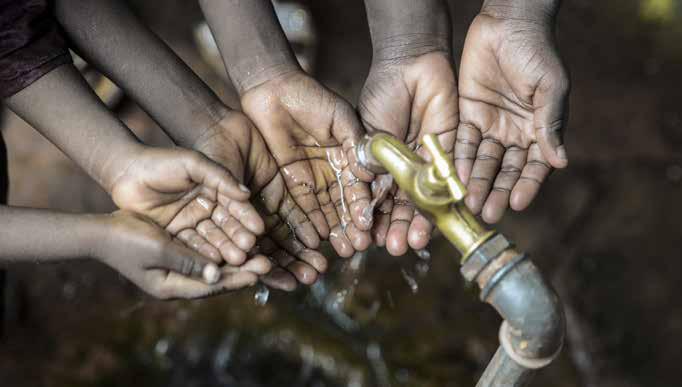 The United Nations Sustainable Development Goals, in particular Goal 6: Clean Water and Sanitation, emphasize the importance of ensuring universal access to water and sanitation by 2030. Clean water is recognized by the United Nations General Assembly as a fundamental human right. Clean water is essential for maintaining health and preventing waterborne diseases. Access to safe drinking water and adequate sanitation can significantly reduce the risk of diseases such as diarrhoea, cholera and typhoid, especially in developing countries where these diseases pose a significant threat to public health.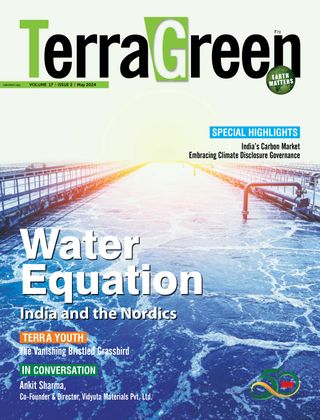

Diese Geschichte stammt aus der May 2024-Ausgabe von TerraGreen.
Abonnieren Sie Magzter GOLD, um auf Tausende kuratierter Premium-Geschichten und über 9.000 Zeitschriften und Zeitungen zuzugreifen.
Sie sind bereits Abonnent? Anmelden
WEITERE GESCHICHTEN VON TerraGreen

TerraGreen
Pollution Rises in Bengaluru Lakes Post Monsoon: Study
A new lake health study, covering three major water bodies in Bengaluru-Ulsoor, Doddabommasandra and Shivapura-has revealed dangerous levels of pollution and a clear link between rapid urbanization and deteriorating water quality.

1 min
November 2025

TerraGreen
Seven-month Fishing Ban Along Three River Mouths in Odisha for Olive Ridley Nesting
In a bid to ensure safe and harmonious mass nesting of Olive Ridley turtles, Odisha has imposed a seven-month fishing ban from November, 2025 to May 31, 2026 at three river mouths along the coastline.
1 min
November 2025

TerraGreen
A New Track Record
Formula 1, long defined by speed, spectacle, and cutting-edge engineering, is now racing towards a different kind of victory—sustainability.
4 mins
November 2025
TerraGreen
Extreme Floods are Slashing Global Rice Yields Faster than Expected
WMO Report Highlights Increasingly Erratic Water Cycle
3 mins
November 2025
TerraGreen
Renewable Energy Adoption and Corporate Sustainability
Future of Responsible Enterprise
5 mins
November 2025
TerraGreen
Nature-based Solutions for Delhi's Pollution Crisis
Delhi's annual struggle with toxic air has become an unfortunate ritual. Each winter, the Air Quality Index (AQI) spikes to hazardous levels often above 300, amid school shut downs, masks returning, and public outrage-only to fade until the next smog season.
1 min
November 2025

TerraGreen
Your Pumpkin Might Be Hiding a Toxic Secret
Pumpkins, squash, zucchini, and other members of the gourd family have a surprising trait-they can take up pollutants from the soil and store them in their edible parts.
1 min
November 2025

TerraGreen
Echoes of Love
Why the Forest Can't Live Without Its Hornbills
4 mins
November 2025
TerraGreen
Forests on the Fence
Can Uttarakhand's Van Panchayats Take Root Again?
6 mins
November 2025

TerraGreen
Sacred Tank, Sinking City The Urban Threat to 'Mini-Kashi'
Nestled amid the urban sprawl of Malabar Hill, Mumbai's Banganga Tank stands as a living relic where myth, memory, and modernity intersect.
4 mins
November 2025
Listen
Translate
Change font size