
Mit Magzter GOLD unbegrenztes Potenzial nutzen
Erhalten Sie unbegrenzten Zugriff auf über 9.000 Zeitschriften, Zeitungen und Premium-Artikel für nur
AGE OF CHANGE
THE WEEK India
|September 14, 2025
Lowering the age to contest elections cuts to the heart of what kind of democracy India aspires to be: one that merely gives its youth a vote, or one that also gives them a voice
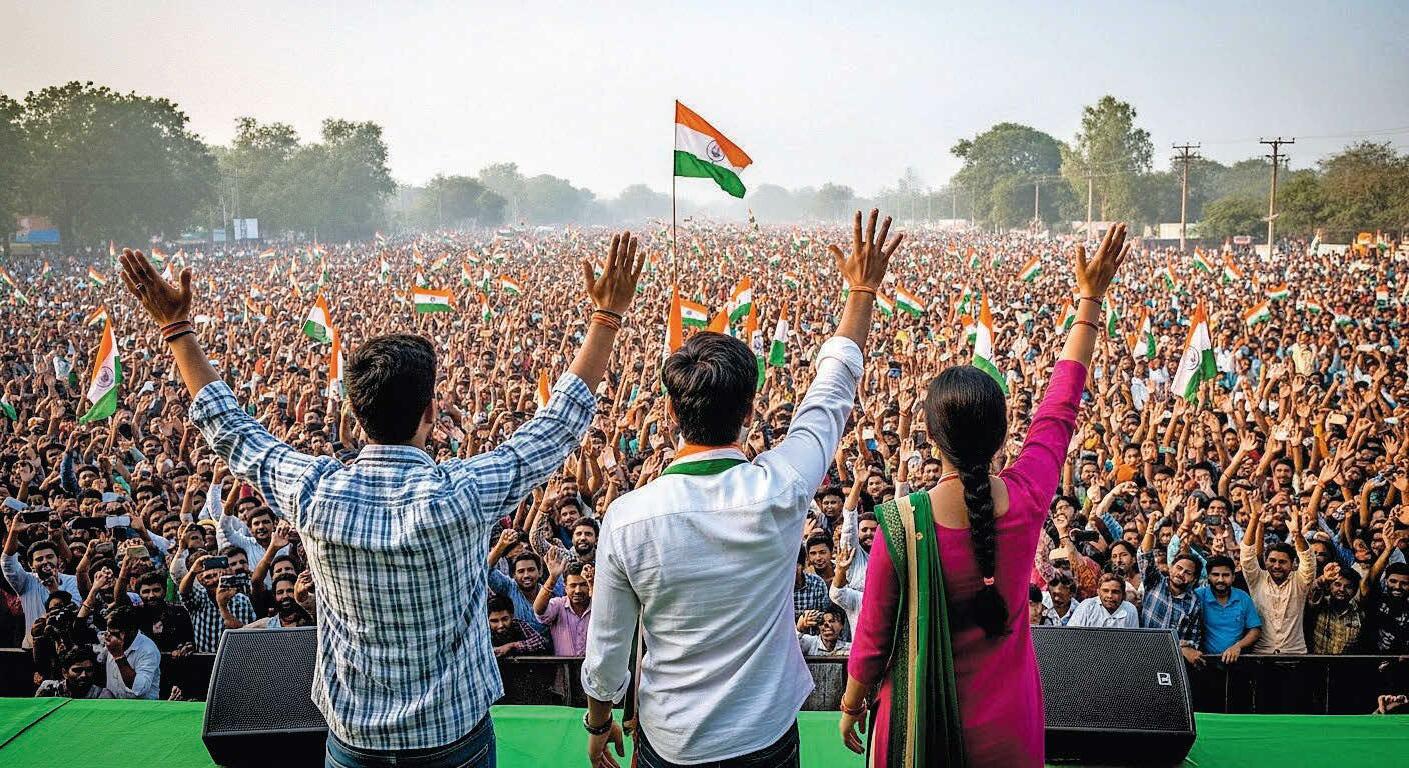
WHEN INDIA HELD its first general election in 1951-52, only those aged 21 and above could vote. Still, over 17 crore citizens lined up, a staggering number in a nation where the majority were under 35, hopeful and untested in democracy. Four decades later, the voting age was lowered to 18, recognising the rising political consciousness of young Indians. But the right to contest remained out of reach. One could vote for leaders at 18, but not become one until 25.
That gap has only grown sharper. India is among the youngest countries in the world, with a median age of 28 and nearly 65 per cent of its people under 35. In 2019, 1.5 crore first-time voters aged 18-19 entered the voter rolls. By 2024, that number had climbed to 1.85 crore. Parties now chase their votes with promises of jobs, digital futures and climate action, yet deny them a seat at the table where those very decisions are made.
The Panchayati Raj system already allows individuals as young as 21 to contest elections. Thousands of young sarpanchs and panchayat members across India are governing villages, handling finances and shaping rural development.
Telangana Chief Minister Revanth Reddy recently suggested lowering the qualifying age for MLAs to 21. His statement has triggered a larger debate. Should India revisit the constitutional age bar that prevents millions of politically conscious young Indians from entering legislative politics until they turn 25? The issue goes beyond legal technicalities. It cuts to the heart of what kind of democracy India aspires to be: one that merely gives its youth a vote, or one that also gives them a voice.
The contradiction becomes starker when viewed alongside the fact that many influential youth leaders like Hardik Patel, Kanhaiya Kumar and Chandrashekhar Azad had significant following before they were eligible to enter legislative politics.


Diese Geschichte stammt aus der September 14, 2025-Ausgabe von THE WEEK India.
Abonnieren Sie Magzter GOLD, um auf Tausende kuratierter Premium-Geschichten und über 9.000 Zeitschriften und Zeitungen zuzugreifen.
Sie sind bereits Abonnent? Anmelden
WEITERE GESCHICHTEN VON THE WEEK India

THE WEEK India
WHERE THE STORM NEVER REALLY PASSES
Guantánamo Bay, once a symbol of the ‘war on terror’, has emerged as a flashpoint in Donald Trump’s immigration battles, exposing deep tensions between America’s security, legality and moral commitments

10 mins
December 21, 2025

THE WEEK India
Moderation is the key
Most people do not believe me, but I am a moderate man.
3 mins
December 21, 2025

THE WEEK India
OCEAN THERAPY
The Modi-Putin summit unveils a cooperation strategy that will rewire sea trade routes and expand India's maritime connect to the Arctic
3 mins
December 21, 2025

THE WEEK India
Indian Army men fighting for the British against the Japanese were also patriots
Readers in India may be misled by the title of Gautam Hazarika's new book, The Forgotten Indian Prisoners of World War II: Surrender, Loyalty, Betrayal and Hell. It is not about the INA prisoners who were put on trial in the Red Fort by the British. This book is about those Indian soldiers who fought the Japanese in Singapore, Malaya and Burma alongside the British, and who had to surrender, were taken prisoner, put to torture and hard labour by the Japanese, refused to join the INA, and faced death or managed to escape. While recounting their stories, Hazarika also gives an insight into the INA movement. Edited excerpts from an interview with the author:
4 mins
December 21, 2025

THE WEEK India
CHAT WITH NEHRU, QUERY KALAM...
The Prime Ministers' Museum & Library showcases the life and contributions of prime ministers and nation-builders
3 mins
December 21, 2025

THE WEEK India
The art of shifting gears in investing
“Hope is not a strategy,” Hayes growls in one memorable scene, dismissing a teammate’s starry-eyed optimism.
3 mins
December 21, 2025

THE WEEK India
Trouble on the tarmac
It is not IndiGo but Indian aviation that has become too big to fail
4 mins
December 21, 2025

THE WEEK India
SHUX AND BLUE MARBLE
THE 18 DAYS IN SPACE MIGHT HAVE MADE HIM A HOUSEHOLD NAME, BUT GROUP CAPTAIN SHUBHANSHU SHUKLA IS AS GROUNDED AS EVER. AND BEFORE HE SUITS UP FOR HIS NEXT MISSION, THE WEEK'S MAN OF THE YEAR SHARES STORIES FROM HIS LIFE AND SPACE, INCLUDING HOW HE BECAME A 'WATER BENDER'
9 mins
December 21, 2025

THE WEEK India
The parietal lobe
If the frontal lobe is where we decide what to do, the parietal lobe is where we understand where we are. It is the brain's internal GPS, the quiet navigator that lets you put your hand exactly where your teacup is, find the edge of a staircase without staring at it, or scratch the correct side of your head when it itches. When it works well, we move through life gracefully. When it falters, life becomes slapstick comedy.
2 mins
December 21, 2025

THE WEEK India
Area of the globe? Pie is cubed
Floating in his private pool, China's helmsman Mao Zedong shared his strategic vision with visiting Soviet strongman Nikita Khrushchev in 1958: \"You look after Europe, and leave Asia to us.\" Obviously, he expected the US to withdraw into its prewar Monroe world of the Americas, thus making the world tripolar.
2 mins
December 21, 2025
Listen
Translate
Change font size