Versuchen GOLD - Frei
The Labour of Historical Fiction
Outlook
|January 21, 2026
I don’t know if I can pinpoint when the idea to write fiction took root in my mind, but five years into working as an oral historian of the 1947 Partition, the landscape of what would become my first novel had grown too insistent to ignore.
It didn’t arrive fully formed, but came to me in images—gestures, dreams, conversations, memories—blending together as a composition. The novel was about smell, about a family of perfumers devoted to the beauty and pursuit of ittar.
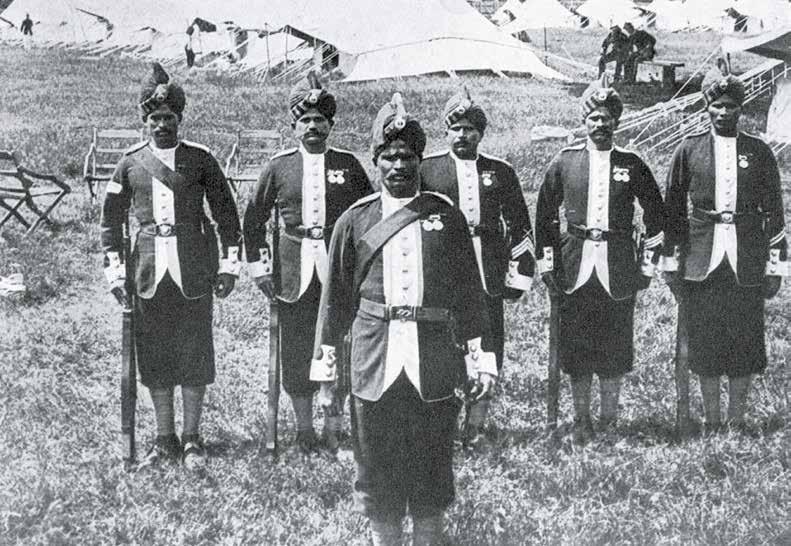
When I first conceived of The Book of Everlasting Things, its world was small. The story followed a boy named Samir, growing up in Lahore in the 1930s-40s, training to be a perfumer under the tutelage of his uncle, Vivek, who carries a secret from his time on the battlefields of the First World War. For decades in the novel, the secret stays dormant, untouched, irrelevant even, until it reveals itself in the years after Partition, when Samir is exiled in France. There, in his uncle’s journals, he discovers the buried truth, and this is how The Great War spills into the novel—coating its chapters in trench systems and regimental diaries, censored letters and slaughtered soldiers, war-sounds and war-stench, and a collision of Empire and allegiance that would reverberate across generations.
As an adult in Paris, Samir recalls to his wife, Léa, that during his childhood, he knew that his uncle had been to war, but always wondered “what perfumers did in battle”. Building this particular historical world—where a young man goes into war as a soldier, and comes out of it as a perfumer, changing the tides of his future generations forever—became in itself a great act of imagination. In fiction, I could search for the private rupture that would transform a soldier’s senses and set him on an unforeseen path.


Diese Geschichte stammt aus der January 21, 2026-Ausgabe von Outlook.
Abonnieren Sie Magzter GOLD, um auf Tausende kuratierter Premium-Geschichten und über 9.000 Zeitschriften und Zeitungen zuzugreifen.
Sie sind bereits Abonnent? Anmelden
WEITERE GESCHICHTEN VON Outlook

Outlook
The Spectacle of the Woman Accused
Media narratives—especially when women are involved—can end up amplifying suspicion and weaponising gender

7 mins
March 11, 2026

Outlook
The Stink of Epstein
Why are the rich and powerful of the world scared of what lies buried in the Jeffrey Epstein files?
6 mins
March 11, 2026

Outlook
Passing the Watermelon
Narendra Modi's presence in Israel is being read not just as a bilateral engagement, but as an endorsement of Israeli action in Gaza and the West Bank
5 mins
March 11, 2026

Outlook
For Phoolan, Who Wasn't a Devi
“Whether or not it is the Truth is no longer relevant. The point is that it will, (if it hasn’t already) - become the Truth. Phoolan Devi, the woman has ceased to be important. (Yes of course she exists. She has eyes, ears, limbs, hair etc. Even an address now) But she is suffering from a case of Legenditis. She’s only a version of herself. There are other versions of her that are jostling for attention. Particularly Shekhar Kapur’s “Truthful” one, which we are currently being bludgeoned into believing.”–Arundhati Roy in ‘The Great Indian Rape-Trick I’, on the film Bandit Queen by Shekhar Kapur based on Phoolan, whom he never met because he didn’t think he needed to meet her. The film was based on journalist Mala Sen’s book India’s Bandit Queen: The True Story of Phoolan Devi.
5 mins
March 11, 2026

Outlook
The Chic Cartel
Women are not just victims or side characters in recent crime-and-power OTT dramas. They are complex forces-capable of empathy, strategy and ruthlessness-whose narratives demand both recognition and reckoning
5 mins
March 11, 2026

Outlook
The Hierarchy of Sympathy
In crimes against women, justice is shaped not only in courtrooms but in newsrooms where narrative determines whose suffering becomes national conscience and whose fades into procedural silence
5 mins
March 11, 2026

Outlook
Dasyu Sundari
Media accounts simultaneously cast her as victim and avenger, until a life shaped by caste violence and gendered oppression was repackaged into a consumable myth of dishonour and revenge
8 mins
March 11, 2026

Outlook
Prince Pervert
Are rumours of the death of the rule of law vastly exaggerated?
4 mins
March 11, 2026
Outlook
Together, Apart
Poonam Saxena's translations of Mannu Bhandari and Rajendra Yadav's memoirs present a portrait of the trailblazing Hindi writer-couple's marriage and of newly independent India
3 mins
March 11, 2026

Outlook
The Great Indian Rape Trick'
The trope of transforming sexual violence against women into a springboard for rage that can only be channelled through counter-violence has long served as a popular framework in cinema, both globally and in India
6 mins
March 11, 2026
Listen
Translate
Change font size